
Vienna Beyond the Postcard: Where Culture Becomes Diplomacy
Cultural tourism from Central Asian art to migrant communities and international institutions
October 06th, 2026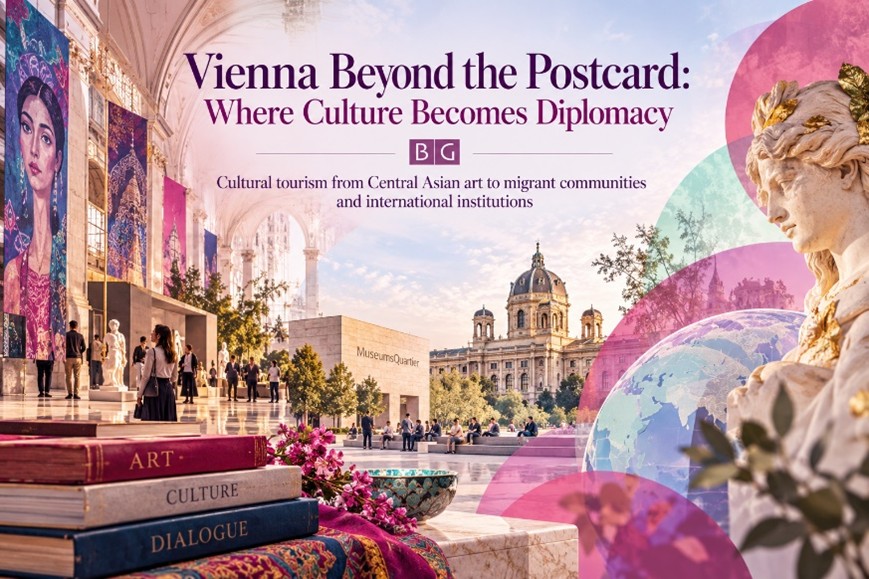
Vienna is known worldwide for its museums, music, architecture and imperial heritage. Yet the city offers more than a collection of famous sights. With more than 100 museums and a dense network of cultural institutions, Vienna is also a place where international artists, communities, diplomats and visitors meet. Looking at the city through the lens of cultural diplomacy reveals another side of tourism: cultural spaces can introduce visitors to different histories, encourage dialogue and create connections between societies.
1. MuseumsQuartier: A Cultural Meeting Point
The MuseumsQuartier is one of Vienna's largest cultural complexes, bringing together more than 50 cultural institutions covering visual art, literature, music, architecture, design, dance, theatre and children's culture. For visitors, it offers a concentrated experience of Vienna's cultural life. But its international dimension goes further.
Its Artist-in-Residence programme welcomes around 60 international artists each year, who live and work in Vienna while developing their projects and engaging with the local cultural scene. The programme is specifically designed to bring international perspectives into Vienna and encourage exchange with local artists and institutions. For cultural tourists, this means that the work encountered in the city is not only produced locally but is also shaped by international encounters.
2. TRANS STANS: Vienna Looks Towards Central Asia
One of the clearest examples of cultural diplomacy in Vienna is TRANS STANS, a new initiative running from 2026 to 2028. Developed by the Austrian Foreign Ministry, Weltmuseum Wien, the KHM Group and MuseumsQuartier, the project focuses on artistic and cultural exchange between Austria and Central Asia.
The first activities have centred on Kazakhstan, including a residency for Didar Azat, a curator and researcher from the Kasteyev Art Museum in Almaty. Her time in Vienna has involved exchanges with Austrian curators and institutions. For visitors, the programme offers an opportunity to encounter contemporary Central Asian perspectives in a Viennese setting. For the institutions involved, it creates longer-term professional relationships and a framework for future cooperation.
3. When Architecture Tells a Diplomatic Story
Architecture can also reveal connections that are easy to miss. The current exhibition “Global – Neutral” at the Architekturzentrum Wien looks at the work of Austrian architects in countries including Burkina Faso, India, Iran, Iraq, Kuwait, Nepal and Tanzania.
The exhibition places these buildings in a wider political context. Austrian architects sometimes worked abroad because Austria's neutrality allowed them to operate as partners outside the major Cold War blocs. Their projects could form part of development programmes, but they could also become symbols of diplomatic rapprochement and places of international cooperation.
For visitors, architecture therefore becomes a way of discovering a less familiar chapter of Austria's international history. It shows how buildings can carry political, economic and cultural relationships across borders.
4. Viena Latina: The City Through Its Communities
Cultural tourism does not have to focus only on historic monuments. The Viena Latina project at the Wien Museum, held earlier this year, explored the lives of Vienna's Latin American and Caribbean communities.
Around 20,000 people from Latin America and the Caribbean live in Vienna, and the project collected migration stories from people from around 20 countries. Interviews, photographs, documents, textiles and shared city walks were used to present their experiences.
For tourists, this offers another way of understanding Vienna: not simply through its imperial past, but through the communities that have helped shape the city more recently. It also demonstrates how cultural institutions can create spaces where different communities can share their own histories with the wider public.
5. A Museum Where Three Religions Meet
At the Jewish Museum Vienna, Israeli artist Eran Shakine's exhibition A Muslim, a Christian, and a Jew uses humour and art to explore the similarities and differences between the three monotheistic religions.
The exhibition presents the three figures not as opposing identities but as people searching for common ground. Its approach is deliberately accessible, using humour to challenge stereotypes and encourage visitors to think about what different religious traditions share.
For cultural tourism, this turns a museum visit into an encounter with questions of religion, identity and coexistence. From a cultural-diplomacy perspective, it shows how art can create a space for conversation around subjects that can be difficult to approach through formal political dialogue.
6. Vienna's International Centre: Diplomacy on Display
Vienna's role as an international city can also become part of the visitor experience at the Vienna International Centre, home to numerous UN organisations and agencies.
Guided tours allow visitors to see the centre's architecture, conference rooms and exhibitions, as well as parts of its international art collection. Works by Austrian artists stand alongside artworks donated or provided by UN Member States. The tours are also offered in several languages and attract around 50,000 visitors each year.
This makes the Vienna International Centre an unusual cultural-tourism destination. Visitors are not simply looking at a building: they are entering a space where representatives of countries from around the world work together. The art displayed inside reinforces that international character, turning the centre itself into a small reflection of multilateral exchange.
Vienna's cultural appeal therefore lies not only in what the city preserves, but also in the relationships it continues to build. Museums, artists-in-residence programmes, community projects, religious dialogue, architecture and international institutions all offer different ways of encountering other cultures. For visitors, cultural tourism can become more than sightseeing; it can be an opportunity to understand how cities bring people and ideas together across borders.
References:
- https://www.wien.info/en/art-culture/museums-exhibitions/top-museums
- https://www.mqw.at/en/artists-in-residence/
- https://www.mqw.at/de/programm/ausstellungen/architekturzentrum-wien/global-neutral/
- https://www.wienmuseum.at/viena_latina
- https://www.jmw.at/exhibition/eran_shakine_a_muslim_a_christian_and_a_jew
- https://unis.unvienna.org/unis/en/visitors_service/general-guided-tour.html
