
UNESCO and Beyond: Paris as a Global UN Stage
From Blue Carbon and AI ethics to music, peacebuilding and youth activism, five events illustrate the international life of a city that is much more than the home of UNESCO
October 06th, 2026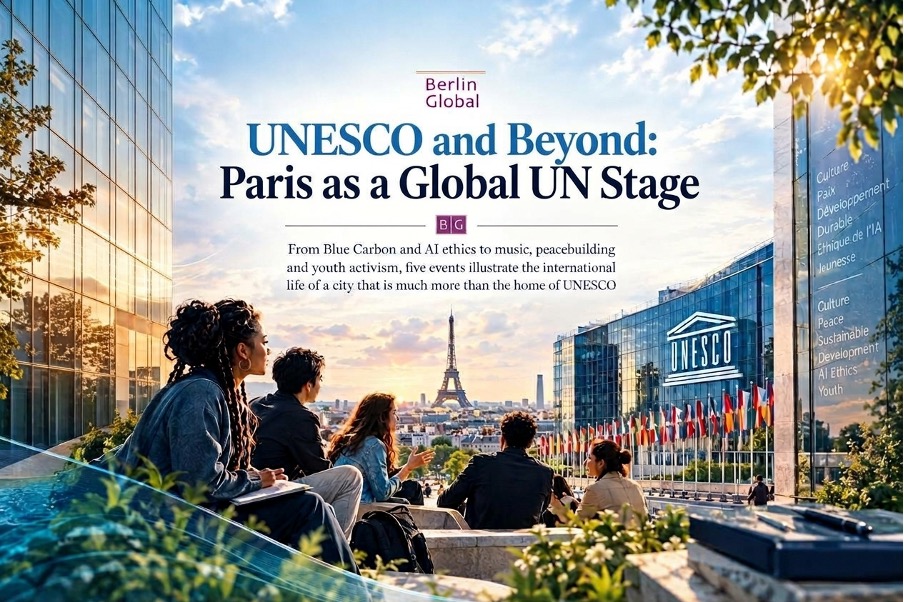
When the United Nations and Paris are mentioned in the same breath, UNESCO is often the first institution that comes to mind. The organisation’s headquarters on the Place de Fontenoy have made the French capital an obvious centre for international cultural cooperation. Yet Paris’ relationship with UN-related international co-operation extends beyond the walls of UNESCO.
This becomes particularly visible in the programme of international events taking place in the city in the final months of 2026. From coastal ecosystems and the ethics of artificial intelligence to cultural diplomacy, peacebuilding and youth participation, the subjects range across environment, technology, culture, peace and governance. Some are organised directly by UN bodies or in cooperation with them; others belong to the wider ecosystem of international organisations, civil society, academia and youth networks that has developed around Paris as a global diplomatic and cultural centre.
Blue Carbon: Climate Cooperation from the Coast to UNESCO
From mangroves and tidal marshes to seagrass meadows, coastal ecosystems play a role that reaches far beyond the shore. They store significant amounts of carbon while supporting biodiversity, coastal livelihoods and resilience to climate change. These ecosystems are at the centre of the International Partnership for Blue Carbon (IPBC), whose partners work to protect, sustainably manage and restore them around the world.
The Partnership will return to Paris from 8 to 10 December 2026, with its meeting taking place at UNESCO Headquarters. Listed through the UN's Indico system and hosted at UNESCO, the three-day gathering brings together the international partnership around its work on blue-carbon ecosystems and their contribution to climate mitigation, adaptation, biodiversity and coastal communities.
The event therefore offers a distinctly environmental facet of Paris' UN-related international life. While UNESCO may be better known for culture, education and science, its Paris headquarters also provide a setting for international cooperation on the oceans, climate and biodiversity. The Blue Carbon Partnership illustrates how these global challenges increasingly overlap — and how Paris remains a meeting point for the institutions, governments and research networks working to address them.
AI Ethics: From Academic Research to Global Governance
Artificial intelligence is developing faster than the rules, institutions and social debates needed to govern it. In Paris this December, UNESCO and the AI and Society Institute at École normale supérieure (ENS-PSL) will bring emerging academic research into that conversation through a call for papers on the Ethics of Artificial Intelligence, culminating in a one-day academic event on 10 December 2026.
The initiative is grounded in UNESCO’s 2021 Recommendation on the Ethics of Artificial Intelligence, the first global standard-setting instrument in this field. Rather than approaching AI ethics solely as a question of technological regulation, the call invites researchers to examine its broader social implications, including human rights, fairness and accountability, social inclusion, culture and knowledge systems, gender equality, sustainability and the implementation of the Sustainable Development Goals.
The event will particularly foreground the work of researchers at the beginning of their careers. Recent PhD graduates from different disciplines and regions are invited to submit research proposals, with selected authors presenting their work alongside established researchers and representatives of academic institutions. Discussions, expert exchanges and interactive “AI ethics labs” will connect academic research with concrete policy and methodological questions.
Music for Peace: Franco-Korean Cultural Diplomacy
On 23 October, UNESCO Headquarters in Paris will become a stage for a different kind of international encounter. The 18th Peace Concert, “United on the Path Toward the Light,” presented by the Échos de la Corée Association, brings together French and Korean artists for an evening built around a simple idea: that artistic creation can provide a space for encounter, fraternity and mutual understanding between peoples.
The 2026 edition carries an additional historical significance, accompanying the 140th anniversary of the Franco-Korean diplomatic treaty of 1886. Yet the concert looks beyond bilateral history towards a more universal message of peace and solidarity. Its programme brings together dance, jazz and voice, with Korean traditional dance placed in dialogue with Western contemporary ballet.
One of the evening's centrepieces, United Stars for Peace, will feature the Lux-Bit Art Company, whose ensemble includes both sighted and visually impaired dancers, alongside students from the National Institute for Blind Youth in Paris. The musical programme similarly combines French and Korean performers, including the Open’ Injazz ensemble of students, alumni and teachers from the institute and Korean popera soloists.
Paris Peace Forum: Rethinking International Cooperation
The Paris Peace Forum, taking place in Paris between 10-11 November, provides perhaps the clearest expression of the broader international ecosystem that surrounds the city's UN institutions. Founded in 2018, the Forum was created around the idea that international cooperation is not limited to negotiations between governments. It brings together heads of state and government, international organisations such as UNESCO, the World Bank, ILO, UNIDIR and UNDP from the United Nations family, civil society, businesses, researchers and other actors to address challenges that cross national borders.
That approach makes the Forum particularly relevant to the wider picture presented by Paris's international calendar. Its agenda extends across peace and security, climate and environmental challenges, technology, democratic governance and the future of multilateral cooperation. Rather than treating these as separate policy fields, the Forum approaches them as interconnected problems requiring cooperation between institutions and actors that do not always operate within the same diplomatic structures.
The Paris Peace Forum also highlights a characteristic of contemporary international cooperation that is visible across the other events discussed here: the growing importance of actors beyond governments. Researchers contribute to debates on AI ethics, environmental partnerships connect scientific and policy communities, artists use culture as a language of dialogue, and youth organisations seek a more direct role in global decision-making. The Forum provides a particularly visible platform for these different communities to meet.
If UNESCO represents one of the established pillars of the multilateral system in Paris, the Peace Forum illustrates how that system is increasingly surrounded by broader networks of civil society, academia, business and emerging political actors. Together, they form a much wider landscape of international cooperation than the formal UN architecture alone would suggest.
Youth and the SDGs: A New Generation in the Global Conversation
From 15 to 18 October, Paris will host the Global Youth Festival 2026, organised by the Headway Institute of Strategic Alliance (HISA). The four-day programme is designed to bring together young leaders and changemakers from more than 120 countries for policy discussions, creative workshops, mentorship, cultural exchange and leadership activities.
The festival is particularly relevant to the wider UN-related ecosystem because its organisers explicitly connect its programme to the UN Sustainable Development Goals. Its agenda covers climate action and environmental justice, peace and conflict resolution, education and the future of work, governance and civic participation, human rights, technology and social innovation, cultural identity, and youth wellbeing.
The programme also places an emphasis on participation rather than simply discussing young people as a policy constituency. One of its stated objectives is to give young participants a role in global decision-making, while other sessions focus on practical skills such as negotiation, public speaking and diplomacy.
The festival is therefore different in character from the intergovernmental meetings held at UNESCO Headquarters. It is a civil-society and youth-led initiative rather than a UN event. That distinction is important, but so is the connection. International cooperation increasingly depends on networks extending beyond governments city's international calendar. The festival also illustrates how the language and objectives of the 2030 Agenda have moved beyond UN conference rooms into programmes designed to connect young people directly with questions of global governance and peace. Youth organisations are therefore becoming part of the wider landscape through which these issues are discussed.
Looking at these events together changes the way Paris’s international role comes into view. It is easy to picture the city’s global institutions through their most recognisable buildings: UNESCO on the Place de Fontenoy, conference rooms filled with diplomats, official meetings and negotiated texts. But much of the international activity connected to Paris takes place elsewhere, and often involves people who would not normally be described as diplomats at all.
A researcher discussing the social consequences of artificial intelligence, scientists and policymakers working on coastal ecosystems, Korean and French artists performing for an audience, a young activist debating the Sustainable Development Goals or representatives of governments meeting with businesses and civil society at the Paris Peace Forum are all taking part in different kinds of international exchange. Their purposes and methods are different, but they share something important: the issues they are dealing with cannot be contained within a single country, institution or profession.
This may be the more interesting story about Paris’s relationship with the United Nations and the wider multilateral system. The city’s importance does not depend only on how many international organisations have an address there. It also lies in its ability to bring different communities into contact with one another. UNESCO provides one of the most visible institutional anchors for this activity, but around it exists a much less formal and more varied landscape of universities, cultural organisations, civil-society groups, international forums and youth networks.
The five events examined here therefore point to a Paris that is not simply a venue for international meetings, but a place where different ways of addressing global problems meet. Sometimes that happens through negotiation and policy; sometimes through research, art, public discussion or youth participation. None of these forms of engagement replaces the formal work of governments and international organisations. But together they show why understanding Paris as an international city requires looking beyond the institutions whose names are most familiar.
References:
- https://indico.un.org/event/1025287/
- https://unric.org/en/unesco-ai-ethics-call-for-papers-2026/
- https://www.unesco.org/en/articles/18th-peace-concert-united-path-toward-light
- https://parispeaceforum.org/
- https://headwayinstitute.org/global-youth-festival-2026/
