
The Wisdom of Nations: The Hidden Wealth of Experience
How Cultural Wisdom, Democratic Renewal and Institutional Memory Shape National Prosperity
October 23rd, 2026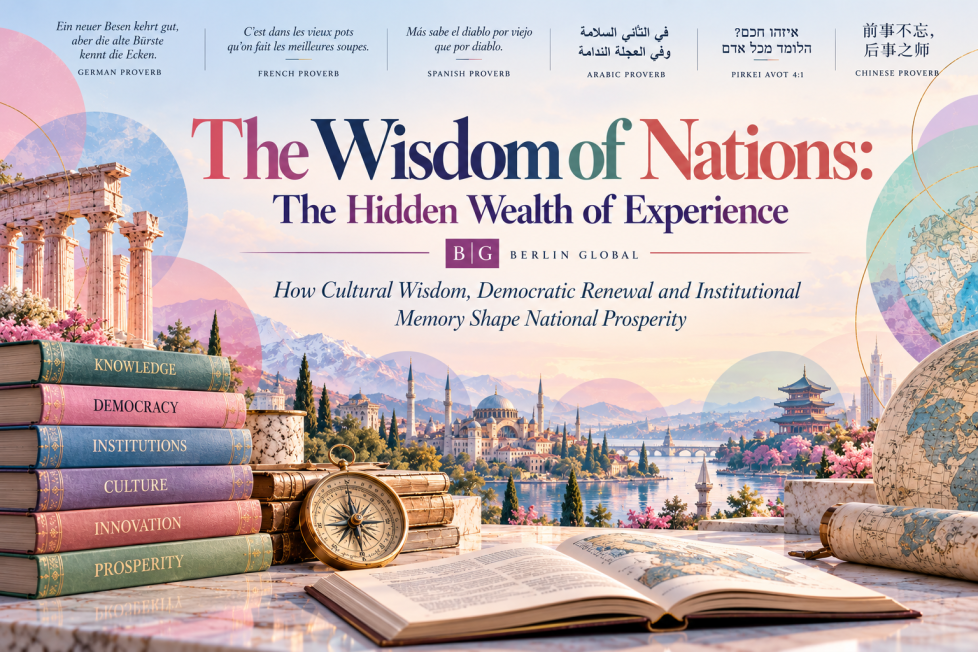
From German proverbs to Arabic wisdom, Hebrew teachings, Chinese philosophy and Roman political thought, the world's civilisations have long recognised that prosperity depends not only on what societies create, but also on what they remember, preserve and pass on.
The Old Brush and the New Broom
“Ein neuer Besen kehrt gut, aber die alte Bürste kennt die Ecken” - A new broom sweeps well, but the old brush knows the corners.
This German proverb captures one of civilisation's enduring dilemmas: the relationship between the promise of change and the wisdom of experience. New leaders, technologies and ideas bring opportunities for progress, yet accumulated knowledge reveals complexities that enthusiasm alone may overlook.
It also raises a fundamental question: What if one of a nation's greatest assets is not what it possesses, but what it has learned?
When Adam Smith published The Wealth of Nations in 1776, he examined prosperity through labour, specialisation, markets and economic organisation. Modern economic thought also recognises the importance of human capital, technological capabilities and institutional quality. Behind these foundations lies another resource: the accumulated knowledge of generations and the capacity to transform experience into future prosperity.
Unlike material resources, knowledge can multiply through exchange. Yet it can also disappear when expertise is neglected, institutions deteriorate or societies fail to learn from their mistakes.
The Wisdom of Civilisations: Experience as a Universal Resource
Across cultures, traditional sayings illuminate different dimensions of experience, judgment and renewal.
The French expression “C'est dans les vieux pots qu'on fait les meilleures soupes” — the best soups are made in old pots — similarly suggests that established knowledge and proven methods should not be dismissed merely because they are old.
Spanish wisdom offers a more provocative image: “Más sabe el diablo por viejo que por diablo” — the devil knows more because he is old than because he is the devil. Experience, rather than status or apparent authority, becomes the source of understanding.
Arabic tradition introduces the importance of prudence: “في التأني السلامة وفي العجلة الندامة” — in deliberation lies safety, and in haste lies regret. The saying reminds us that decisions should be judged not only by their intentions, but also by their consequences.
Hebrew tradition offers an inclusive understanding of wisdom. In Pirkei Avot 4:1, the question “איזהו חכם?” — who is wise? — receives the answer “הלומד מכל אדם” — the one who learns from every person. Wisdom is therefore not simply accumulated experience, but also the willingness to recognise knowledge in others.
Chinese historical thought adds the importance of collective memory through “前事不忘,后事之师” — past experience, if not forgotten, can guide the future. The saying emphasises learning from history rather than repeatedly confronting familiar mistakes.
These traditions do not constitute economic or political theories. Their significance lies in revealing a shared human challenge: how to preserve useful knowledge while remaining capable of change.
When Knowledge Becomes National Wealth
The economist Douglass North demonstrated how institutions influence economic performance through the rules, incentives and expectations governing economic life. Institutions also preserve practical knowledge that cannot always be captured in formal regulations.
Experienced administrators understand the consequences of earlier reforms. Engineers recognise problems through practice. Universities transmit intellectual traditions while developing new discoveries. Businesses acquire expertise through experimentation and accumulated relationships.
These capabilities constitute productive capital that cannot always be purchased or rapidly reconstructed. Yet experience is not automatically wisdom. Institutions may preserve outdated assumptions, protect privileges or discourage innovation.
A nation becomes wealthier not simply by accumulating experience, but by developing the capacity to evaluate and apply it.
Democracy: The Wisdom of Renewal and the Protection of Freedom
Democracy gives this relationship particular significance. Elections allow citizens to replace governments and introduce new political directions, while constitutional institutions provide continuity beyond individual leaders. The advancement and protection of democracy depend on maintaining this distinction.
Historical experience can inform the protection of civil liberties, judicial independence, political pluralism and the peaceful transfer of power. Institutional memory helps societies understand why democratic safeguards were established and what may happen when they are weakened. Yet experience must never become an argument for preserving political authority indefinitely or shielding institutions from public scrutiny.
Democratic renewal requires opportunities for new generations to participate, challenge established assumptions and improve public institutions. At the same time, protecting democratic freedoms requires respect for constitutional limits, accountability and the rights of those who disagree with the government.
This balance also matters economically. Transparent administration, predictable laws and accountable institutions can support long-term investment and public confidence, while democratic participation provides mechanisms for challenging policies and correcting institutional failures.
The wisdom of democracy lies in its capacity to change those who govern without sacrificing the principles that make democratic change possible.
Innovation, Cultural Diplomacy and the Exchange of Knowledge
The economist Joseph Schumpeter described economic transformation through creative destruction, whereby innovation generates new industries and methods while displacing established ones. Yet progress need not require the indiscriminate destruction of inherited expertise.
Experienced professionals can help modernise industries, while younger generations contribute new technologies and perspectives. The challenge is to distinguish between knowledge worth preserving and practices that obstruct development.
This exchange also extends beyond national boundaries. Cultural diplomacy, academic cooperation and international partnerships enable societies to share institutional experience, scientific discoveries and approaches to common challenges.
Such exchanges are especially valuable because economic and political institutions operate within different historical and cultural contexts. Learning from another nation's experience does not necessarily mean copying its institutions. It requires understanding why particular approaches succeeded, where they failed and how their lessons might be adapted.
The international proverbs explored here illustrate that principle: different civilisations have developed distinctive ways of expressing the value of experience, prudence and learning. Their wisdom can enrich contemporary discussions of prosperity and democratic development without replacing rigorous economic or political analysis.
The Wealth That Cannot Be Inherited Automatically
The German proverb offers a lesson extending beyond leadership and generational change. The old brush knows the corners, but that knowledge becomes valuable only when it contributes to a better future.
Nations inherit institutions, traditions, expertise and historical experience. Yet inheritance alone guarantees neither prosperity nor freedom. Knowledge can be forgotten, misapplied or used to resist necessary reform.
The challenge is to preserve what works, question what does not and ensure that accumulated wisdom remains accessible to future generations. This applies equally to economic institutions, democratic safeguards and the international relationships through which societies learn from one another.
A nation's greatest inheritance may not be the wealth previous generations accumulated, but the knowledge, democratic freedoms and institutional capacity they leave behind for future generations to create a more prosperous society.
