
The Train to Freedom: October 4, 1989, and the Diplomacy That Made It Possible
From Genscher’s Prague Balcony to the Power of Diplomacy: How the Old Wisdom of Personal Trust and the Diplomat’s Art Can Bear Fruit in Times of Crisis
October 04th, 2026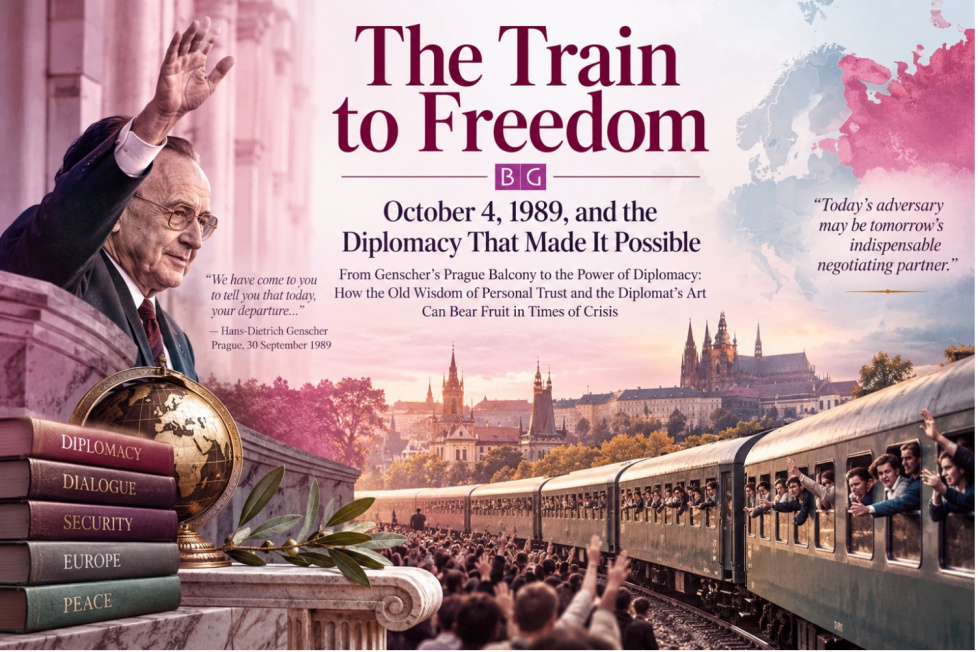
On October 4, 1989, thousands of East Germans travelled by special train from Prague toward freedom in West Germany. Yet their extraordinary journey took them first through the very country they were trying to escape.
It was one of the great paradoxes of the final weeks of the German Democratic Republic. East Berlin had insisted that the refugees pass through GDR territory, preserving the appearance that their departure remained under its authority. Instead, the trains became moving evidence of a state rapidly losing control of its citizens. Around Dresden Hauptbahnhof, more than 5,000 people gathered after learning that the refugee trains would pass through the city. Some hoped to reach the trains themselves. Serious confrontations with East German security forces followed.
But thirty-seven years later, there is another reason to remember those trains.
They demonstrate what can become possible when relationships have been built long before a crisis begins.
Four days earlier, on September 30, West German Foreign Minister Hans-Dietrich Genscher had appeared on the balcony of the Federal Republic's embassy in Prague. Almost 6,000 East Germans were waiting below. “We have come to you to tell you that today, your departure…” He could not finish. The cheering overwhelmed his words.
It remains one of the most moving scenes in modern German history. Yet perhaps the most important part of the story is what the cameras could not see.
Before the Balcony
Genscher did not arrive in Prague and suddenly find a solution to the crisis. The diplomatic foundations had been laid over many years. As West Germany's foreign minister from 1974 until 1992, he devoted considerable political energy to relations across the Iron Curtain. He remained firmly anchored in NATO and European integration while cultivating serious relationships in Moscow and throughout Eastern Europe.
He spoke with people whose political systems and strategic objectives he fundamentally opposed. He listened to them, treated them seriously and maintained relationships with them. Under Mikhail Gorbachev, these contacts acquired particular importance. Genscher recognised relatively early the significance of the changes taking place in Moscow and developed an especially close relationship of trust with Soviet Foreign Minister Eduard Shevardnadze.
They were not political allies. Their governments continued to disagree on fundamental questions.
That is precisely why the relationship mattered.
During the United Nations General Assembly in New York in September 1989, as conditions inside the Prague embassy became increasingly desperate, Genscher spoke with Shevardnadze. Years later, German Foreign Minister Frank-Walter Steinmeier recalled the exchange. Genscher described the humanitarian situation. Shevardnadze asked whether children were among those trapped at the embassy. There were hundreds, Genscher replied.
After a long pause, according to Steinmeier's account, Shevardnadze answered: “Mr Genscher, I'll help you.”
One conversation did not resolve the crisis. Several governments were involved, and the profound political transformations already underway in Eastern Europe made a solution possible. But the exchange reveals something essential about diplomacy. When Genscher needed Shevardnadze's help, he was not speaking to a stranger. Years of conversations, encounters and personal trust already stood behind them.
Genscher could speak to the East because he had spent years speaking to the East.
An Old Wisdom of Diplomacy
There is an old wisdom in diplomacy that appears almost banal until it is needed: do not unnecessarily humiliate the person with whom you may one day have to negotiate.
Not so long ago, a schoolchild who insulted another pupil might have been told to stand before the blackboard and write a hundred times that one should not insult others. The lesson was elementary: words have consequences, and coexistence requires a minimum of respect.
International politics today can present a striking contrast. Personal insults, ridicule and deliberately provocative language have become increasingly visible features of political communication. Modern media reward the sharp sentence; social media reward it even faster. Political strength can become confused with the ability to humiliate an opponent publicly.
Yet states cannot choose their geography, and history rarely allows governments to choose everyone with whom they must eventually negotiate.
Today's adversary may be tomorrow's indispensable negotiating partner.
This does not mean ignoring aggression, abandoning principles or pretending that profound conflicts do not exist. Diplomacy is not weakness, and dialogue is not concession. It means understanding that communication itself is an instrument of statecraft—and that destroying a relationship may also destroy possibilities that cannot easily be recreated when they are suddenly needed.
Genscher offers a powerful example. He did not need to share Shevardnadze's worldview in order to earn his confidence. He did not need to agree with Gorbachev in order to speak seriously with him. And he did not need to weaken West Germany's commitment to NATO in order to develop relationships in Moscow.
Respecting an adversary did not diminish Genscher's ability to represent his own country's interests. It enlarged his room for manoeuvre.
Another Winter of War
The relevance of this old wisdom is difficult to ignore today. Russia's war against Ukraine continues, bringing enormous human suffering and destruction, while another winter approaches. Russia, Ukraine and European governments remain divided by fundamental questions of war, sovereignty, territory and the future security order of Europe. These differences are profound. Personal relationships cannot make them disappear, nor can diplomacy substitute for the political choices of Ukraine or the security interests of the states involved.
But precisely because the conflict is so serious, one question deserves consideration: what diplomatic relationships and channels will exist when the circumstances for serious negotiations eventually emerge?
No one can know when that moment will come or what conditions will surround it. Yet history suggests that when an opening finally appears, it matters whether people on opposing sides can speak seriously to one another; whether a confidential message will be trusted; whether each side understands what the other can and cannot accept; and whether sufficient credibility survives for a proposal to be considered rather than immediately dismissed.
Such relationships cannot always be manufactured on the morning they become necessary. They are a form of diplomatic capital accumulated slowly through conversations, commitments honoured, confidences respected and disagreements conducted without unnecessary humiliation.
Most of the time, their value is invisible.
Then history accelerates.
And the Trains Moved
In September 1989, that accumulated diplomatic capital suddenly had practical value. Thousands of people were crowded into the West German Embassy in Prague. Bonn needed a solution; Czechoslovakia wanted the crisis resolved; the GDR was struggling to retain control; and Moscow remained the decisive external power behind the political order of Eastern Europe.
A compromise was reached. It was a peculiar one. The refugees would be permitted to travel to West Germany, but East Berlin insisted that their trains first pass through GDR territory.
Following Genscher's September 30 announcement, the first trains departed. Yet the Prague embassy quickly filled again, this time with approximately 7,600 new refugees. Further special trains were arranged. By October 5, fourteen trains had travelled from Prague through Dresden and Karl-Marx-Stadt, today's Chemnitz, toward Hof in Bavaria, carrying around 10,000 people in total.
On October 4, word spread that the trains would pass through Dresden. More than 5,000 people gathered at the Hauptbahnhof, many hoping to reach them. The Volkspolizei and other security forces intervened, and serious clashes followed. The route through East Germany had been demanded by the GDR leadership to demonstrate that those leaving were formally departing through its territory. Instead, the trains exposed how rapidly the state's authority was eroding.
Five weeks later, the Berlin Wall fell.
Diplomacy did not cause the peaceful revolution. The courage of East German citizens was indispensable. The transformations sweeping Poland and Hungary, Hungary's opening of its western border, the demonstrations in Leipzig and elsewhere, the weakening authority of the East German leadership and, critically, Gorbachev's changed Soviet policy created the conditions in which history could move.
But diplomacy helped political leaders navigate an extraordinarily dangerous transformation in the centre of Europe. The relationships cultivated between Bonn and Moscow would matter again as Germany moved toward reunification and questions involving borders, NATO membership, Soviet forces and the future European security order had to be negotiated.
What the Train Still Tells Us
The train of October 4, 1989 therefore deserves to be remembered for more than the remarkable people aboard it. It offers a lesson about something international politics cannot afford to lose.
Strength matters. Principles matter. Alliances and deterrence matter.
But relationships matter too.
There will always be adversaries and moments when condemnation is necessary. The deeper diplomatic wisdom lies in understanding that condemnation and communication need not always be opposites. A politician can defend national interests without making every disagreement personal. A diplomat can speak firmly without unnecessarily humiliating the person across the table. A government can oppose another government while preserving channels through which a future crisis might eventually be resolved.
Genscher did not invent this wisdom. He was one particularly powerful example of what it can produce. When he stood on the balcony in Prague, the world saw the dramatic result. What it could not see were the years that preceded it: conversations, visits, disagreements conducted without destroying communication, and confidence slowly accumulated between representatives of opposing political systems.
That was the invisible diplomacy behind the visible moment.
Today, as another winter of war approaches in Europe, this lesson deserves renewed attention. The diplomat's greatest achievement may not always be the speech everyone hears or the confrontation everyone watches. Sometimes it is the relationship quietly preserved with an adversary the relationship that appears to produce little until the day it suddenly matters.
On October 4, 1989, that old wisdom ceased to be theoretical.
The trains were moving.
