
The Return of Ostpolitik?
Why Germany Is Reopening the Door to Dialogue with Russia
September 27th, 2026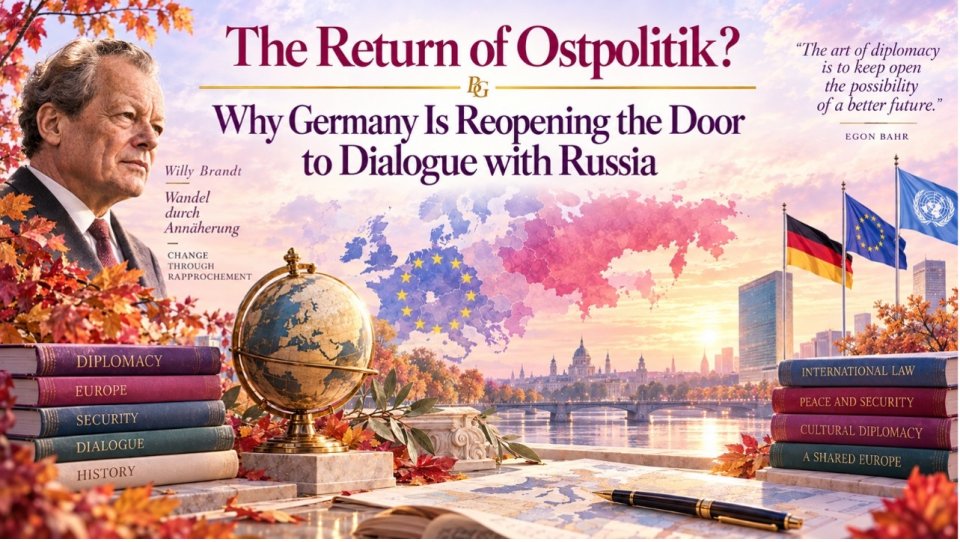
Few concepts in German foreign policy carry as much historical weight as Ostpolitik. Associated above all with Chancellor Willy Brandt and his adviser Egon Bahr, the policy sought to manage West Germany's relationship with the Soviet Union and Eastern Europe through engagement alongside deterrence.
Bahr gave the idea its famous formulation in 1963: Wandel durch Annäherung, change through rapprochement. West Germany remained firmly anchored in NATO, but Brandt and Bahr believed that confrontation did not eliminate the need for communication.
More than half a century later, under circumstances profoundly different from those of the Cold War, a related question is returning to Berlin.
Russia's full-scale invasion of Ukraine in 2022 shattered the assumptions that had guided German policy towards Moscow for decades. Economic interdependence ceased to look like a bridge towards stability and increasingly appeared to be a strategic vulnerability. Germany became one of Ukraine's principal supporters, while sanctions, deterrence and military preparedness replaced partnership with Russia.
None of that has now been reversed.
But something more subtle is changing. Germany appears increasingly willing to test whether direct political dialogue with Moscow can again become an instrument of European security.
Twenty Minutes in New York
The clearest indication came on 26 September, when German Foreign Minister Johann Wadephul met his Russian counterpart Sergey Lavrov on the margins of the United Nations General Assembly in New York.
The conversation lasted around twenty minutes. Yet it was the first bilateral meeting between the German and Russian foreign ministers since Russia launched its full-scale invasion in February 2022. Russian officials said Germany had requested the meeting, although Berlin did not confirm that account.
There was no rapprochement. Wadephul called on Russia to abandon what he described as its dangerous escalation towards Germany, Europe and NATO. He raised the attempted attack at Leipzig/Halle Airport and other hybrid operations attributed by Berlin to Moscow. Lavrov subsequently said the conversation had produced nothing new.
But Wadephul delivered another message as well.
According to the German delegation, he told Lavrov that a return to a more constructive bilateral relationship remained possible, provided Russia demonstrated a willingness to end its war against Ukraine. Berlin says it currently sees no such willingness.
That distinction matters.
Germany is not saying that relations with Russia are normal. It is saying that their present condition need not be permanent.
A Door Deliberately Left Open
The New York meeting was not an isolated signal.
When Germany formally attributed the Leipzig/Halle incident to Russia on 1 September, Wadephul used exceptionally severe language, saying Russia's leadership was confronting Germany with "open hostility."
Yet in the same statement he added something equally significant: "This state of our relations is not in the interest of the Federal Government."
Germany's objective, he continued, remained ending the war, restoring peace in Europe and eventually returning to a constructive relationship with Russia.
Even Germany's retaliatory measures were presented in this context. Wadephul subsequently said they had been designed in a way that still made it possible for Germany and Russia to return to a "constructive path."
Then came another important signal.
When the United States invited President Vladimir Putin to the G20 summit in Miami, Wadephul welcomed the opportunity. He called it a "Lackmustest", a litmus test of Putin's willingness to negotiate seriously, and argued that such opportunities should be used. WELT noted that his position was more open than those expressed by several European partners and initially by the German government's own spokesman.
Days later, Wadephul met Lavrov.
The sequence suggests more than an accidental diplomatic encounter.
The Old Argument Inside the SPD
For the Social Democratic Party, this debate is older and more contentious.
Figures associated with the SPD's traditional Ostpolitik wing, particularly former parliamentary leader Rolf Mützenich and foreign-policy politician Ralf Stegner, have long argued that military strength alone cannot provide a European strategy towards Russia.
Others inside the party, particularly Defence Minister Boris Pistorius, have been much more sceptical of Moscow's willingness to negotiate and have stressed that diplomacy requires credible military strength.
Recently, however, the distance between these positions has become more interesting.
After the Leipzig incident, SPD parliamentary leader Matthias Miersch supported the government's response but warned against further escalation. Germany, he said, should never abandon the Gesprächsstrang, the thread of dialogue, and should repeatedly seek to renew it.
Mützenich went further. On German television on 22 September, he called for a European strategy combining military strength with diplomacy and argued that Europe should explore possibilities for a ceasefire.
His criticism was encapsulated in one sentence:
"Andere reden für uns mit Putin und das ist falsch."
Others are talking to Putin on our behalf, and that is wrong.
Four days later, a CDU foreign minister sat down with Lavrov.
This does not mean Wadephul has adopted the SPD's traditional Ostpolitik. He has not. Rather, the assumption that direct dialogue with Moscow is incompatible with a firm policy towards Russia appears to be weakening across parts of Germany's political centre.
Europe Confronts the Same Dilemma
Germany's opening becomes more significant when viewed from Europe.
There is no European consensus in favour of normalising relations with Russia. Quite the opposite: the EU continues to increase pressure on Moscow. EU foreign-policy chief Kaja Kallas said during September's foreign-ministers' discussions that Moscow had not changed its war aims and that Europe's immediate priority remained giving Ukraine what it needed to defend itself.
Yet EU institutions also distinguish between normalisation and diplomacy.
Responding to Putin's G20 invitation, the European Commission noted that Russia remains a G20 member and therefore has the right to participate. The EU said it would continue using the forum to condemn Russia's invasion regardless of who attended.
European Council President António Costa went further at the UN this week, declaring that the war must end and that "the only way forward is diplomacy and an immediate ceasefire." At the same time, he reaffirmed continued European support for Ukraine.
This is increasingly the European dilemma: how can diplomacy resume without becoming normalisation?
France: Negotiations Without Rehabilitation
France illustrates that distinction.
Paris reacted cautiously to Putin's G20 invitation. The French Foreign Ministry stressed that Russia remained isolated because of its continuing aggression and said Moscow's recent attacks showed that it was not, at present, genuinely ready for peace negotiations. France's immediate priority remained strengthening Ukraine.
Yet France is not opposed to negotiations themselves.
In June, France, Germany and the United Kingdom jointly supported direct dialogue between Ukraine and Russia, with active American and European participation, provided that a ceasefire, Ukrainian sovereignty, security guarantees and European security interests formed the basis of the process.
The distinction is important: talking to Russia is acceptable; rehabilitating Russia before its behaviour changes is another matter.
Poland and Europe's Eastern Flank
Poland places greater emphasis on the conditions of any peace.
Prime Minister Donald Tusk said this week that the war should end as quickly as possible, but not on the aggressor's terms. Peace, he argued, must be fair and durable.
Further north, scepticism about renewed engagement is even more explicit.
Estonian Foreign Minister Margus Tsahkna has warned that seeking dialogue and improved relations with Putin while Russia continues its aggression could weaken both Ukraine and Europe's negotiating position. From Tallinn's perspective, earlier attempts to restore relations with Moscow without a fundamental change in Russian behaviour offer a warning rather than a model.
This represents perhaps the strongest counterargument to the emerging German approach.
For countries geographically and historically closest to Russia, the danger is not insufficient dialogue but that Moscow could interpret renewed engagement as evidence that European isolation will eventually weaken.
Britain: Pressure to Produce Negotiations
The United Kingdom occupies another position within this spectrum.
London continues to advocate increased sanctions and strong military support for Ukraine. But Prime Minister Keir Starmer and President Volodymyr Zelenskyy agreed this week on the need for Putin to participate in meaningful talks to end the war, while increasing pressure on Russia to bring him to the table.
That formulation is remarkably close to the emerging German logic.
Pressure and negotiations are not alternatives. Pressure is intended to make negotiations possible.
A European Debate, Not a German Exception
The emerging picture is therefore more complex than a division between advocates of confrontation and advocates of peace.
Germany is testing direct engagement while maintaining pressure.
France supports negotiations but rejects premature normalisation.
Poland insists that peace cannot be concluded on the aggressor's terms.
Estonia warns that engagement without a change in Russian behaviour could weaken Europe.
Britain seeks greater pressure precisely in order to produce meaningful negotiations.
And the EU simultaneously calls for stronger measures against Moscow and describes diplomacy as the only path to ending the war.
The disagreement is increasingly about sequence, conditions and political signalling.
When should dialogue begin?
What must Russia do first?
Does speaking with Putin increase Europe's influence over an eventual settlement, or allow Moscow to escape isolation without changing its behaviour?
These are becoming central questions of European diplomacy.
The Pressure from Within: Elections, Economy, Immigration, Identity and War
Germany's changing debate over Russia is taking place against a wider domestic crisis of confidence about the country's direction.
The first pressure is electoral. September's three state elections in eastern Germany, in Saxony-Anhalt, Mecklenburg-Western Pomerania and Berlin, demonstrated the growing strength of parties challenging important elements of Berlin's political consensus. The most dramatic result came in Saxony-Anhalt, where the AfD won 43.8 per cent of the vote. In Mecklenburg-Western Pomerania, it became the largest party with 38.2 per cent, while in Berlin both the AfD and the Left made substantial gains as the CDU and SPD lost ground. Foreign policy alone cannot explain these results, but taken together they revealed considerable dissatisfaction with the established political centre.
The second pressure is economic. Years of weak growth, industrial restructuring, high energy costs and concerns about international competitiveness have created uncertainty about the future of Germany's economic model. The loss of inexpensive Russian energy is one element of a much larger structural challenge involving investment, productivity, demographics, regulation, energy policy and increasing global competition.
Then come immigration, identity and social cohesion. Migration and asylum remain among Germany's most contentious political questions, while parts of the electorate express concern about rapid social and cultural change, distrust of institutions and a sense that established parties no longer adequately represent their priorities. Whether all these perceptions accurately describe German society is contested. Their political consequences are not.
At first sight, economic stagnation, immigration, identity and Russia policy have little in common. Politically, however, they increasingly converge around a larger question: whether the assumptions and policies of Germany's established political centre still provide convincing answers to a rapidly changing country and continent.
And then there is war.
After more than four years of conflict, a substantial part of the German public wants greater diplomatic efforts to bring the war in Ukraine to an end. This should not be confused with support for Moscow or with a desire to restore the German-Russian relationship that existed before 2022.
The distinction is visible in eastern Germany. Post-election polling in Saxony-Anhalt found considerable support for opposition to further weapons deliveries to Ukraine, while at the same time almost half of voters regarded Russia as a serious threat to German security.
These positions are not necessarily contradictory. A voter can regard Russia as dangerous while believing that negotiations should resume. One can support Ukrainian sovereignty while questioning how long the war can continue without a credible diplomatic process.
What appears to be emerging among part of the electorate is therefore not necessarily a pro-Russian constituency, but something more complicated: a post-confrontational constituency, concerned about Russia but increasingly unconvinced that military support, sanctions and diplomatic isolation, without a visible political path towards ending the war, constitute a permanent strategy.
There is no evidence that these domestic pressures caused Wadephul's meeting with Lavrov. Nor should Germany's economic difficulties, immigration debate, electoral fragmentation and attitudes towards the war be reduced to a single political phenomenon.
Together, however, they have changed the environment in which foreign policy is made.
For Berlin, the Russia question is therefore becoming domestic as well as diplomatic: how to maintain Germany's security commitments and support for Ukraine while responding to an increasingly unsettled electorate that also wants to know how the confrontation eventually ends.
The Return of Ostpolitik?
Against this background, calling Germany's emerging approach a return of Ostpolitik would still be premature.
The historical circumstances are fundamentally different. Putin's Russia is not the Soviet Union of Brandt's era. Germany is no longer divided. Ukraine is a sovereign European state defending itself against invasion, and decisions concerning its future cannot be made over its head.
Nor can Germany simply return to the relationship with Russia that existed before 2022. The belief that ever deeper economic interdependence would necessarily encourage political stability has been profoundly damaged.
What may be returning is something narrower: the conviction that strength and dialogue need not be opposites.
That question now extends well beyond Berlin.
Across Europe, governments that differ considerably in their assessment of Russia are confronting different versions of the same dilemma. France supports negotiations while resisting premature normalisation. Poland insists that peace cannot be made on the aggressor's terms. Estonia warns that engagement without a change in Russian behaviour could weaken Ukraine and Europe. Britain seeks greater pressure precisely to produce meaningful negotiations. The European Union continues sanctions and support for Ukraine while acknowledging that diplomacy will ultimately be necessary.
The disagreement is therefore increasingly about sequence and conditions rather than the abstract value of diplomacy.
When should dialogue begin? What must Russia do first? Does speaking with Moscow give Europe greater influence over an eventual settlement, or allow Russia to escape isolation without changing its behaviour?
Germany faces an additional complication because these questions are now being asked at home as well.
Electoral fragmentation, economic uncertainty, immigration, disputes over identity and growing impatience with the war are creating pressure for political answers that extend beyond deterrence. None requires Berlin to abandon Ukraine. But together they make it increasingly difficult to treat the absence of relations with Moscow as a strategy in itself.
This is where the comparison with Ostpolitik becomes revealing.
The old Ostpolitik asked whether engagement could gradually change an adversary. Wandel durch Annäherung rested on the possibility that contact, agreements and growing relationships could transform the political environment over time.
The question confronting Germany today is more modest, and perhaps more difficult:
Must Europe learn to speak with an adversary even when it has little expectation of changing him?
Seen from this perspective, Wadephul's meeting with Lavrov acquires a different significance.
Twenty minutes did not alter the war. They produced no agreement and no reconciliation. Germany continues to support Ukraine, strengthen its defence and condemn Russian actions. Russia, meanwhile, has given Berlin little reason to believe that a fundamental change of policy is imminent.
Yet after years in which German-Russian relations were dominated by sanctions, weapons, accusations and diplomatic distance, their foreign ministers sat opposite one another again.
That does not constitute a new Ostpolitik.
If anything, it suggests a different doctrine: deterrence without permanent silence, pressure without eliminating communication, and support for Ukraine without abandoning the search for an eventual diplomatic settlement.
Ostpolitik has not returned. The assumptions that sustained it belong to another Germany, another Russia and another Europe.
But the question behind it has returned.
Twenty minutes between Wadephul and Lavrov did not answer that question. They merely demonstrated that Berlin is prepared to ask it again.
And perhaps that is where diplomacy always begins: not with trust, agreement or reconciliation, but with the recognition that geography endures, adversaries remain, and eventually even the most difficult conflicts require a table at which both sides can sit.
