
The Quiet Sadness of a Violent World
On Gentleness, Conscience, Compassion and the Moral Purpose of Cultural Diplomacy
October 11th, 2026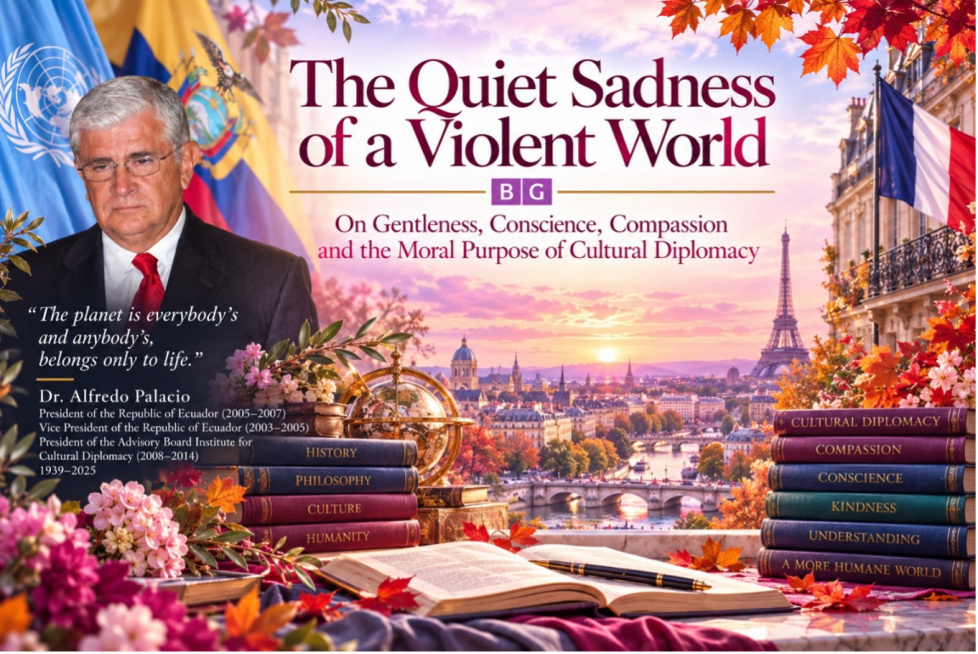
This article was inspired by the sadness of witnessing scenes of violence and destruction, including attacks on schools and public institutions, reported in Paris and other parts of France. Such senseless acts, whatever their motivations or those responsible for encouraging them, are profoundly heartbreaking, particularly when directed against places dedicated to young people, education, knowledge and public life. They stand in painful contrast to the French ideals of liberty, equality and fraternity, which once inspired the world and helped advance a more humane civilisation founded upon human dignity, conscience, compassion and mutual respect.
There is a particular kind of sadness that arises not from personal misfortune or disappointment, but from observing the world and wondering why humanity, despite its extraordinary achievements, remains so deeply troubled by hatred, intolerance and violence.
It is a sadness experienced by those who believe in human goodness, who find happiness in knowledge, nature and peaceful coexistence, and who struggle to reconcile these convictions with the conduct of individuals, societies and nations. This feeling is not necessarily despair. It may instead reflect an enduring awareness of the distance between what humanity has achieved and what it could become.
Civilisations have devoted enormous energy to developing economic power, political institutions, scientific knowledge, military capabilities and technological sophistication. Yet they have not always devoted comparable attention to cultivating the qualities that make human existence meaningful: gentleness, conscience, compassion, sympathy, kindness and respect for life. These are not merely desirable personal characteristics or sentimental additions to social progress. They are among the essential foundations of a humane civilisation. Their neglect exposes a fundamental contradiction in human development: societies may become increasingly sophisticated in their capabilities while remaining remarkably limited in their humanity.
Gentleness, Conscience and the Strength of Human Character
From childhood, some individuals demonstrate an instinctive preference for gentleness over confrontation, curiosity over competition, and contemplation over aggression. They discover entire worlds through history, geography, astronomy, literature, animals and the remarkable diversity of nature. Their fascination with knowledge is accompanied by an appreciation of beauty and an unwillingness to accept cruelty as an inevitable feature of existence. Such dispositions reveal an important dimension of human character: the capacity to approach the world with wonder rather than suspicion, appreciation rather than possession, and understanding rather than domination.
Gentleness, however, is frequently misunderstood. In societies that associate strength with assertiveness, competition and the exercise of power, kindness may be mistaken for weakness, restraint for indecision, and sympathy for vulnerability. Yet a gentle disposition does not imply the absence of anger or moral conviction. Those who value honesty, fairness and compassion may experience profound indignation when confronted with betrayal, deliberate dishonesty, injustice or unnecessary suffering. Their anger need not arise from hostility towards others, but from the violation of principles they consider essential to human dignity.
The Roman emperor and Stoic philosopher Marcus Aurelius explored the importance of self-command, rational judgment and responsibility towards others in his Meditations. His reflections suggest that moral strength lies partly in recognising wrongdoing without allowing resentment to determine one's character. With maturity, the impulse to confront every injustice may give way to reflection and restraint. Yet gentleness must never become an excuse for indifference. Conscience sometimes demands principled resistance. The challenge is to oppose cruelty without becoming cruel, and to defend moral principles without abandoning compassion.
Cultural Diplomacy as the Cultivation of Humanity
At its deepest level, cultural diplomacy should be understood not simply as an instrument of international relations, but as a means of cultivating the human qualities upon which peaceful coexistence depends. Its purpose extends beyond cultural exchanges, artistic presentations, academic cooperation and the celebration of national traditions. Cultural diplomacy can encourage individuals and societies to become more attentive, considerate, compassionate and responsible towards one another. It begins with the willingness to listen before speaking, to understand before judging, and to approach unfamiliar people, ideas and traditions with genuine curiosity.
Every culture possesses its own expressions of kindness, moral responsibility, sympathy and respect. These values may emerge through philosophy, literature, religious traditions, family relationships, artistic expression or everyday acts of human consideration. Cultural diplomacy offers opportunities to discover how different societies understand and practise them, while recognising that no civilisation possesses a monopoly on moral wisdom. Its significance lies not in demonstrating the superiority of one cultural tradition over another, but in encouraging humanity to learn from the ethical achievements, experiences and shortcomings of all.
Listening is particularly important because it requires something that power alone cannot provide: the willingness to give another person genuine intellectual and emotional attention. Understanding does not demand agreement, just as compromise does not require the abandonment of conscience. The ability to disagree without humiliation, to recognise another person's dignity despite profound differences, and to seek peaceful solutions without resorting to threats or aggression requires considerable moral discipline. Non-violence extends beyond the rejection of physical force; it includes restraint in language, resistance to prejudice and the refusal to transform disagreement into hatred.
A civilisation that cultivates these qualities achieves something that cannot be measured through economic indicators or technological accomplishments alone. It develops the moral capacity to exercise power responsibly, recognise suffering beyond its own borders, and place human dignity above the immediate satisfaction of pride, resentment or narrow interests. Cultural diplomacy should contribute to this development, not by replacing political institutions or legal obligations, but by strengthening the human conscience upon which their responsible operation ultimately depends.
Compassion, Nature and Reverence for Life
The relationship between gentleness and the natural world offers another essential dimension of this understanding. Albert Schweitzer's philosophy of reverence for life placed ethical responsibility towards living beings at the centre of moral thought. His approach reminds us that compassion need not end at the boundaries of human society. The appreciation of animals, forests, flowers, landscapes and the extraordinary diversity of living organisms can cultivate humility and a recognition that human existence forms part of a much larger living world.
Nature belongs to no single civilisation, religion or political tradition. Its beauty and vulnerability remind humanity of responsibilities that transcend national boundaries. The capacity to admire a living creature without wishing to possess it, to recognise suffering without remaining indifferent, and to protect what cannot defend itself reflects a moral sensitivity that deserves a more prominent place in our understanding of civilisation.
This sensitivity can also deepen the sadness experienced when confronting human cruelty. The German concept of Weltschmerz, associated with nineteenth-century Romantic thought, describes the sorrow arising from the distance between an imagined ideal and the imperfections of reality. Today, the extraordinary immediacy of global communications exposes individuals to suffering, violence and deception across continents, often without providing meaningful opportunities to influence their causes.
Yet such sadness need not signify resignation. It may express the continuing presence of conscience: an unwillingness to accept unnecessary suffering as normal or to regard human cruelty as an unavoidable condition of existence.
The Moral Measure of Civilisation
Humanity has never inhabited an entirely peaceful or morally harmonious age. History offers countless examples of extraordinary intellectual and artistic achievements existing alongside persecution, exploitation and violence. Scientific discoveries do not automatically produce wisdom, prosperity does not guarantee generosity, and sophisticated institutions cannot substitute for personal integrity. Moral progress requires conscious effort, education, self-examination and the willingness to place human dignity above the unrestricted pursuit of power.
The greatness of a civilisation should therefore be measured not only by what it creates, discovers or accumulates, but also by the qualities it encourages in human relationships. Gentleness in the exercise of strength, conscience in the making of decisions, compassion towards suffering, sympathy for the experiences of others, and respect for the dignity of life are not peripheral virtues. They are essential expressions of what it means to be civilised.
Cultural diplomacy has an important responsibility in advancing this understanding. Its highest purpose should not be merely to bring societies into contact, but to help them become more humane through curiosity, listening, mutual consideration and moral reflection. The quiet sadness of those who continue to believe in gentleness may therefore represent something valuable: a conscience that refuses to surrender its expectations of humanity.
Perhaps the greatest unfinished achievement of civilisation is not the conquest of distant worlds or the perfection of increasingly powerful technologies, but the ability to live with greater kindness, wisdom and compassion. Humanity has learned how to become powerful. Cultural diplomacy should help it learn how to become humane.
***
This understanding of humanity's responsibility towards life also resonates with the early philosophical foundations of the Institute for Cultural Diplomacy. Dr. Alfredo Palacio, former President of Ecuador, a cardiologist by profession and the first President of the ICD Advisory Board, was among the individuals who helped advance the Institute's development, including during his presidency of Ecuador. In his inaugural address as President of the ICD Advisory Board, he expressed a principle of remarkable simplicity and universal significance:
“The planet is everybody’s and anybody’s, belongs only to life.”
His words remind us that beyond the boundaries of nations, cultures and political interests, humanity shares a deeper responsibility towards life itself.
In Memoriam
Dr. Alfredo Palacio
President of the Republic of Ecuador (2005–2007)
Vice President of the Republic of Ecuador (2003–2005)
President of the Advisory Board Institute for Cultural Diplomacy (2008–2014)
1939–2025
