
The “Je Ne Sais Quoi” Magic
On the Fifth Anniversary of Jean-Paul Belmondo’s Death, Remembering the Golden Age When French Cinema Captured the World’s Imagination
September 13th, 2026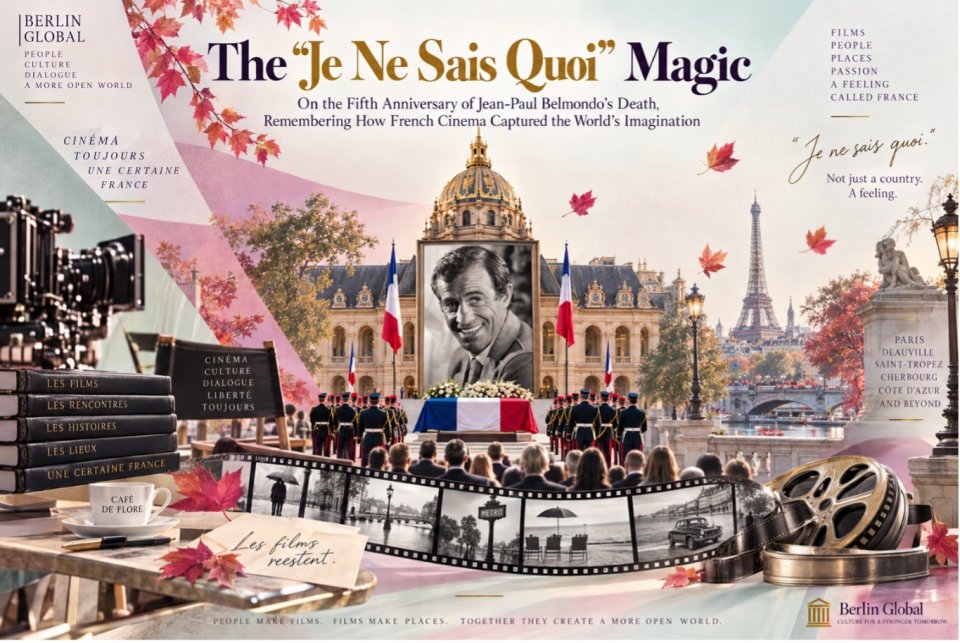
Five years ago this month, France said goodbye to Jean-Paul Belmondo. At the Cour d’Honneur of Les Invalides in Paris, his coffin lay draped in the French tricolour as the Republic paid him a national tribute. President Emmanuel Macron described him as a “hero with a thousand faces” whose career had accompanied six decades of French life. It was an extraordinary honour for an actor, yet somehow entirely natural for Belmondo.
As the ceremony drew to its end, the Republican Guard played Ennio Morricone’s haunting Chi Mai, forever associated in the French imagination with Belmondo and the 1981 film Le Professionnel. Cinema, music, memory and national ceremony suddenly occupied the same space.
It was solemn and theatrical, official and emotional, grand and intimate. And somehow, unmistakably, French.
Perhaps there is only one expression for what made Belmondo and the cinematic world he represented so powerful: je ne sais quoi.
Literally, “I do not know what,” the expression describes something we recognise more easily than we can explain. It is not simply beauty, elegance, intelligence, sensuality or charm. Sometimes it appears in perfection; sometimes in imperfection. It can belong equally to a crooked smile or an immaculate face, to a woman walking alone through Paris at night or another looking silently through the rain at Deauville.
For several extraordinary decades, from the late 1950s through the 1980s, French cinema seemed to possess this quality in abundance. More importantly, it sent it around the world.
Long before millions of people ever visited Paris, Saint-Tropez, Deauville or the Côte d’Azur, they had already imagined France through cinema. They knew its cafés and boulevards, beaches and railway stations, restaurants and apartments, cars and clothes, cigarettes, conversations and music. They knew the faces of Jean-Paul Belmondo and Alain Delon, but equally those of Simone Signoret, Jeanne Moreau, Brigitte Bardot, Anouk Aimée and Catherine Deneuve.
French cinema did not simply export films.
It exported a feeling about France.
When France Became a Feeling
That feeling did not suddenly begin with the Nouvelle Vague. Henri-Georges Clouzot’s Les Diaboliques in 1955 had already given Simone Signoret one of her great screen roles. Signoret represented a kind of magnetism essential to understanding French cinema: intelligence, maturity, experience and emotional authority rather than manufactured perfection. A few years later, her performance in the British film Room at the Top brought her the Academy Award for Best Actress and confirmed her international stature.
Signoret demonstrates immediately that je ne sais quoi was never simply another word for beauty.
Neither was Jeanne Moreau. In Louis Malle’s Ascenseur pour l’échafaud (1958), Moreau walks through nocturnal Paris while Miles Davis’s trumpet accompanies her. Very little is needed: a face, a city at night and music. Yet together they create something extraordinarily evocative. Moreau brought intelligence, sensuality and ambiguity to the screen; in François Truffaut’s Jules et Jim, those qualities became something freer and more unpredictable.
Then there was Brigitte Bardot.
Roger Vadim’s Et Dieu… créa la femme (1956) did more than make Bardot an international phenomenon. Bardot, Saint-Tropez, the Mediterranean, sexuality, fashion, youth and rebellion became intertwined in the international imagination. France was no longer only Paris, museums and haute culture. It could also mean sunshine, freedom and a woman apparently unconcerned with the conventions surrounding her.
By the end of the 1950s, something was clearly changing. François Truffaut’s Les Quatre Cents Coups brought Jean-Pierre Léaud running through a new cinematic Paris. Alain Resnais’s Hiroshima mon amour, with Emmanuelle Riva, turned memory, love and trauma into an entirely different kind of film language. Agnès Varda would observe Paris and female experience through Cléo de 5 à 7. French cinema was becoming younger, freer and more personal.
And then, in 1960, Jean-Luc Godard put Jean-Paul Belmondo and Jean Seberg onto the streets of Paris in À bout de souffle.
Belmondo did not look like the movie star convention demanded. His features were irregular, his nose carried the traces of his youthful boxing, and his smile seemed more likely to mock glamour than submit to it. Yet the camera adored him. He could appear dangerous and funny, masculine and playful, stylish and apparently indifferent to style.
He seemed not to be performing charisma at all.
He simply had it.
Across the same decade stood Alain Delon, who appeared almost to prove the opposite. Where Belmondo was movement, Delon could be stillness. Where Belmondo grinned, Delon stared. Where Belmondo seemed spontaneous, Delon appeared sculpted. In Plein Soleil and, above all, Jean-Pierre Melville’s Le Samouraï, Delon projected beauty, silence, elegance and danger with astonishing economy.
One challenged the conventional requirements of a screen idol; the other seemed created to fulfil them.
Both were magnetic.
That contradiction may tell us more about je ne sais quoi than any definition ever could.
The Women Who Defined the Magic
But the international image of French cinema was created as much by its women as by its men. Without them, much of the France the world fell in love with on screen simply would not exist.
Signoret’s authority was not Moreau’s sensual intelligence. Moreau was not Bardot. Bardot’s rebellion was not Catherine Deneuve’s cool elegance, and Deneuve’s mystery was not Anouk Aimée’s melancholy restraint. Their differences were precisely what made them compelling.
Anna Karina brought playfulness, youth and sadness to Godard’s cinema, becoming inseparable from the visual memory of films such as Vivre sa vie and Pierrot le Fou. Catherine Deneuve became another international image of France through Jacques Demy’s Les Parapluies de Cherbourg, surrounded by extraordinary colour and Michel Legrand’s music. Then Belle de Jour revealed something more enigmatic behind the same apparently perfect face.
Romy Schneider brought another dimension. Born in Vienna and first internationally famous through the German-language Sissi films, she reinvented herself within French cinema and became one of its defining actresses. Her story reveals another side of cultural power: a culture does not only export its attractions; at its strongest, it draws artists towards itself.
Annie Girardot represented yet another image of the modern French woman independent, direct, humorous and closer to everyday life than the distant glamour sometimes associated with French stardom. Later, Isabelle Adjani and Isabelle Huppert would bring new forms of intensity and psychological ambiguity to the screen. The female je ne sais quoi continually changed because there had never been a single formula in the first place.
Perhaps no actress demonstrates the power of restraint more beautifully than Anouk Aimée.
Claude Lelouch’s Un homme et une femme (1966) required remarkably little to create its magic: Aimée, Jean-Louis Trintignant, a beach at Deauville, cars, rain, memory, silence and Francis Lai’s unforgettable music. Lelouch moved between colour and monochrome and allowed glances, hesitations and atmosphere to communicate as much as dialogue.
The film became an international triumph, sharing the top Grand Prix at Cannes in 1966 and later winning Academy Awards for Foreign Language Film and Original Screenplay. Aimée herself received an Oscar nomination for Best Actress.
But awards do not explain why the film still feels so evocative.
If Godard made the world want to walk through Paris with Belmondo, Lelouch made it want to fall in love in Deauville.
France had become a feeling.
The fascination did not always end when the cameras stopped. Around French cinema grew another mythology in which art, romance and public life intertwined. Alain Delon and Romy Schneider met while making Christine and, years after their relationship ended, reunited in La Piscine, where their history seemed to intensify the film’s mixture of beauty, desire and danger on the Côte d’Azur. Simone Signoret and Yves Montand represented something different: cinema, chanson, intellectual engagement and public life joined in one of post-war France’s most recognisable cultural partnerships. Godard and Karina combined romance with artistic creation, while Agnès Varda and Jacques Demy offered another model entirely—two major filmmakers, each with an independent vision, sharing a life as well as a profound commitment to cinema.
And then there were Bardot and Vadim. With Et Dieu… créa la femme, their partnership helped transform Bardot into an international phenomenon and Saint-Tropez into a symbol of sensuality, freedom and Mediterranean life. The cinema created the stars, but the lives surrounding them added to the mythology. Paris, Saint-Tropez, the Côte d’Azur and Deauville became more than locations: they became part of an imagined French way of life.
The cinema created the image; life around the cinema completed the feeling.
More Than the Nouvelle Vague
This is why the story cannot be reduced to the Nouvelle Vague. French cinema’s international attraction came precisely from the extraordinary variety of worlds it offered.
Godard gave France rebellion and modernity. Truffaut gave it humanity, childhood, romance and emotional warmth. Melville stripped it towards silence, shadows, trench coats and codes of honour. Varda brought independence and another way of seeing women, streets and ordinary life. Jacques Demy turned Cherbourg into colour, music and melancholy. Claude Chabrol looked beneath the polished surface of bourgeois respectability. Éric Rohmer could make conversation, attraction and moral hesitation cinematic. Louis Malle moved between genres while retaining an unmistakable curiosity about people and society. Clouzot had already demonstrated that French cinema could make suspense and psychological darkness travel internationally.
And Claude Lelouch demonstrated that sometimes a face, a landscape and a melody were enough.
These filmmakers did not agree about what French cinema should be. That was their strength. There was no single image of France being manufactured. The country could be Godard’s restless Paris, Melville’s nocturnal underworld, Demy’s colourful Cherbourg, Varda’s observed streets or Lelouch’s romantic Deauville.
The paradox is important:
French cinema became extraordinarily effective cultural diplomacy precisely because its greatest filmmakers were not trying to make cultural diplomacy.
They were making films.
And Then There Was Louis de Funès
Nor did the French je ne sais quoi belong only to intellectual cinema, beautiful stars and serious critics.
There was also Louis de Funès.
His frantic movements, explosive temper, extraordinary facial expressions and perfectly controlled panic created a comic language that needed surprisingly little translation. Le Corniaud, La Grande Vadrouille, Le Gendarme de Saint-Tropez and Les Aventures de Rabbi Jacob carried another France across borders: popular, absurd, energetic and very willing to laugh at itself.
Perhaps Le Grand Restaurant (1966) is particularly appropriate to our story. De Funès plays Monsieur Septime, the tyrannical proprietor of a prestigious Paris restaurant, turning the rituals of French gastronomy elegance, service, hierarchy, ceremony and an obsession with perfection into comedy. Here cinema and another great instrument of French cultural influence, gastronomy, meet in the same room.
But de Funès could also make laughter carry a more serious message. In Gérard Oury’s Les Aventures de Rabbi Jacob (1973), his character begins as an intolerant and prejudiced businessman and is thrown into an absurd adventure involving Jewish and Arab characters, cultural misunderstandings and mistaken identities. Behind the physical comedy was a plea for tolerance and coexistence released, remarkably, against the background of the Arab-Israeli tensions of 1973.
French sophistication could become the joke, prejudice could become the target, and neither prevented millions from laughing.
Laughter, too, can be soft power.
When the Rebels Became Icons
By the 1970s, many of the young rebels of the previous decade had become institutions. New actors and actresses were emerging, but Belmondo and Delon remained enormous cultural presences.
Jacques Deray’s Borsalino (1970) finally put them together. The pleasure of seeing them side by side came partly from everything they already represented: Belmondo with his movement, humour and physical confidence; Delon with his beauty, control and danger. Two completely different ideas of French masculinity occupied the same frame.
Yves Montand represented yet another kind of magnetism. Singer, actor and international star, he combined elegance with intelligence and an unmistakable sense of lived experience. His career moved naturally between chanson and cinema, between popular culture and politically engaged films, while his presence in Melville’s Le Cercle rouge placed him alongside Delon in one of the director’s most controlled worlds of silence, professionalism and danger. Montand reminds us that French cultural influence rarely remained within one artistic form: cinema, music, performance and public life continually flowed into one another.
Belmondo meanwhile performed one of the most remarkable transformations in French popular cinema. The young face of À bout de souffle did not remain imprisoned within art-house cinema. Through films such as Le Casse, Peur sur la ville and L’Animal, he became “Bébel,” one of France’s most popular entertainers, famous for his humour, physicality and spectacular stunts.
This matters. France’s cinematic soft power was not produced only by films shown at festivals or discussed by intellectuals. It came from popular entertainment too—from Belmondo running across rooftops, from de Funès destroying the order he desperately tried to maintain, from Bourvil’s warmth and comic timing, from Montand’s elegance, and from stars such as Jean Gabin, Lino Ventura and Michel Piccoli connecting different generations and different ideas of French masculinity.
By the 1980s, the visual language was changing again. Jean-Jacques Beineix’s Diva and Luc Besson’s Subway belonged to another France of design, colour, music and urban style. Adjani and Huppert represented another generation of female stardom. Yet the attraction survived because it had never depended upon one aesthetic.
The je ne sais quoi had simply changed clothes.
Cinema as Cultural Diplomacy
What did all this mean beyond cinema?
It meant that millions of people encountered France culturally before they encountered it geographically or politically. They walked through Paris with Belmondo and Moreau, discovered Saint-Tropez through Bardot, Deauville through Aimée and Trintignant, Cherbourg through Deneuve and Demy, and the Mediterranean through Delon and Schneider. They entered restaurants with de Funès and criminal underworlds with Melville. They heard French spoken against the music of Miles Davis, Michel Legrand and Francis Lai.
They encountered a France of Citroëns and Peugeots, cafés and terraces, fashion and food, jazz and chanson, Mediterranean summers and rainy Paris streets, intellectual conversation and effortless style.
It was not the whole France, nor necessarily the real France.
It was an imagined France.
But imagined countries can exercise enormous cultural power.
French cinema did not simply show international audiences what France looked like.
It helped teach the world how France should feel.
That is where cinema became soft power. Governments can establish cultural institutes, embassies can organise programmes and diplomats can build relationships. But culture can accomplish something different: it can create attraction before anyone asks for it.
Godard was not telling audiences to admire France. Bardot was not advertising Saint-Tropez. Lelouch was not producing a tourism campaign for Deauville. Melville was not promoting Paris. Indeed, these filmmakers could be rebellious, critical, melancholy or deeply uncomfortable about the society around them.
And perhaps that was precisely why their influence was so persuasive.
The greatest cultural diplomacy does not tell the world to admire a country. It creates something compelling enough that curiosity and attraction arise by themselves.
For several extraordinary decades, French cinema did exactly that.
Few instruments of French soft power in the second half of the twentieth century were as seductive, international and enduring.
And Then the Republic Played Chi Mai
And so we return to Les Invalides in September 6th, 2021.
Belmondo had never governed France. He had commanded no army, negotiated no treaty and represented his country at no embassy. Yet for six decades his face had travelled the world, carrying with it something instantly recognisable as French. And he was not alone. Delon’s elegance had done it. Signoret’s authority had done it. Moreau’s intelligence, Bardot’s rebellion, Deneuve’s mystery and Aimée’s melancholy had done it. Karina, Schneider, Girardot, Adjani and Huppert each added something different. Montand did it through cinema and song. Godard, Truffaut, Melville, Varda, Demy, Malle, Chabrol, Clouzot, Rohmer and Lelouch created the worlds in which these personalities became unforgettable.
And then the Republican Guard played Chi Mai. A melody born in popular cinema entered one of the great ceremonial spaces of the French Republic. Film, music, memory and national identity suddenly occupied the same space. Perhaps that was the ultimate demonstration of the cultural power French cinema had accumulated. The state could organise the ceremony, drape the coffin in the tricolour and assemble the Republican Guard. But it had not created the emotion that made the ceremony necessary. Cinema had done that.
Why could Belmondo’s crooked smile rival Delon’s perfect face? Why could Moreau walking alone at night transform Paris into an emotion? Why could Bardot make Saint-Tropez represent freedom, Deneuve turn distance into elegance, Signoret make experience itself magnetic, or Anouk Aimée looking through the rain make generations dream of Deauville? These were not simply performances or images. Together, they created an idea of France that travelled farther than diplomacy and lasted longer than politics.
We can call it cinema, soft power or cultural diplomacy. All are true. But something remains beyond all three: something recognisable, seductive and almost impossible to manufacture.
The French have always had the perfect expression for it.
Je ne sais quoi.
