
The Intractable Conflict Still Awaiting Resolution
Israel-Palestine Essay: The Unfinished Search for Peace
October 08th, 2026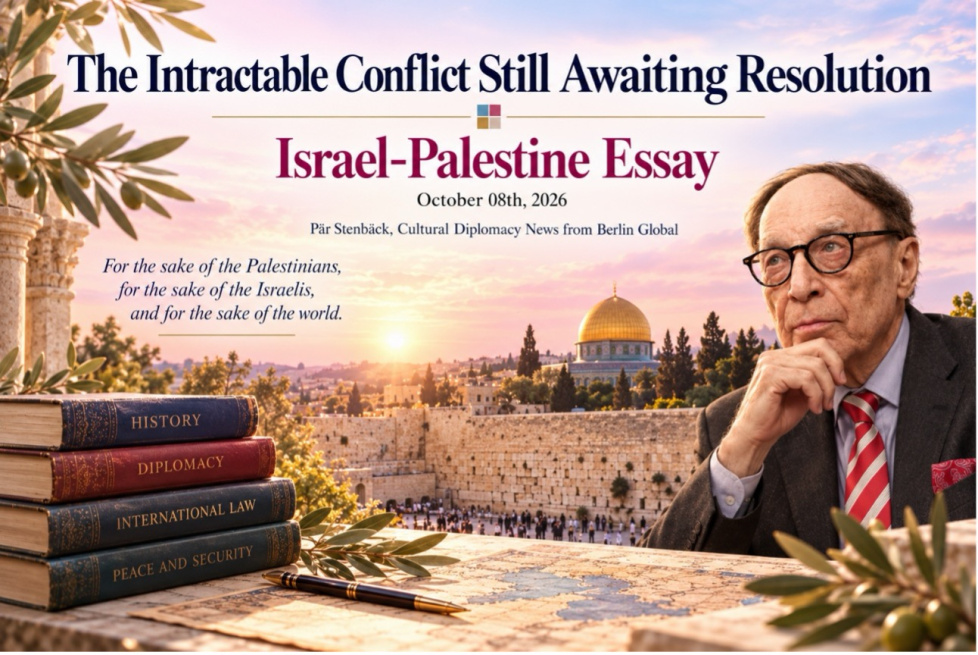
There are three reasons why the Israeli–Palestinian conflict must be resolved. For the sake of the Palestinians, for the sake of the Israelis, and for the sake of the world. Each of the three requires a solution in its own right, yet they are interdependent. A solution benefiting only one may preclude a solution for another party.
Unfortunately, the need is perceived differently: for the Palestinians it is urgent; in present-day Israel, a solution is regarded as a threat; and the international community acknowledges the need but is, in practice, powerless to act.
Nevertheless, an objective assessment of the need shows that all three would benefit greatly from a settlement accepted by all parties and enjoying broad support. Even if the moral and legal imperatives are set aside and attention is confined solely to practical benefit, the case speaks for itself.
For the Palestinians, the benefit is so evident that it scarcely requires elaboration, beyond observing that they need a secure homeland with protected borders under a two-state solution, equal citizenship under a one-state solution, or some combination of the two.
For Israelis, the benefit would lie in safeguarding the long-term future of the State of Israel and bringing its permanent state of war to an end within the framework of a regional peace settlement. Polarisation and declining social cohesion would be countered, and citizens’ sense of security would increase.
A faltering world order would benefit from a calmer Middle East if Israel could be incorporated into a regional security framework. The United States would be relieved of its costly role in financing Israel’s wars and of the political price it pays across much of the world for its one-sided support of Israel’s military advance.
Yet the evident benefits and advantages of a settlement have not sufficed to produce the two-state solution that has dominated discussion for half a century. Today, that solution appears more remote than ever. The events of 7 October 2023 brought to an end a process that had long been proceeding at little more than a standstill, if at all.
Why did so many attempts at a settlement fail? Did inept or disingenuous negotiators contribute to the failures? Did the self-appointed mediator, the United States, fail to put sufficient weight behind its efforts? Or were the negotiations based on the wrong model for a realistic settlement?
There is much to suggest that neither Israel nor the Palestinians have regarded the two-state model as an ideal solution. It fulfils none of the dreams and aspirations regarded as fundamental by Zionists, Jewish and Islamic religious groups, or the founders and present-day adherents of the Palestinian liberation movement.
The heirs to Zionism—the radical right and religious extremists—dream of Kol Israel, a Greater Israel. This, they believe, would guarantee security, but it would require Israel to be the dominant power in the region. The Palestinians are a disruptive element in that vision.
The Palestinians dream of redress and dignity: of justice for the loss of homes and land during the displacement of 1948. Although they have been forced to acknowledge their position as the defeated party, they continue to dream of returning to something that no longer exists. Any proposed settlement must take account of the reservations inherent in that dream if peaceful coexistence is to be secured in the long term.
One probable explanation for the absence of a settlement is the limited enthusiasm for a two-state solution; belief in it has been considerably stronger abroad. Israel sees no reason to assist in creating a neighbouring state over which it might lose control. The Palestinians continue to hope for a more generous settlement: a moral solution that respects their sense of justice and takes account of the support they receive from the wider world.
A Fresh Start Is Needed—but Where Is the Will?
An analysis of repeated failures does not bring the parties or the wider world any closer to a settlement. At the time of writing, the global spotlight has shifted away from events in Gaza. Many outside observers persuade themselves that Trump’s so-called peace plan represents a step towards a lasting settlement. They breathe a sigh of relief at being spared the difficult moral and political questions that have deliberately been left unresolved.
No sustainable and enduring solution is remotely in sight. Trump’s peace plan provides a respite from open warfare, but chiefly benefits Israel. An impatient Trump wishes to turn his attention to other projects. The Gulf states can concentrate on trade and respectability, while Saudi Arabia has received its reward in the form of arms deals with the United States, even though it has not yet recognised Israel. The bombing of Gaza has continued after the ceasefire, destroying several thousand homes, without any significant attempt by the United States to restrain it.
The so-called peace plan appears likely to produce a bureaucratic and political nightmare. Its various processes and bodies virtually guarantee complications and give the Israeli Government every opportunity to obstruct implementation. It provides no answers regarding the Palestinians’ future or the length of Israel’s presence in Gaza. Ironically, the United Nations has approved a plan that is regarded as an attempt to create a Trump-led alternative to the United Nations itself.
Hamas has several options: to dissolve itself, relocate to Iran, or transfer its activities to the West Bank; it may choose the last of these. Israel’s conditions for allowing the Palestinian Authority (PA) a role in Gaza include the withdrawal of its complaint before the International Criminal Court.
The United States has adopted the refrain concerning corruption within the PA, which unquestionably exists. Elections to a Palestinian parliament ought to be held, not least in order to replace the leadership. Yet Israel will not allow the residents of East Jerusalem to vote and also refuses to transfer Palestinian tax revenues due to the PA. By the end of November 2025, the sum withheld amounted to €3.5 billion, according to the PA.
Israel considers itself to possess a veto over most matters, while Trump believes that the reconstruction of Gaza should be undertaken by the Gulf states, and perhaps by Europe as well. The Gulf states, however, do not appear especially interested.
Two modestly positive outcomes should be noted. For the time being, the Arab states and the United States will not permit an Israeli annexation of the West Bank. Trump’s and Netanyahu’s unrealistic demand for the displacement of Gaza’s population—but to where?—has been abandoned, at least for now. Meanwhile, abuses of Palestinians in the West Bank by the occupying forces and settlers are increasing. The objective is continually to restrict their freedom of movement and force them out—but to where?
Settlers—or perhaps more accurately, colonists—already account for 25 per cent of the West Bank’s population. An interesting detail is that many hold dual nationality: American, Russian, or that of a European country. It has been reported that approximately 25,000 votes were cast in the West Bank in the most recent French parliamentary election—not implausible, given that there are at least 150,000 French citizens in Israel. Is their other homeland aware that its citizens are engaged in illegal and, in places, criminal activity when Palestinians are subjected to abuse?
Back to the Drawing Board
With such poor prospects for a settlement, it is once again necessary to return to the drawing board. Any analysis of these recurring crises tends to include a historical overview. My own account is necessarily concise, since there have been so many negotiations that it is easy to become absorbed in fascinating details that now belong to history. It is tempting to lament all the opportunities for settlement squandered over five decades. Two phases must therefore suffice as examples of negotiations and agreements that might have opened the way to a more positive future.
I first visited Israel in 1973, shortly after its victory in the Six-Day War. The sense of euphoria was considerable. Israel had consolidated the gains of the 1967 war and held the trump cards: the West Bank, Jerusalem, Gaza, Sinai and the Golan Heights were all in Israeli hands. It could now negotiate with its hostile neighbours from a position of strength.
It did so, relinquishing the Sinai Peninsula in exchange for Egypt’s recognition of Israel in 1979. Thereafter, however, the process came to a halt. Jordan was perhaps not especially eager to recover the Palestinian West Bank, so why press it upon the royal house? Meanwhile, the settler movement grew, asserting on religious and economic grounds a right to colonies in the West Bank: the territory had formed part of an ancient Israel that existed two thousand years ago.
This produced a shift to the right in domestic politics, and colonisation soon became a central issue. The myth of a Greater Israel acquired concrete boundaries, although today there are fanatics who even claim that the frontiers of prehistoric Israel extended from the Mediterranean to the Euphrates and the Tigris.
Israel succumbed to the temptation to retain the spoils of war, although they were not easy to administer: the West Bank, Gaza and the Golan Heights required constant vigilance.
A second opening for a settlement emerged with the conclusion of the Oslo Accords in 1993. As is well known, they were intended to lead to a two-state solution on the basis of a timetable containing a series of interim objectives. After approximately five years, it had become clear that the plan had unravelled.
Why? Responsibility for the failure may be apportioned among three parties: the Palestinians, the Israelis and the United States.
The PLO was the umbrella organisation of the Palestinian liberation movement that signed the Oslo Accords in 1993. The Palestinian Authority (PA) was then established to implement one party’s commitments. From the outset, this contained an inherent contradiction: a liberation movement that had agreed to depart from its ultimate objective was now to assume responsibility for administrative tasks. It was led by its grand old man, Yasser Arafat, a charismatic survivor who was respected by his own people but had a reputation as an astute and unpredictable negotiator for Fatah, the leading faction within the PLO.
The Oslo Accords represented clear progress, but they did not address the most central questions: Jerusalem, the borders of a future Palestine, or the right of the refugees of 1948 to return. Notwithstanding the Accords, the illegal settlements in the West Bank continued to expand throughout the 1990s.
Opposition to the Oslo Accords was strong in Israel, not least because it remained unclear whether their objective was a Palestinian state. Prime Minister Yitzhak Rabin, who supported the Accords but not a fully sovereign state, was assassinated by a Jewish right-wing extremist in 1995.
The Camp David summit in 2000 was intended to provide clarity. President Clinton openly supported Prime Minister Ehud Barak’s relatively generous terms, but Yasser Arafat declined them. He considered that he should not have to relinquish the Palestinians’ fundamental demands when accepting a Palestinian state comprising only 22 per cent of the territory inhabited by Palestinians in 1947.
Arafat was subsequently accused of having squandered the opportunity; the Palestinians had only themselves to blame. The question is whether an agreement on the terms offered would in fact have brought peace. Camp David had not been preceded by realistic negotiations on the details. Nor had Barak honoured his promises of a settlement freeze. Arafat believed that a better offer would emerge if he held out.
Shlomo Ben-Ami, the former Israeli Foreign Minister whom I came to know on the board of the International Crisis Group, stated that ‘if I were a Palestinian, I would have rejected what was offered at Camp David’.
Above all, however, President Clinton failed: he and the Americans passively supported Barak’s various proposals. Clinton is not the only president to have refrained from using the power at the United States’ disposal to compel the parties towards a realistic agreement. Obama’s Kerry initiative likewise failed, and Biden remained a passive observer who called for Israeli restraint but did not follow through. It may be unpalatable to acknowledge that Trump at least succeeded in concluding an agreement—the Abraham Accords of 2020—which led several Arab states to recognise Israel in return for substantial rewards from the United States.
The Oslo Accords provided for police cooperation between the Palestinian Authority in Ramallah and the Israeli security services. The United States and Europe gave generous support to the Authority, with two consequences. Many Palestinians regarded the cooperation as humiliating, as their former liberation movement was now combating militant activists in coordination with the occupying power. Moreover, the flow of funds led to endemic corruption as a new civil service had to be built almost from scratch.
Shortly after the failure at Camp David, the Second Intifada erupted in the West Bank. The immediate cause was Ariel Sharon’s provocative visit to the Muslim holy site of Haram al-Sharif on the Temple Mount. The faltering Oslo process and the continuing negotiations on a two-state solution then receded from view.
***
A serious setback befell the Palestinian cause when it became divided. Hamas emerged from the old Muslim Brotherhood and initially devoted itself to religious and social activity. When the PLO renounced armed struggle in 1988, Hamas stepped into its place. Its objective was an Islamic society to be realised gradually; the final struggle over and for Palestine could wait until the movement was sufficiently strong. The Oslo Accords were rejected. As early as 1989, Hamas carried out its first deadly raid from Gaza, and during the Intifada it supported the uprising. When Israel, under Prime Minister Sharon, unexpectedly withdrew from Gaza in 2005, Hamas saw its opportunity.
Arafat died in 2004 and was succeeded by Mahmoud Abbas. In January, the Palestinian Authority held elections in which Hamas won a majority, securing 74 of the 132 parliamentary seats. It was a typical protest vote: against corruption and cronyism within the old guard, and against its close cooperation with the Israeli authorities.
The United States had designated Hamas a terrorist organisation in 1997 and suspended all support to Palestine when Hamas formed a government. Israel likewise imposed a financial blockade on the Palestinian Authority. Attempts were made to reconcile the PLO and Hamas, but these failed, and in 2007 Hamas expelled the PLO and Fatah from Gaza after fighting that claimed many lives.
Israel’s blockade of Gaza then began and was gradually tightened. When I visited Gaza in 2009, the high walls had already been erected. The humanitarian branch of the Red Crescent was still administered from Ramallah. The Palestinian Authority continued to pay the salaries of thousands of suspended civil servants. Israel was said to ‘mow the lawn’, a euphemism for bombing campaigns undertaken when Hamas launched rockets and attempted to break out.
The division naturally served Israel’s interests. It declared that it no longer had a credible partner for peace and that further compromise was impossible. In 2012, Prime Minister Netanyahu stated that a strong Hamas was in Israel’s interest, since it rendered a two-state solution impossible. For many years, Israel permitted Qatar to finance Hamas in Gaza.
The Turning Point
Hamas was therefore able, almost undisturbed, to consolidate its position of power in Gaza. It governed, but not on Israel’s terms, as the PLO had done, and it remained on its guard. Israel, to be sure, monitored everything that occurred in the narrow Gaza Strip. Striking at centres of resistance posed little difficulty when informants were available.
Yet the massive breakout of 7 October 2023 nevertheless took Israel and the world by surprise. Militarily superior Israel had lulled itself into a false sense of security and paid a heavy price for its hubris. Warnings had existed, but they had not been taken seriously—an unforgivable lapse by a gaoler who had promised to keep those confined under control.
A less well-known fact is that Hamas and various Israeli negotiators discussed a Hamas proposal for a longer ceasefire in exchange for improved conditions for the people of Gaza, including arrangements for exports, imports and passage to Egypt, only a few weeks before the attack. It is unclear who represented Israel—Netanyahu’s office, the military or Shin Bet—but the Israeli side was unable to reach a decision. Perhaps it was a diversionary manoeuvre; perhaps the absence of a response contributed to the decision to attack.
There is broad agreement that the killing of civilians was barbaric and that the tragedy destroyed whatever progress may have been made towards understanding between the two peoples. Much of that was now lost. Explanations have been sought for why a relatively disciplined movement resorted to so desperate and hopeless an act, which it must have understood would provoke merciless retaliation.
Israel’s response was that the bloodshed constituted final proof: the Palestinians’ objective is to destroy us, and no agreements are possible. This accorded with the prevailing outlook of the Netanyahu Government, which now received stronger backing from Israelis and from Jews in the diaspora. The sharp rise in support for Hamas in the West Bank merely reinforced the conviction that no settlement was any longer possible.
The killing of civilians is nothing new in the struggle between the two sides. The PLO and Fatah carried out many terrorist attacks during the 1960s and 1970s. In 1994, an Israeli-American extremist murdered 29 worshippers in a mosque and wounded one hundred, while fatal shootings are common in the West Bank. The events of 7 October were nevertheless exceptional in the scale of the terrorist attack.
It has been argued that the number of victims was so high because the attackers encountered unexpectedly weak resistance and that what had been intended as a hostage-taking operation degenerated into a pogrom. Such claims may readily be perceived as excuses, but they may help to explain the irrationality of the assault. If the operation had gone awry, its organisers could do little but claim responsibility for the macabre ‘success’.
Desperate, certainly; yet hostage-taking has always served to offset the asymmetry in the balance of power between the parties. Israel has traditionally been willing to pay a high price for the release of hostages. It did so again, but the people of Gaza paid the difference in the form of at least 70,000 deaths during several years of bombardment. Thousands of prisoners held in Israeli prisons were released. Hamas could demonstrate that it had achieved something that the Palestinian Authority and the PLO had failed to accomplish—even though the price was exorbitant. Hamas could probably have obtained the same result by taking a dozen hostages.
The pogrom provoked widespread revulsion, particularly in the West. The prolonged bombardment of Gaza mobilised both longstanding and new critics and friends of Israel. A war of words and culture was waged over the difficult-to-define concepts of genocide and antisemitism.
Israel: A Society in Places Chaotic
Before asking whether there is any room at all for a peace process after 7 October 2023, it is necessary to examine Israel’s condition and its outlook for the future. This is not easy to assess unequivocally: Israeli domestic politics are, to put it mildly, confused, while those Palestinian institutions that still function do so with a low profile. Palestinians need time to recover in a devastated Gaza and in a West Bank subject to unremitting settler violence.
The Gaza crisis occurred at a critical moment for Israel. In January 2023, Netanyahu had presented his plan to reshape the judiciary. At its core was an attempt to prevent the courts from reviewing the Government’s political decisions. It would grant governments powers to suppress various protest movements and permit a harsher response to opposition forces.
The plan triggered a powerful backlash and enormous demonstrations involving hundreds of thousands of participants. It became clear to many that Israel was moving towards an authoritarian society with theocratic elements and ethnic racism in the form of Jewish supremacy. Reservists also joined the protests and threatened to refuse call-up orders.
Netanyahu did not hesitate, however, and in July 2023 forced a central part of the plan through the Knesset, Israel’s parliament. It should be noted that the protests did not concern the provisions aimed at annexing parts of the West Bank.
Following the Hamas attack, the pro-democracy protests came to an abrupt end, and the same participants now demanded a forceful response to Hamas. Before long, however, they were demonstrating against the Government’s refusal to negotiate over the hostages. Their relatives demanded a ceasefire, while the extremist ministers demanded—and secured—further bombardment.
Gaza nevertheless gave Netanyahu an opportunity to pursue his project of restricting democracy despite some resistance from the Supreme Court. Israel describes itself as the region’s only democracy, yet it lacks a constitution setting out citizens’ rights and equality. In the 1950s, the founding father Ben-Gurion opposed adopting one because it might have constrained the power of his dominant Labour Party. Today, that party is merely one of many vulnerable minor parties.
Alongside the debate over democracy, a protracted struggle continues over the exemption of the ultra-Orthodox from military service. Secular Israelis are increasingly critical of the system: taxpayers support large families whose members devote themselves exclusively to the study of the Torah, the Jewish holy scripture, while the most extreme Haredim do not even support the existence of the State of Israel.
The yeshiva population numbers several hundred thousand and exercises disproportionate political influence through a handful of ultra-religious minor parties occupying pivotal positions; Netanyahu’s Government is entirely dependent upon them. The Supreme Court has declared both the exemption and the subsidies paid to students unlawful. Some students have yielded to the pressure, but this creates new difficulties for a gender-neutral defence force when single-sex units have to be formed.
At the time of writing, Netanyahu remains on trial for corruption. It is conceivable that pressure on the judiciary will ultimately result in his acquittal, as the phrase goes, in the national interest. President Trump has urged Israeli politicians and lawyers to ensure that his friend is pardoned.
By all appearances, Netanyahu succeeded in March 2026 in persuading Trump that the time was ripe for a major attack on Israel’s arch-enemy, Iran. This may deliver him victory in the next Knesset election and postpone any prison sentence.
Most observers consider that much of Netanyahu’s policy has been motivated by his efforts to avoid conviction. Those who believe that his departure would bring a clear change of course on democracy and Palestine are, regrettably, mistaken. Although public debate remains free and vigorous, no liberal centrist or left-wing politician is currently in sight who could lead Israel out of the impasse. Nor is there any discernible political appetite for restarting the peace process.
There should nevertheless be grounds for self-examination. Israel’s international reputation has suffered a serious setback, and 7 October demonstrated that the country is not invulnerable. Trump appears to offer unconditional support, but he is mercurial. One recalls how he humiliated Netanyahu by forcing him to telephone Qatar’s ruler and apologise for the attack on a Hamas negotiator in Qatar.
Netanyahu and his most important ultra-religious ministers are fundamentalists who believe that Israel must choose strength and violence in order to survive. They thereby condemn their country to a perpetual state of emergency, constant vigilance and the exhausting readiness to strike forcefully at every real or potential enemy.
Although Israel’s economy and capacity for innovation are strong, the questions of peace and democracy create uncertainty among younger people and foreign business partners. Many tire of constant military service, and some emigrate. Young reservists become brutalised, and when they commit offences that are prosecuted, many protest not on behalf of the victims but against the judgments. Israel’s moral core is in danger.
Israel is the region’s strongest military power—the only one possessing nuclear weapons—and appears to enjoy unwavering support from the United States. It has crippled Hamas and Hezbollah in Lebanon. Syria has been pacified, while Iran is shaken by domestic unrest and is licking its wounds after attacks by the United States and Israel. Israel’s future as a democracy is threatened not from without, but from within.
The absence of a plan capable of reducing tensions with a growing Palestinian population remains Israel’s existential problem. The Jewish identity of the nation has been enshrined in law, disregarding the reality that 20 per cent of Israeli citizens are not Jewish. Annexation of all or part of the West Bank would increase that proportion substantially. In total, the issue concerns the relations between seven million Jews and seven million Palestinians within a small geographical area.
The fundamentalist politicians are probably working on a plan for the forcible expulsion—plainly, the ethnic cleansing—of millions of Palestinians. Perhaps they are biding their time, or perhaps they have not yet found a willing recipient country.
By all appearances, the country’s politicians continue relentlessly in their attempts to silence and render invisible these seven million Palestinians, by both military and political means. Yet an unresolved problem cannot be made to disappear, and in time open conflict will flare up again.
I would wish a better fate for Israel. The fate of the Palestinians remains unchanged and mercilessly harsh.
If Not Two States, Is There a Future?
Although there is little hope of a fresh start while Trump and Netanyahu set the agenda, the next few years should be devoted to creative thinking. European and Arab politicians will probably continue mechanically to repeat the demand for renewed negotiations on a two-state solution. As Israel and the United States cease even to maintain appearances, that demand will sound increasingly hollow.
For forty years, informal discussions took place behind the scenes between Israeli and Palestinian individuals: academics, politicians without mandates, idealists and peace activists. They sought to keep the process alive even during difficult periods. One can only hope that the same is happening now, preferably out of public view, after a new nadir has been reached. New thinking is needed, even though many wish to maintain that the only solution is two separate states.
Hopes for decisive intervention by the international community remain a dream. Israel and the United States pay little heed to the decisions of the Hague courts in 2024 concerning an end to the occupation and the arrest of Netanyahu. Both are united by their openly expressed contempt for the United Nations and its various bodies. The European Union is, as is well known, divided, and most Member States are unwilling to confront the United States openly over Israeli policy. Most Arab states and China maintain a low profile, while South Africa may seek to mobilise the Global South, perhaps together with Turkey.
Among the alternatives that occasionally emerge is a federation between Israel and an autonomous Palestinian polity. Another proposal would transfer parts of the West Bank to Jordan while Israel annexed the areas with the greatest concentration of settlements.
Both proposals are easily dismissed. A federation would require compromise by both sides, and the will to do so does not exist, at least not today. Imagination has its limits when no successful example of such a state structure exists. Bosnia and Herzegovina is perhaps the closest comparison, but it is a complicated arrangement that has yet to function effectively.
The Jordanian model would probably be acceptable to Israel if it thereby rid itself of several million Palestinians. The Jordanians, however, fear losing their majority and their identity, while the Palestinians are unwilling to abandon their dream of independence, or at least autonomy.
A one-state ‘solution’ already exists today: the present State of Israel, encompassing Gaza, the Golan Heights and the West Bank. Israel controls this territory with little constraint and is determined not to relinquish that control. This state, in which inhabitants are unequal and rights are determined by ethnicity and religion, is increasingly described as an apartheid state.
The longer Israel adheres to its one-state ‘solution’, the more it will be regarded as a pariah state. Boycotts will become more common. The Jewish diaspora will suffer from increasing antisemitism. Demands for equal civil rights for all will grow, and Israel’s Jewish identity will become ever more difficult to defend before the wider world.
I do not believe that such a state will, in the long term, be able to withstand internal and external pressures. The unique State of Israel, created by the United Nations, will face serious difficulties of survival within half a century. Its religious and political foundations will inevitably change. For the present, however, Israelis themselves still hold the key to the future.
Although a two-state solution appears unrealistic and remote under present circumstances, it must not be forgotten. It fulfils neither the Palestinians’ aspirations for historical justice nor the Israelis’ dream of security without Palestinians. Even so, it remains the solution that comes closest to the objective: a more peaceful Middle East founded on respect for humanitarian principles and international law.
