
New York: Where the United Nations Builds Cultural Bridges
From intercultural dialogue and remembrance to education, peacebuilding and global exchange
October 06th, 2026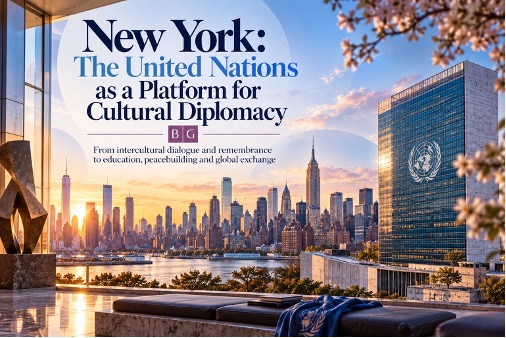
New York is more than the headquarters of the United Nations: it is one of the main places where the UN system turns international dialogue into direct encounters between cultures, communities and institutions. Around UN Headquarters, organisations and programmes such as the United Nations Alliance of Civilizations (UNAOC), UNICEF and the UN peacebuilding architecture bring together governments, civil society, artists, educators, young people and international organisations. In 2026, this role has been particularly visible through initiatives addressing intercultural dialogue, historical memory, education, peacebuilding and social inclusion. From exhibitions and artistic projects to high-level conferences and youth participation, these activities demonstrate how cultural exchange can complement traditional diplomacy and contribute to more peaceful and inclusive societies.
Dialogue Among Civilizations: Building Bridges Through International Exchange
On 10 June 2026, UN Headquarters in New York hosted the second annual International Day for Dialogue among Civilizations, bringing nearly 300 high-level representatives together under the theme “Exploring New Pathways for Dialogue Among Civilizations and Jointly Writing New Chapters for Global Governance.” The event was organised in cooperation with the United Nations Alliance of Civilizations (UNAOC) and UNESCO, alongside several UN Member States.
The initiative provides a particularly clear example of cultural diplomacy within the UN system. Rather than treating cultural differences as obstacles to international cooperation, the event placed dialogue between civilisations at the centre of global governance. Representatives from different geographical, cultural and political contexts were brought together to discuss how mutual understanding can support cooperation on global challenges.
The involvement of the UNAOC is especially significant. Based in New York, the Alliance works to improve understanding and cooperative relations across cultures and religions, while countering stereotypes and polarisation. Its participation in the June event connected diplomatic discussions with the broader objective of strengthening relationships between societies.
The event therefore illustrates how New York functions as a meeting point between political diplomacy and cultural exchange. By creating spaces in which different traditions and perspectives can be represented and discussed, the UN seeks to transform diversity into a resource for international cooperation rather than a source of division.
Intercultural Dialogue Against Hate Speech
A second major initiative took place on 17 September 2026, when UN Headquarters hosted the Global Conference on Promoting Interreligious and Intercultural Dialogue and Tolerance in Countering Hate Speech. Organised by the Kingdom of Morocco, the UN Office on Genocide Prevention and the Responsibility to Protect and UNAOC, the conference brought together representatives of UN entities, governments, religious communities, civil society and other stakeholders.
The conference connected cultural diplomacy with one of the most urgent challenges facing international societies: the spread of hate speech and growing social polarisation. Rather than addressing these problems exclusively through political or legal mechanisms, the initiative emphasised dialogue, tolerance and mutual understanding as tools for prevention.
Its structure also reflects a broader transformation in contemporary diplomacy. Religious leaders, media representatives, civil society organisations and international institutions participated alongside governments, creating a space for dialogue that extended beyond traditional state-to-state relations. This multi-stakeholder approach recognises that social cohesion cannot be achieved by governments alone.
For New York, the conference demonstrated the UN's capacity to act as a platform where different communities can meet and address tensions through conversation. Cultural diplomacy here operates not simply through the promotion of cultural heritage, but through the creation of relationships between people with different religious, cultural and social backgrounds. By encouraging dialogue before tensions escalate, such initiatives link cultural exchange directly to conflict prevention, peace and sustainable development.
Art and Historical Memory: Remembering Srebrenica
Culture also plays an important role in how the United Nations addresses historical trauma. In July and August 2026, the Visitors' Lobby at UN Headquarters hosted two exhibitions dedicated to the 1995 Srebrenica genocide: From Words to Violence: Lives Behind the Fields of Death and Legacy of Hope After the 1995 Genocide: A New Generation's Journey.
The exhibitions presented photographs, personal objects and testimonies from survivors and young people connected to Srebrenica. Rather than presenting the genocide only through political or historical documentation, the exhibitions placed individual experiences and personal stories at the centre. This approach gives visitors an opportunity to encounter history through human narratives and encourages reflection on the consequences of hatred, indifference and violence.
The programme also included the June discussion “Art Remembers: Culture as Witness and Prevention”, organised by the UN Department of Global Communications. Artists, historians and musicians explored how creative expression can contribute to memory, justice and the prevention of future atrocities. One of the participants was Bosnian-American artist Aida Šehović, whose ŠTO TE NEMA project uses thousands of Bosnian coffee cups as a nomadic memorial to the victims of Srebrenica.
These initiatives show how art can become a form of international dialogue. By bringing difficult histories into a diplomatic space, the UN creates opportunities for societies to listen to one another, preserve memory and develop a culture of peace.
Peacebuilding Week: Connecting Communities and International Cooperation
From 22 to 26 June 2026, New York hosted the first-ever UN Peacebuilding Week, established following the 2025 review of the UN Peacebuilding Architecture. The week marked the twentieth anniversary of the Peacebuilding Commission and the Peacebuilding Fund and brought together governments, civil society organisations, youth-led groups, international financial institutions and private-sector partners.
Under the theme “UN Peacebuilding @20 – Partnerships for Innovation, Inclusion and Impact,” the programme focused on sharing practical experiences and developing new partnerships for sustaining peace. Importantly, the initiative did not frame peacebuilding exclusively as a governmental or security issue. It emphasised locally led approaches and cooperation with actors from different sectors and communities.
This makes Peacebuilding Week relevant to cultural diplomacy because sustainable peace depends not only on political agreements but also on relationships between societies. The inclusion of youth organisations and civil society creates opportunities for different social groups to participate in discussions about their own communities and future.
The week also highlighted new forms of cooperation involving digital technology, the private sector and young people. In this sense, New York became a laboratory for connecting international diplomacy with grassroots perspectives and innovative forms of social engagement.
By opening the peacebuilding conversation to a wider range of participants, the UN demonstrates that international cooperation can be strengthened through dialogue across institutional, cultural and generational boundaries.
Education, Creativity and Global Exchange: UNICEF and the UN Tour Experience
Cultural diplomacy in New York also takes place through education and creative collaboration. In September 2026, the UNICEF Executive Board held a special session at UN Headquarters entitled “EdTech, Artificial Intelligence and the Learning Revolution: From Promise to Proof.” The discussion brought together education officials, international organisations, private-sector representatives and young advocates to examine how technology can transform learning.
The presence of a UNICEF Youth Advocate from Argentina and a UN Youth Advocate from Finland illustrated the importance of giving younger generations a direct role in international discussions. Education therefore becomes more than a development objective: it becomes a mechanism for connecting people across national and cultural boundaries.
The UN's own visitor programme offers another example. Guided tours of Headquarters are available in the six official UN languages and introduce visitors to the history of international diplomacy through the building's art, architecture and institutional spaces. The programme also includes specialised Art, Architecture, Black History and Focus on Women tours, extending the experience beyond traditional institutional explanations. UN tour guides themselves come from 13 countries and speak more than 15 languages.
In April 2026, the UN also launched a new phase of its sustainable tour-guide uniform initiative with the Swedish School of Textiles and London's Central Saint Martins. Students and researchers were invited to combine creativity, design and sustainability in a project connected to the UN visitor experience.
Together, these initiatives show how education, design, multilingualism and public engagement can make international cooperation accessible beyond diplomatic circles.
New York as a Platform for Cultural Diplomacy
The UN presence in New York demonstrates that cultural diplomacy can take many forms. It can be a high-level dialogue among civilisations, a conference addressing hate speech, an exhibition preserving historical memory, a peacebuilding forum or an educational and creative initiative.
What connects these activities is the creation of spaces where people from different backgrounds can encounter ideas, histories and perspectives beyond their own. In this sense, New York's UN ecosystem does not simply host international diplomacy: it provides a platform where culture, education and human exchange become instruments of cooperation and peace.
References:
- https://www.un.org/en/observances/international-day-for-dialogue-among-civilizations
- https://www.unaoc.org/2026/09/remarks-global-conference-countering-hate-speech/
- https://www.un.org/en/observances/srebrenica-genocide-commemoration-day
- https://www.un.org/peacebuilding/en/content/peacebuilding-week-2026
- https://www.un.org/sustainabledevelopment/blog/2026/04/press-release-sustainable-tour-guide-uniforms/
