
Israel’s Elections, Netanyahu’s Future and the Prospects for Peace
Dr. Yossi Beilin discusses the election results, Gadi Eisenkot’s prospects of forming a government, Arab political participation, Iran, Gaza and the Israeli–Palestinian peace process
October 28th, 2026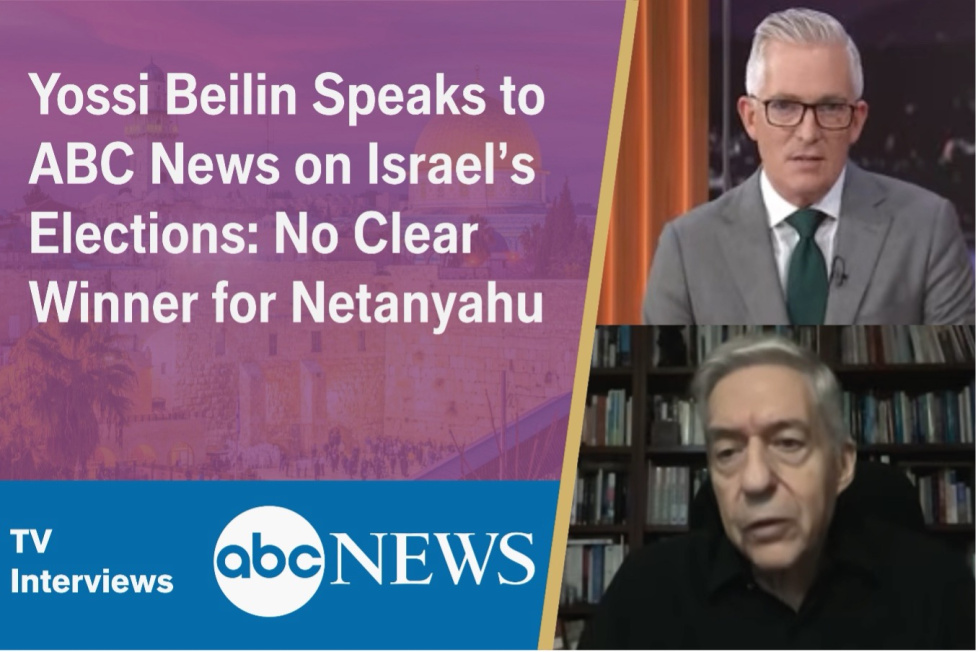
In an interview with David Speers on ABC News Australia, Dr. Yossi Beilin, former Israeli Minister of Justice and a leading figure in the Israeli–Palestinian peace process, discussed the emerging results of Israel’s parliamentary elections and their implications for the country’s political future. The interview addressed the prospects for forming a new government, the role of Arab political parties, relations with Iran and the future of Gaza and Israeli–Palestinian peace negotiations.
The following is an edited transcript of the interview, with the questions and answers lightly revised for clarity and readability while preserving the substance of the original exchange.
The Interview
David Speers: From what you are seeing in these early results, and given that both Benjamin Netanyahu and Gadi Eisenkot are claiming something of a mandate, who do you believe is most likely to form the next government?
Dr. Yossi Beilin: Netanyahu cannot form a government. I do not think he will even try. He may try, but he needs 61 seats, and he has approximately 54. He cannot obtain the additional support from the other bloc.
The person who can form a government, at least theoretically, but in my view also practically, is Eisenkot. The problem is that the leaders of his bloc have established certain conditions for the Arab parties to join them. Although the Arab parties are prepared to support Eisenkot, it will be very difficult to form a government until these conditions are addressed.
Nevertheless, I believe it is possible, and I hope it will happen. I do not think we have the luxury of allowing Netanyahu to remain in power. In my view, he has made enormous mistakes, and after so many years in power, he should not continue.
David Speers: We have seen a very strong showing for the Arab parties. What is the significance of this? Is it a reaction to 7 October and everything that followed? Could this turnout among Arab citizens of Israel represent a turning point in Israeli politics?
Dr. Yossi Beilin: It may be a turning point. When we speak about turning points, we usually need some historical distance before we can identify a particular moment as such. I do not want to be hasty, but I believe this is a very important moment.
Arab citizens have sometimes argued that there is no real difference between the Jewish right and left, that neither side supports them and that voting will not make a difference.
This time, they did not follow that reasoning. They came out to vote because they understood what had happened to them when Ben-Gvir and others held important positions in the government. They suffered as a consequence of those policies.
David Speers: So you see this as a reaction to those far-right members of the government?
Dr. Yossi Beilin: No doubt. They say so themselves, and I believe they are absolutely right.
David Speers: Returning to the difficulties Eisenkot might face in forming a coalition that includes Arab parties, Netanyahu has already argued that it would be impermissible for his opponents to rely on their support. What would be the political consequences for Eisenkot if he did so?
Dr. Yossi Beilin: I think including Arab parties in the coalition would also be an important educational step, especially when they are approaching you and offering their support.
It is quite unusual for political parties to come forward and say that they want to support you and ask what they need to do, only to be rejected because they are Arab.
Gadi Eisenkot is not a racist.
David Speers: But would Eisenkot be going back on his word? Would he be contradicting what he told voters before the election if he formed such an alliance?
Dr. Yossi Beilin: Actually, it is more his political partners who have taken that position.
Throughout the campaign, Eisenkot said that he would establish three or four conditions for anyone wishing to join his government, including the Arab parties. If they meet those conditions, they can participate.
In a way, this is more elegant than simply saying that you do not want someone because they are Arab.
David Speers: But he also suggested that they lacked shared values.
Dr. Yossi Beilin: I did not notice that particular statement, but I see no problem with Arab parties becoming part of the coalition, and I hope that will happen.
Replacing Netanyahu is not simply a matter of replacing one statesman with another who has different views on welfare or other domestic policies. The difference is day and night. Israel is paying a very high price for having Netanyahu as its leader.
David Speers: Netanyahu could remain caretaker Prime Minister for some time. Before the election, there was speculation that he had been pushing for a joint military strike with the United States against Iran, but that Donald Trump had refused. Do you think such an operation could still take place?
Dr. Yossi Beilin: I hope not. I do not know. We will see.
David Speers: Turning to Gaza, where a tenuous ceasefire remains in place, you have been a strong supporter of the two-state solution for many years. But support for that idea has declined significantly since the Hamas attacks of 7 October. What do you think the future holds for Gaza?
Dr. Yossi Beilin: There is no connection between 7 October and the two-state solution.
David Speers: But the decline in public support for the two-state solution is clear, isn't it?
Dr. Yossi Beilin: Yes, that is true. It is partly because of the cruelty of Hamas on 7 October and partly because of Netanyahu's tendency to suggest that all Arabs are the same.
From his political perspective, this is an effective argument. It is not a particularly sophisticated intellectual explanation, but it is very catchy. People begin to believe that all Arabs are bad and ask how peace with them could be possible.
But I believe it will not be difficult to make peace with the Palestinians because we know, more or less, what the solution is.
I hope this can also be achieved through the proposal developed by a group of Israelis and Palestinians for an Israeli–Palestinian confederation. Such a confederation would not require Palestinians to leave their homes or Israeli settlers to leave theirs.
David Speers: But when both Netanyahu and Eisenkot say they do not support a two-state solution, surely we remain a long way from achieving it?
Dr. Yossi Beilin: Yes, but the point is that we support President Trump's twenty-point plan, which was issued towards the end of last year.
It refers to Gaza and also to the diplomatic process with the Palestinians.
David Speers: On the reconstruction of Gaza, is there any indication that reconstruction is actually taking place?
Dr. Yossi Beilin: Please let me finish my sentence.
Point 19 of the plan refers to a pathway towards a Palestinian state. This is very clear, and Gadi Eisenkot supports the plan.
If he comes to power, I believe one of his major priorities, as he himself has indicated, will be the implementation of the twenty points, including the arrangements for Gaza and the broader diplomatic process.
Netanyahu agreed to this framework but never implemented it. This is one of the differences between the two political camps.
David Speers: Former Justice Minister Yossi Beilin, we appreciate your analysis of these unfolding election results. Thank you very much for joining us.
Dr. Yossi Beilin: Thank you for having me.
