
Hendaye, October 23, 1940: The Meeting That Changed Nothing and Everything for Gibraltar, North Africa and the Mediterranean
When Military Power Met the Limits of Diplomacy: The Lessons of Hendaye for Contemporary Diplomacy
October 25th, 2026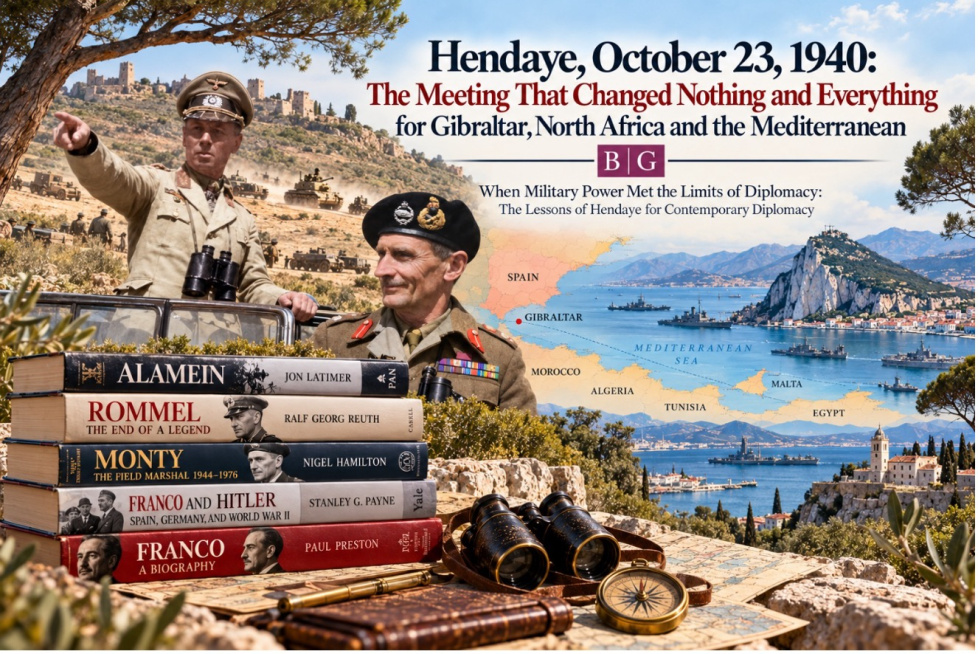
Eighty-six years ago, on 23 October 1940, the leader of Nazi Germany, Adolf Hitler, and the leader of Spain's Francoist dictatorship, Francisco Franco, met at Hendaye railway station on the French–Spanish border for negotiations that could have altered the course of the Second World War. Germany had conquered much of continental Europe, yet Hitler failed to secure the full military cooperation of a dictator whose victory in the Spanish Civil War had been supported by Nazi Germany.
The encounter raises a question extending far beyond 1940: how can overwhelming military power fail where effective diplomacy might succeed? The answer lies in the relationship between national interests, diplomatic preparation, competing ambitions and the ability of political leaders to transform strategic opportunities into workable agreements.
Hitler's Mediterranean Ambitions and Spain's Strategic Importance
By October 1940, Germany had defeated France, but Britain remained at war. Unable to force British surrender, Hitler considered alternative strategies for weakening Britain's military and imperial position.
The Mediterranean offered significant opportunities. Gibraltar guarded its western entrance, while Malta, Egypt and the Suez Canal supported British naval operations and communications with the Middle East and Asia.
Spain occupied a potentially decisive geographical position. Its ports, airfields, armed forces and territories bordering Gibraltar and North Africa could have strengthened Axis operations considerably. Spanish participation might have enabled closer military coordination, increased pressure on British shipping and provided additional resources for the North African campaign.
Hitler's immediate objective was to secure cooperation for Operation Felix, a planned German assault on Gibraltar through Spanish territory. Yet Spain's potential value extended far beyond the fortress itself. A German–Italian–Spanish partnership might have transformed the strategic balance across the western Mediterranean.
Achieving that partnership, however, required something Germany's armies could not automatically deliver: Franco's agreement.
Hendaye: When Two Dictators Could Not Agree
Franco entered the negotiations with substantial demands. Spain had emerged from its Civil War economically devastated, suffering food shortages, fuel scarcity and damaged infrastructure. Participation in another major conflict threatened severe economic consequences and British retaliation.
Franco therefore demanded extensive economic and military assistance alongside territorial concessions, particularly French Morocco and parts of French Algeria.
Hitler wanted Spain to join the Axis war effort but was unwilling to guarantee Franco's requested rewards. A secret understanding envisaged possible Spanish participation, yet no binding timetable or satisfactory settlement of the principal disagreements emerged.
The later portrayal of Franco as a leader who courageously resisted Hitler and deliberately saved Spain from war was largely a construction of Francoist propaganda. Historian Paul Preston demonstrates that Franco was interested in joining the war under sufficiently favourable conditions and was disappointed by the outcome.
The negotiations failed not because the two dictators lacked ideological affinities, but because their strategic and territorial interests could not be reconciled.
Three Partners, Competing Ambitions
Perhaps the most revealing diplomatic problem was that Hitler was negotiating with Franco while simultaneously managing the interests of Mussolini's Italy and Marshal Pétain's Vichy France.
Italy pursued its own Mediterranean and North African ambitions, including territorial claims at French expense. Vichy France sought to preserve its colonial possessions, despite France's military defeat. Franco wanted French Morocco and additional territories in North Africa.
These competing ambitions complicated any potential agreement. Concessions to Spain threatened Germany's relationship with Vichy France, while territorial arrangements also had to account for Italian interests.
Hitler wanted the cooperation of all three governments without paying the political price of satisfying each one's demands.
The problem illustrates a fundamental weakness of international alliances: ideological sympathy cannot eliminate conflicting national interests. Germany's military dominance did not provide a diplomatic formula capable of reconciling the competing ambitions of its partners.
Indeed, Hitler's October 1940 diplomatic journey included meetings with Vichy French leaders Pierre Laval and Philippe Pétain. He was assessing alternative forms of cooperation rather than simply pursuing Spain at any cost.
Hendaye therefore represented more than a disagreement between two dictators. It exposed the difficulty of constructing a coherent Mediterranean strategy among governments with incompatible territorial expectations.
Could Better Diplomatic Preparation Have Changed History?
One of Hendaye's most important lessons concerns the preparation of high-level negotiations.
Germany maintained an experienced diplomatic mission in Madrid under Ambassador Eberhard von Stohrer. His correspondence from August 1940 demonstrated that Berlin already knew about Spain's economic vulnerabilities, territorial demands and conditions for entering the war.
The German leadership was therefore not negotiating without information. The more revealing question is why such a consequential summit proceeded without a mutually acceptable framework.
Could additional economic assistance, stronger guarantees or phased military commitments have changed Franco's calculations? Could more extensive negotiations with Rome and Vichy have identified territorial compromises before Hitler met Franco?
Alternatively, might political pressure have made Spanish participation more likely?
These possibilities deserve historical examination, but none guarantees a different outcome. Germany had limited resources with which to support Spain, while threats against Franco could have provoked resistance or required costly military intervention. Moreover, there is little evidence that Hitler actually threatened Franco with removal at Hendaye.
The lesson concerns the relationship between diplomatic preparation and political leadership. Ambassadors, foreign ministries and experienced negotiators must identify obstacles, assess competing interests and explore realistic compromises before leaders attempt to conclude major agreements.
A summit should be the culmination of serious diplomatic preparation, not a substitute for it.
The Consequences for Gibraltar and North Africa
German–Spanish negotiations continued after Hendaye, and Germany developed detailed military plans for Operation Felix. Nevertheless, Franco never provided the cooperation necessary to implement the operation.
Gibraltar remained British, preserving an important naval and military position at the western entrance to the Mediterranean.
Its strategic value became particularly evident in November 1942, when Gibraltar served as an important Allied command and operational base during Operation Torch, the invasion of French North Africa. General Dwight D. Eisenhower used Gibraltar as an advance command post during the operation.
Had Spain entered the war, Germany might have gained access to additional ports, airfields, military formations and positions in North Africa. Spanish forces could potentially have supported Axis operations or released German and Italian formations for other fronts.
Yet Spain's economic weakness, limited mechanisation and logistical difficulties would have constrained its military contribution. Even capturing Gibraltar would not automatically have secured Axis victory in North Africa or opened an easy advance towards Egypt, Palestine and the wider Middle East.
The eventual Axis defeat also reflected Allied military resources, British naval power, Malta, supply shortages and battlefield developments.
Nevertheless, the failure to secure Spanish cooperation represented an important unrealised strategic opportunity. Hendaye did not determine the Mediterranean war, but it formed part of the diplomatic failure that limited Germany's options.
When Military Power Meets the Limits of Diplomacy
Hendaye illustrates the difference between possessing military strength and achieving diplomatic influence.
Hitler could defeat armies and occupy countries, yet he could not automatically persuade Franco to accept an agreement that threatened Spain's economic security and failed to satisfy its territorial ambitions.
Effective diplomacy requires understanding the interests of negotiating partners, anticipating the consequences for third parties, offering credible commitments and recognising the limits of coercion.
The distinction between effectiveness and legitimacy is essential. Hitler sought diplomatic cooperation to facilitate further military conquest. Examining how his negotiations failed does not imply that achieving those objectives would have been desirable.
The broader lesson is that diplomatic failures can influence military outcomes as profoundly as decisions made on the battlefield.
From Hendaye to Contemporary Conflicts: Why Failed Diplomacy Must Be Studied
The lessons of Hendaye remain relevant to contemporary efforts to prevent and end armed conflicts. President Donald Trump has repeatedly argued that the war in Ukraine should never have happened. Beyond the political debate surrounding that assertion lies a historical question deserving rigorous investigation: why did diplomatic efforts fail to prevent the escalation of the crisis beginning in 2013–2014 into Russia's full-scale invasion in February 2022?
Historians and international relations scholars should reconstruct the negotiations, agreements, warnings and political decisions preceding the invasion. The events surrounding Ukraine's European integration, Russia's annexation of Crimea, the Minsk agreements, the Normandy Format and subsequent diplomatic initiatives all warrant examination.
Were opportunities for compromise missed? Were security guarantees credible? Did political leaders misunderstand one another's objectives, underestimate the risks of escalation or fail to implement existing agreements?
Such questions must be investigated without excusing military aggression or assuming that every war could necessarily have been prevented. Responsibility for initiating an invasion remains distinct from the historical examination of unsuccessful diplomacy.
The same analytical approach applies to conflicts in the Middle East and elsewhere. Sustainable agreements require careful preparation, realistic expectations, credible security arrangements and respect for international law. They also depend on whether the parties genuinely intend to honour their commitments.
If military historians devote generations to understanding why battles were won or lost, historians of diplomacy should devote equal attention to understanding why negotiations succeeded or failed.
Studying diplomatic failures is not merely an exercise in interpreting the past. It is an essential contribution to preventing future conflicts.
Conclusion: Diplomacy as a Force That Shapes History
Hendaye did not produce the military alliance Hitler sought, but its unresolved disagreements contributed to developments affecting Gibraltar, North Africa and the Mediterranean.
The meeting demonstrated that military superiority cannot replace diplomatic preparation, credible commitments or an understanding of competing national interests.
For contemporary leaders, the lesson is that negotiations deserve the same seriousness, expertise and strategic foresight devoted to military operations.
The greatest lesson of Hendaye is not simply that diplomacy can fail, but that its success or failure can influence the fate of nations, the course of wars and the future of entire regions.
Understanding why diplomacy fails is therefore indispensable to understanding how future wars might be prevented and lasting peace achieved.
