
Geneva: Where Culture Becomes a Language of Diplomacy
From human rights and hip-hop to universities and contemporary art, Geneva turns cultural exchange into international dialogue
October 16th, 2026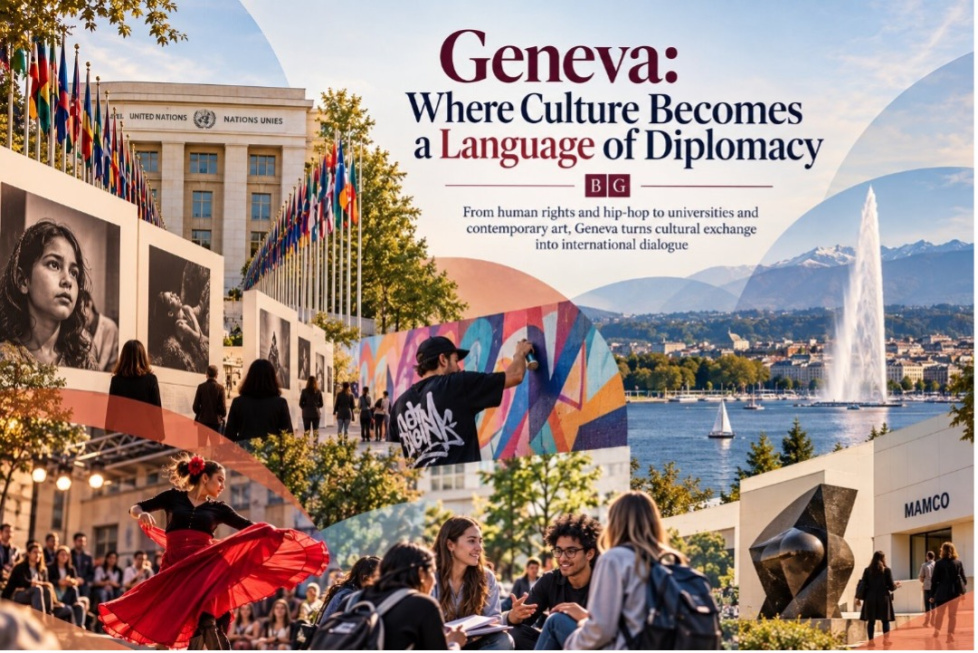
In Geneva, diplomacy does not happen only around negotiating tables. Across the city, exhibitions, music, theatre, universities and contemporary art are creating opportunities for people from different countries and backgrounds to meet, exchange ideas and build relationships. From a German-led human rights exhibition at the Palais des Nations to a Swiss-Jordanian hip-hop exchange, an international university programme and collaborations between Geneva and Lebanese artists, these initiatives show how culture can become a practical tool for connecting societies.
Art and Human Rights Meet at the Palais des Nations
On 7 September, the Palais des Nations became a meeting point between diplomacy, human rights and visual art with the opening of the “Pictures for Human Rights” exhibition, presented by the Permanent Mission of Germany and a partner NGO.
The initiative uses images to make principles of the Universal Declaration of Human Rights more immediate. Rather than approaching rights exclusively through diplomatic language, legal texts or political statements, the exhibition invites audiences to encounter ideas such as dignity, equality and freedom through visual expression.
UN Geneva Director-General Tatiana Valovaya highlighted the ability of art to challenge indifference, create empathy and encourage action. This gives the exhibition a role that goes beyond displaying artworks: it creates another way of communicating around universal values.
Germany’s involvement is also significant from a cultural-diplomacy perspective. By bringing an artistic project into one of the world’s major multilateral diplomatic spaces, its Permanent Mission is using culture to engage an international audience.
The setting itself reinforces the message. The Palais des Nations is usually associated with negotiations, conferences and international decision-making. Introducing art into that environment changes the way visitors encounter human rights, transforming abstract principles into something that can be seen, interpreted and emotionally experienced.
In this sense, the exhibition demonstrates how cultural diplomacy can complement traditional diplomacy. Art does not replace political or legal action, but it can create empathy and open conversations that formal diplomatic language may struggle to reach.
From Geneva to Amman: Hip-Hop as Cultural Diplomacy
Geneva’s cultural diplomacy also took a very different form in September, when Swiss and Jordanian artists came together through Cross Rhymez, the first Swiss-Jordanian hip-hop cultural exchange.
Running from 3 to 15 September, the programme brought together artists, educators and communities through rap, DJing, beatmaking, dance, graffiti and beatboxing. Its focus was not simply on presenting one country’s culture to another, but on creating something collaboratively.
Workshops allowed Jordanian artists to share their skills with young people in Geneva, while artists from both countries worked together during a creative residency. The programme culminated in performances presenting the results of that exchange.
A particularly visible example was a mural created at Porteous by Jordanian graffiti artist Suhaib Attar and Geneva-based artist Wost. Their collaboration combined different artistic approaches and turned cultural exchange into something physically visible in the city.
The choice of hip-hop is important. Unlike more traditional cultural diplomacy, which can rely on established institutions and formal cultural presentations, hip-hop connects directly with contemporary youth and urban communities. It offers artists a shared creative language even when their national and cultural backgrounds are different.
Cross Rhymez also has a reciprocal structure. Following the Geneva edition, a corresponding programme is planned for Amman in 2027. Cultural diplomacy therefore becomes a two-way relationship: artists are not simply presenting their culture abroad, but exchanging knowledge, skills and creative practices.
When Theatre Opens the City to Cultural Exchange
Geneva’s Fête du Théâtre offers another, more public form of cultural diplomacy. Opening on 4 October, the festival brought theatre, street arts, circus, magic and comedy into the city, alongside workshops, concerts, culinary experiences and other activities.
The festival’s programme also draws on different linguistic and cultural traditions, including Italian, Spanish and Mediterranean influences. Theatre is therefore presented not simply as entertainment but as a way for audiences to encounter different forms of storytelling, humour, performance and artistic expression.
That matters in a city as international as Geneva. Cultural diversity is part of everyday life, but festivals can transform that diversity into an active experience. Audiences do not simply live alongside different communities; they are invited to encounter their cultural expressions.
The decision to bring performances beyond conventional theatre buildings is particularly relevant. Cultural diplomacy does not necessarily require an embassy, international organisation or official cultural institute. Public spaces can become places where people meet across cultural and linguistic boundaries.
The Fête du Théâtre demonstrates this more local dimension of cultural diplomacy. Rather than representing countries through formal showcases, it creates opportunities for audiences to encounter different cultural traditions through participation and shared experiences.
Diplomacy Starts in the Classroom
Another important part of Geneva’s international cultural life took place at the University of Geneva during International Week, held from 28 September to 1 October.
Organised around international academic exchange, the programme connected students with partner universities and with peers who had already experienced studying abroad. Alongside practical information about exchange opportunities, participants explored different academic and cultural environments.
One of the programme’s most interesting elements was its regional “speed exchange” sessions, covering Europe; Africa, Latin America and the Middle East; North America and Australia; and Asia. Incoming students from partner universities also shared their experiences directly with students considering international mobility.
Academic exchange is often discussed in terms of education and career development, but it also has a strong cultural dimension. Students who study abroad encounter different languages, educational systems, social habits and perspectives. They build personal relationships that can continue across borders long after their academic exchange ends.
Geneva itself becomes part of this process. The university is not only sending students abroad; it is also bringing international students into the city. Internationalisation therefore operates in both directions, allowing Geneva to become a meeting point between different academic and cultural communities.
This makes universities important spaces for cultural diplomacy. Students can become informal bridges between societies, carrying knowledge and personal experiences across borders. In that sense, diplomacy can begin in the classroom long before people enter professional diplomatic life.
Geneva’s Art Scene Looks Beyond Its Borders
Contemporary art provided another international meeting point during Geneva Art Week from 16 to 20 September. The programme brought together exhibitions, artist talks, studio visits and cultural encounters across the city, connecting artists, galleries, museums and audiences.
One particularly strong example of this international dimension was the collaboration between MAMCO and the Saint-Antoine Archaeological Site with Lebanese artists and filmmakers Joana Hadjithomas and Khalil Joreige.
Born in Beirut, Hadjithomas and Joreige work across film, photography and contemporary art, often exploring archaeology, memory, images and the relationship between past and present. Their work in Geneva created a conversation between the city’s own archaeological heritage and contemporary artistic perspectives from Lebanon.
The collaboration also brought together different ways of thinking about history. A site connected to Geneva’s archaeological past became a setting for contemporary artistic work, while discussions between the artists and Geneva’s cultural institutions explored the relationship between archaeological excavation and artistic creation.
This is where contemporary art can become cultural diplomacy. International artistic exchange is not simply about bringing a foreign artist into a gallery. It creates opportunities to discuss questions that cross borders: memory, identity, displacement, history and belonging.
Geneva Art Week also illustrates a decentralised model of cultural diplomacy. Instead of relying on a single national presentation, it creates a network of artists, curators, museums, galleries and audiences. The city itself becomes the platform for international cultural exchange.
Across these five initiatives, Geneva reveals several different faces of cultural diplomacy. Art can bring human rights closer to audiences; hip-hop can connect young people across continents; theatre can make cultural diversity part of public life; universities can turn academic mobility into lasting personal relationships; and contemporary art can create conversations between different histories and societies. Together, they show that diplomacy does not always need to begin with negotiations. Sometimes it begins with an image, a performance, a classroom, a mural or a conversation between artists.
References:
- https://www.ungeneva.org/en/director-general/tatiana-valovaya/activities/2026/09/director-generals-remarks-exhibition-pictures
- https://crossrhymez.com/
- https://www.geneve.com/en/events/the-theater-festival
- https://www.unige.ch/exchange/mobilite/mobilite-out/etudiants/sinformer/ou-se-renseigner/semaine-internationale-28-septembre-au-1-octobre-2026
- https://genevaartweek.com/
