
From the “Sun of Nations” to the Algorithm: The Secret Language of Leadership
Why Ancient Symbols Survive in the Modern Age - The Ancient Language of Modern Leadership
September 06th, 2026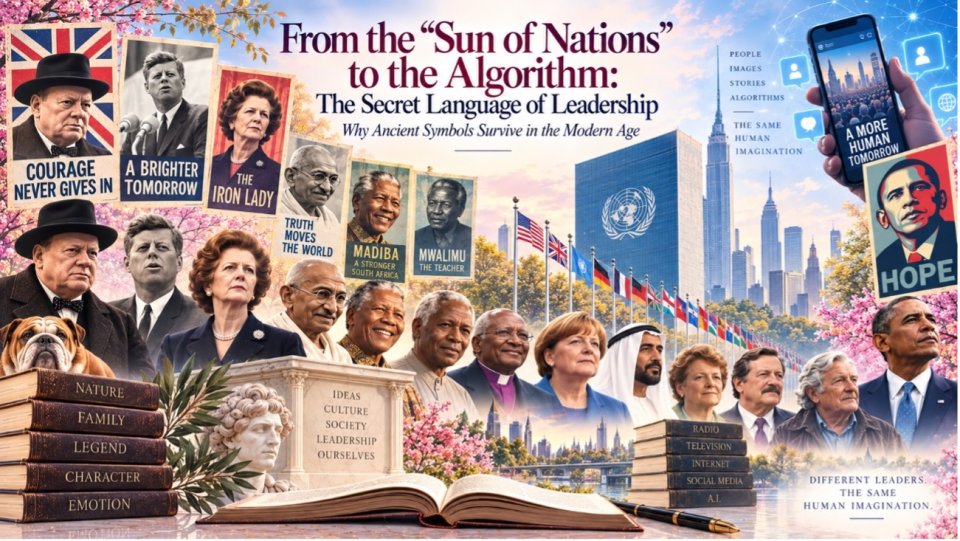
Ninety years ago, Soviet political culture increasingly presented Joseph Stalin through one of humanity’s oldest metaphors: the “Sun of Nations”. Poetry, posters and propaganda associated political leadership with light, warmth and life itself.
The imagery belonged to Stalin’s dictatorship. The human instinct behind it did not. Long before Stalin, rulers had been understood through nature, animals, religion, family and legend. In the ninety years since, the same instinct has continued across democracies and very different cultures.
Churchill became the Bulldog. Kennedy’s presidency became Camelot. Thatcher became the Iron Lady. Gandhi was Mahatma, the Great Soul. Nyerere became Mwalimu, the Teacher. Mandela was Madiba. Merkel became Mutti. Obama became inseparable from Hope.
Today, describing a political leader as a bulldog might sound unflattering or even insulting. In Churchill’s time, however, the image carried a very different meaning. The British Bulldog was already a familiar national symbol of courage, tenacity and determination. During the Second World War, Churchill’s association with the Bulldog came to represent Britain’s resilience and refusal to surrender. The image therefore tells us less about Churchill’s appearance than about the qualities wartime Britain wished to recognise in its leader and in itself.
These are not all the same kind of expression. Some are nicknames, others metaphors, inherited names, campaign images or cultural memories. But together they reveal something remarkable:
Modern leadership is still interpreted through an ancient cultural vocabulary of nature, family, legend, character and emotion.
From Leaders to Symbols
The examples form an extraordinary cultural dictionary. Churchill’s Bulldog drew upon an animal associated with British determination. Charles de Gaulle became simply the General, linking the man with resistance, authority and France itself. Kennedy’s Camelot, shaped largely by Jacqueline Kennedy after his assassination, transformed a modern presidency into Arthurian legend.
Thatcher’s Iron Lady began with her Soviet critics, but she embraced it. Reagan’s Morning in America turned political renewal into an ancient cycle: darkness followed by dawn.
Across Africa and Asia, different traditions produced different languages. Gandhi’s Mahatma means Great Soul. Tanzania’s Julius Nyerere was Mwalimu, Teacher. Madiba was Mandela’s clan name, a traditional form of respectful address that became known around the world. Desmond Tutu became affectionately the Arch.
Family provided another universal language. Robert Schuman became a Father of Europe. Sheikh Zayed bin Sultan Al Nahyan is remembered as the Father of the Nation in the UAE. Norway’s Gro Harlem Brundtland became Landsmoderen, Mother of the Nation. Angela Merkel became the more informal Mutti, Mum, a nickname that moved between affection, irony and criticism, yet unmistakably placed political authority within the language of family.
Other images brought leaders closer to ordinary life. Lech Wałęsa remained inseparable from the electrician who emerged from the Gdańsk shipyard. Uruguay’s José “Pepe” Mujica became internationally associated with simplicity, symbolised by his modest lifestyle even as president.
Dag Hammarskjöld represented something different. He helped turn the idea of the international civil servant into a model of leadership based upon independence, integrity and service.
Then came Obama and perhaps the simplest image of all: HOPE.
The Leader Is Also a Mirror
Here lies the second idea: the symbol often tells us as much about society as about the leader.
The Bulldog tells us what wartime Britain wanted to recognise in itself. Camelot tells us how America chose to remember Kennedy. Mwalimu expresses respect for the teacher. Madiba carries ancestry and respect. Mutti placed authority inside the vocabulary of family. Hope captured what millions wanted a political moment to mean.
We think we are describing the leader, but we are also describing ourselves.
The third idea is equally striking: leaders often do not create the symbols by which they are remembered.
Thatcher did not invent the Iron Lady. Kennedy did not create Camelot. Obama did not design Shepard Fairey’s Hope portrait. Symbols can come from opponents, families, journalists, artists or the public.
Political identity is created somewhere between the leader and society.
Sometimes it grows larger than the individual. This is the fourth idea: a political symbol can become shared memory, identity and even community.
Schuman became part of Europe’s founding story. Mandela’s Madiba travelled far beyond its original cultural setting. The person becomes associated with an idea, and the idea can survive the person.
From the Sun to the Algorithm
The fifth idea concerns technology. Stalin’s sun travelled through poetry, newspapers and posters. Churchill through radio, photography and newsreels. Kennedy through television. Reagan through advertising. Obama’s Hope moved through graphic art and the internet.... as well as Twitter.
Today, political imagery can circle the world within hours through smartphones, memes, short videos and algorithms.
The technology changes. The human need for metaphor does not.
The medium travelled from the printed poem to the smartphone screen. The human instinct for metaphor travelled with it.
Our political institutions have become extraordinarily sophisticated. We have constitutions, parliaments, elections, international organisations, artificial intelligence and global communications.
Yet when we try to understand leadership, we still reach for the sun and the animal, the legend and the material, the father and the mother, the teacher and the ancestor, the worker, the soul and the emotion.
Political technology became modern. The human imagination remained surprisingly ancient.
We began by asking how societies describe their leaders.
We end with a different discovery:
When societies describe their leaders, they are also describing themselves.
