
Europe in Four Voices: Culture and Diplomacy Across Berlin, London, Geneva and Vienna
How European embassies turn culture into a language of dialogue
September 29th, 2026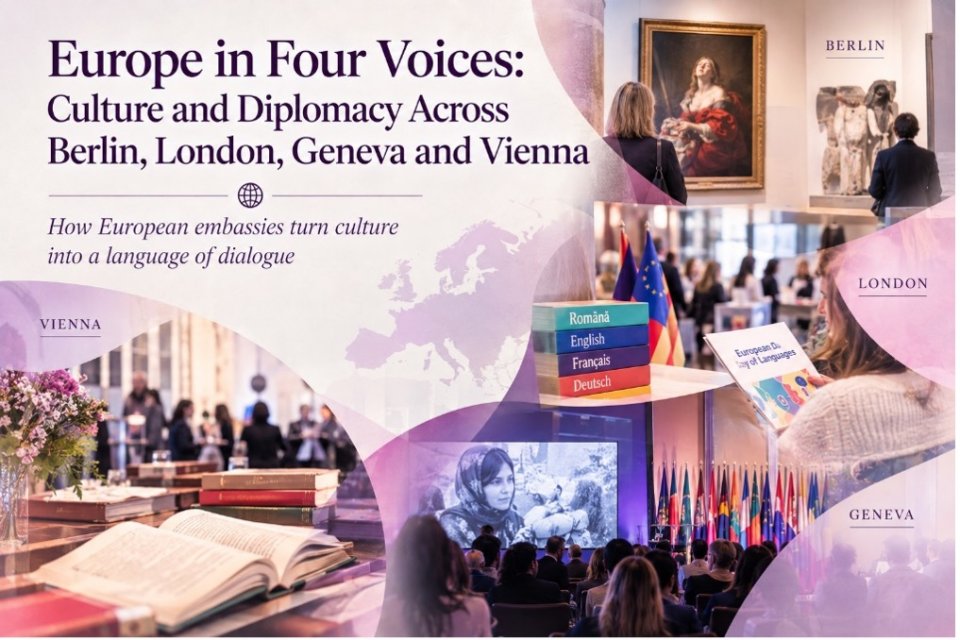
Across Europe, diplomatic missions are finding new ways to engage with audiences beyond traditional political dialogue. Art exhibitions, language celebrations, documentary film and literature are becoming spaces where countries can present their cultural identities while opening conversations about wider European and international issues.
Recent initiatives in Berlin, London, Geneva and Vienna illustrate this diverse approach to cultural diplomacy. In Berlin, the Embassy of Italy transformed its diplomatic premises into an exhibition space during Berlin Art Week, bringing together a Baroque masterpiece by Caravaggio and contemporary art. In London, Romania participated in the European Day of Languages, placing its language and culture within a broader celebration of Europe’s linguistic diversity. In Geneva, Ireland supported an event centred on Afghan women, peacebuilding and accountability, where documentary film provided a platform for voices connected to the conflict. In Vienna, Poland used collective reading to connect literature, national memory and the Polish community abroad.
Although these initiatives differ in subject and format, they share a common element: culture is used as a means of creating encounters. Rather than simply presenting national traditions, diplomatic missions are creating opportunities for audiences to engage with questions of identity, memory, language, creativity and social participation.
Together, these four examples show how cultural diplomacy can operate across very different settings — from galleries and literary gardens to international institutions and educational spaces — while building connections between countries and communities.
BERLIN — When an Embassy Becomes an Art Space
The Embassy of Italy in Berlin recently stepped into the centre of the German capital’s contemporary art scene by participating in the official programme of the Berlin Art Week for the first time. Its exhibition, Caravaggio × Berlinde De Bruyckere, opened on 7 September 2026 in the Embassy’s own premises, transforming a diplomatic building into a temporary cultural space.
At the heart of the project was a dialogue between two artists separated by more than four centuries. Caravaggio’s Mary Magdalene in Ecstasy, painted around 1606, was presented alongside a new work commissioned from Belgian contemporary artist Berlinde De Bruyckere. Her artistic practice explores the body, vulnerability, transformation and religious imagery, creating an unexpected connection with the Baroque masterpiece.
Rather than presenting Italian heritage as something fixed in the past, the exhibition placed it in conversation with contemporary European creativity. Themes such as ecstasy, suffering, desire and the transformation of the body became a common language between two very different artistic periods.
The Embassy also connected the exhibition with other Berlin Art Week initiatives, including events linked to Maurizio Cattelan’s NIGHT at the Neue Nationalgalerie and Giulia Andreani’s Sabotage at the Hamburger Bahnhof. According to the Italian Foreign Ministry, the initiative forms part of a broader effort to develop the Embassy into a cultural hub and strengthen dialogue between the Italian and German art worlds.
In this setting, the Embassy becomes more than a representation of the Italian state: it becomes a meeting point where artistic heritage can encounter contemporary Europe.
LONDON — When Languages Bring Europe Together
On 24 September, London became a meeting point for Europe’s linguistic and cultural diversity during the European Day of Languages 2026, held at Sinfonia Smith Square. Organised by the EU Delegation to the United Kingdom and the European Parliament Liaison Office, in collaboration with the national cultural institutes of EU Member States through EUNIC London, the event brought together schools, university students, educators and members of the public.
Among the participating representations was Romania. The Romanian Cultural Institute in London, working closely with the Embassy of Romania in the United Kingdom and its Romanian Language Office, hosted a dedicated stand presenting Romanian language and culture. Visitors could discover information about Romania, educational resources and materials designed to encourage interest in the language.
The event was designed to make multilingualism something to experience rather than simply discuss. Participants could move between stands hosted by European embassies, cultural institutes and diaspora schools, discovering different languages, traditions and cultural practices. An interactive “European Day of Languages Passport” encouraged visitors to explore this diversity across the different stands.
The initiative also reflected London’s particularly international character. According to the Romanian Cultural Institute, more than 300 languages are spoken across the city, making it a fitting setting for an event centred on multilingualism and intercultural exchange. Language skills were presented not only as educational tools but also as instruments for communication, cooperation and participation in increasingly interconnected societies.
Romania’s participation therefore placed its own linguistic and cultural heritage within a wider European framework. Rather than presenting culture as a national boundary, the event used languages as points of connection — showing how cultural diplomacy can begin with something as fundamental as the way people communicate.
GENEVA — When Film Gives Women a Voice
In Geneva, Ireland supported an initiative that used film and public discussion to bring women’s experiences into an international diplomatic setting. On 4 September 2026, the Permanent Mission of Ireland to the United Nations in Geneva partnered with Women for Afghanistan and the City of Geneva for the event Women’s Voices for Peace and Justice: Advancing Accountability for Afghanistan, held at the Geneva Graduate Institute.
The programme brought together Afghan women, activists, civil society representatives and members of Geneva’s diplomatic community. A central cultural element was the screening of an excerpt from the documentary The Sharp Edge of Peace. The film follows four Afghan women involved in the Doha peace negotiations and explores their experiences and participation in a process traditionally dominated by political actors.
The screening was followed by a panel discussion focusing on women’s leadership, their aspirations and their contribution to dialogue and peacebuilding. By combining documentary cinema with direct conversation, the event allowed personal experiences to become part of a broader international exchange.
Ireland’s involvement illustrates how diplomatic missions can support cultural formats that create connections between individual stories and international discussions. In Geneva, film became more than a means of documenting events: it provided a space for voices from Afghanistan to reach diplomats, civil society and an international audience, demonstrating how cinema can contribute to dialogue across national and cultural boundaries.
VIENNA — Keeping Literature Alive Across Borders
In Vienna, cultural diplomacy returned to one of the oldest forms of cultural exchange: literature. On 12 September, the Embassy of the Republic of Poland in Austria hosted the ninth Vienna edition of Narodowe Czytanie, Poland’s annual collective reading initiative. Held in the Embassy gardens in cooperation with the Polish-Austrian magazine Polonika, this year’s event was dedicated to Adam Mickiewicz’s Dziady (Forefathers’ Eve).
The gathering brought together members of the Polish community in Austria, students from the Polish School at the Embassy and invited guests. Rather than treating literature simply as a cultural performance, the event presented collective reading as an opportunity for conversation and reflection on memory, freedom, responsibility and intergenerational relationships.
Consul Robert Filipczak, who opened the event, emphasised the role of Narodowe Czytanie in promoting Polish literature while strengthening community and maintaining Polish identity abroad. The literary programme featured actors Krzysztof Zawadzki and Małgorzata Zawadzka, associated with the National Old Theatre in Kraków, whose interpretations of excerpts from Mickiewicz’s work formed the central part of the gathering.
The initiative also involved the Polish educational community in Vienna. Hanna Kaczmarczyk, director of the Polish School at the Embassy, together with Polonika editor Halina Iwanowska and University of Vienna professor Jolanta Doschek, introduced the literary work and provided context for the readings.
For a diplomatic mission, literature offers a particularly powerful way to maintain cultural connections abroad. A nineteenth-century Polish text was brought into a contemporary Austrian setting, creating a space where language, history and identity could be shared by different generations. In Vienna, the Embassy became not only a place of representation, but also a setting in which cultural memory could be read, heard and passed on.
Four Cities, Many Languages of Diplomacy
From Berlin to London, Geneva and Vienna, these four initiatives reveal how European diplomacy can take shape through very different forms of cultural engagement.
In Berlin, an Embassy became an art space where Italian heritage entered into dialogue with contemporary European creativity. In London, language became a tool for celebrating the continent’s diversity. In Geneva, documentary film and personal testimony helped bring Afghan women’s experiences into an international discussion on peace and accountability. In Vienna, literature connected a Polish community abroad with its cultural heritage and with generations of readers.
What emerges from these examples is a broader understanding of cultural diplomacy. It is not limited to promoting national traditions or showcasing artistic achievements. It can also create spaces for dialogue around identity, memory, inclusion, language and international challenges. Culture can provide an accessible entry point into conversations that might otherwise remain confined to diplomatic or institutional circles.
The four cities also demonstrate the flexibility of diplomatic spaces. An embassy can become a gallery, a cultural institute can become a meeting point for languages, an international mission can support storytelling and dialogue, and an embassy garden can become a literary gathering place.
In this way, culture does more than represent Europe’s diversity: it creates opportunities to experience it. Across four diplomatic capitals, these initiatives show how cultural exchange can become a practical language of connection — one capable of linking institutions, communities and individuals across borders.
References:
- https://ambberlino.esteri.it/it/news/dall_ambasciata/2026/09/lambasciata-per-la-prima-volta-nel-programma-ufficiale-della-berlin-art-week-con-caravaggio-x-berlinde-de-bruyckere-07-09-2026/
- https://www.icr.ro/londra/ziua-europeana-a-limbilor-2026-sarbatorita-la-londra-pe-24-septembrie/en
- https://www.gov.pl/web/austria/narodowe-czytanie-2026-w-ambasadzie-rp-w-wiedniu
