
Corporate Culture in Germany: When Business Meets Art and Ideas
German companies engage in contemporary art, music and cultural heritage
October 01st, 2026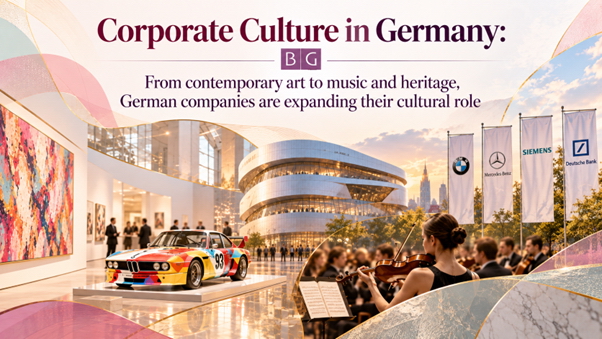
Germany's corporate landscape is closely connected to culture, design and technological innovation. The country's cultural and creative economy includes around 238,000 companies and self-employed professionals, employing approximately two million people and generating €204.6 billion in turnover in 2023.
Large German corporations have historically developed substantial cultural programmes alongside their core business activities. These initiatives often connect contemporary art with technology, industrial heritage with public education, or music with international dialogue.
In 2026, companies including BMW, Mercedes-Benz, Siemens and Deutsche Bank have continued this tradition through exhibitions, artistic commissions, cultural education and international musical collaboration. Their activities demonstrate how corporate cultural engagement can create spaces in which business, artistic experimentation and wider social questions meet.
BMW: Fifty Years of Art on the Move
BMW's cultural programme reached a major milestone in 2026 with the return of all 20 BMW Art Cars to Munich. The collection, created over five decades through collaborations with artists including Alexander Calder, David Hockney and Julie Mehretu, was exhibited together at BMW Welt from 29 July to 31 August 2026. More than 120,000 visitors attended the exhibition.
The project demonstrates the unusual relationship BMW has built between automotive design and contemporary art. Rather than treating the automobile simply as an industrial product, the Art Car programme has invited artists to reinterpret it as a cultural object.
The company's wider cultural programme includes more than 100 initiatives internationally across contemporary art, music, film, architecture and design.
BMW's cultural engagement therefore operates internationally as well as domestically. The Art Cars have travelled across different countries and cultural institutions, carrying German industrial design into dialogue with artists and audiences around the world.
The 2026 Munich exhibition offered another dimension: bringing the entire collection back together created an opportunity to look at five decades of artistic exchange as a single cultural history.
Mercedes-Benz: Turning Industrial Heritage into Public Culture
In 2026, the Mercedes-Benz Museum in Stuttgart marked several important anniversaries, including 140 years of the automobile and 20 years since the museum opened. Its cultural programme included the exhibition “130 Years of Commercial Vehicles”, running from June 2026 to April 2027, as well as the Stadtkultur am Mercedes-Benz Museum programme and an open-air cinema series.
The museum's summer programme brought together music, spoken-word performances, club nights, film and regional cultural organisations. The open-air cinema, held from 21 August to 6 September, used the museum's distinctive architecture as its setting.
This approach transforms corporate heritage into a public cultural experience. The history of the automobile becomes a starting point for conversations about technology, design, mobility and social change.
The museum also has a strongly international audience: in 2025, 55% of its visitors came from outside Germany, with China, France and the United States among the leading countries of origin.
Through exhibitions and cultural programming, Mercedes-Benz therefore combines industrial heritage with international cultural participation.
Siemens: Music as a Language Across Borders
The Siemens Arts Program took a distinctly international approach in July 2026 through its participation in Reimagining Europe – Hopeful Futures for the Next Century, held in Varna, Bulgaria.
For the centenary of the Varna Summer festival, Siemens Arts Program collaborated with the Young Network TransEurope to present a Mozart concert at the State Opera Varna. The programme featured the Vienna Chamber Orchestra and four soloists from Berlin's Barenboim-Said Academy.
The event connected artists and institutions from Germany, Austria and Bulgaria around classical music and a broader discussion about Europe's future. Siemens described the project as reflecting the idea of music's ability to cross cultural, national and political boundaries.
The initiative is particularly relevant to cultural diplomacy because it uses artistic collaboration as part of a wider European conversation. The concert was not an isolated performance: it formed part of a conference addressing Europe's future and brought together cultural and academic networks from different countries.
In this context, Siemens' role extends beyond corporate sponsorship. Through its Arts Program, the company participates in international cultural networks that connect artistic institutions, young musicians and intellectual debate.
Deutsche Bank: Supporting Contemporary Art and New Perspectives
In September 2026, the PalaisPopulaire in Berlin, the cultural institution operated by Deutsche Bank, opened Moving Clouds, a major solo exhibition by Slovak artist Lucia Tallová, the bank's Artist of the Year 2026.
Tallová works across painting, collage, assemblage and installation. Her work explores memory, ecology, modernity, loss and forgotten female histories, often combining photographs from old books and magazines with found objects.
The Artist of the Year programme was established in 2010 and supports contemporary artists whose work has artistic and social relevance. Deutsche Bank's collection focuses particularly on photography and works on paper, while the programme provides artists with an exhibition and broader international visibility.
Tallová's exhibition illustrates how corporate art programmes can create platforms for artistic perspectives that engage with contemporary questions. The international background of the artist and the curatorial network behind the award also demonstrate how corporate cultural programmes can connect German institutions with the wider international art world.
References:
- https://www.press.bmwgroup.com/global/article/detail/T0460481EN/anniversary-exhibition-%E2%80%9Cbmw-art-cars-%E2%80%93-20-artists-50-years-of-innovation-reunited-at-bmw-welt%E2%80%9D-concluded-on-31-august-with-a-record-breaking-attendance-of-over-120-000-visitors?language=en
- https://media.mercedes-benz.com/en/article/f1be3681-993f-4ac9-bc02-e2b8878ddcc4
- https://www.siemens.com/de-de/company/about/partnerships/arts-program/
- https://gcp.prd.palaispopulaire.db.com/exhibitions/preview/artist-of-the-year-2026-lucia-tallova
