
Cars as Cultural Ambassadors: From Ric Hochet’s Yellow Porsche to James Bond’s Aston Martin
How Iconic Cars Captured the World’s Imagination and Connected Cultures Across Generations
October 21st, 2026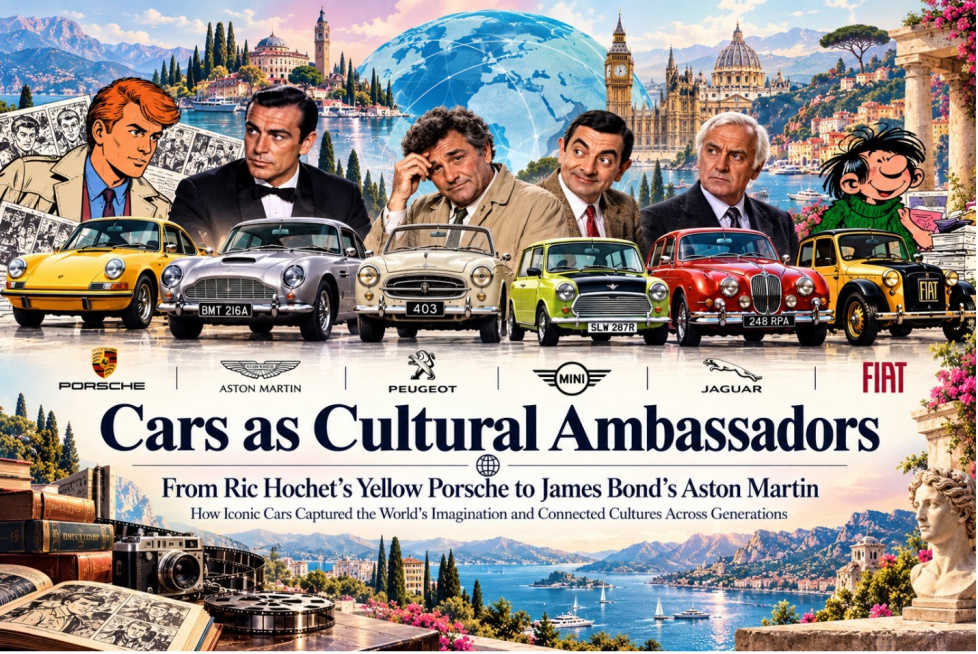
For generations growing up during the second half of the twentieth century, certain automobiles represented far more than transportation. They embodied adventure, elegance, freedom, humour and the excitement of discovering unfamiliar worlds. Children followed their favourite detectives through illustrated comic books, families gathered around television sets, and cinema audiences encountered extraordinary characters whose cars became almost as memorable as their adventures.
One such character was Ric Hochet, the young detective created for Belgian comics. His yellow Porsche, a product of German engineering, became a familiar companion in stories read across national borders. The relationship illustrates a fascinating phenomenon: an automobile designed and manufactured in one country could acquire an entirely new cultural identity through the imagination of artists and audiences in another.
From Ric Hochet's Porsche to James Bond's Aston Martin, these vehicles became unofficial cultural ambassadors, connecting countries not through formal diplomacy but through popular culture and the memories of generations.
Ric Hochet: A Belgian Detective and His Yellow Porsche
Created in 1955 by cartoonist Tibet (Gilbert Gascard) and writer André-Paul Duchâteau, Ric Hochet emerged from the pages of Journal de Tintin to become a celebrated figure in Franco-Belgian comics. A journalist and amateur detective, he solved mysteries through intelligence, determination and a taste for adventure.
Over the course of the series, a yellow Porsche became one of his recognisable companions. Porsche models associated with the character included the 356 and, subsequently, the 911. The German sports car complemented his independent personality, adding speed and excitement to investigations and dramatic pursuits.
For readers discovering Ric Hochet during the 1960s and subsequent decades, the Porsche was not merely a symbol of German automotive engineering. It was the detective's car, associated with curiosity, courage and the anticipation of another adventure.
Through Belgian storytelling, an automobile from Stuttgart acquired a place in the cultural imagination of readers beyond Germany. Its significance extended beyond performance or commercial prestige: it became part of a fictional world that audiences loved and remembered.
James Bond: British Elegance on the World Stage
In 1964, Goldfinger introduced cinema audiences to one of the most celebrated partnerships between a fictional character and an automobile: Sean Connery's James Bond and the Aston Martin DB5.
With its silver bodywork, sophisticated appearance and ingenious gadgets, the DB5 embodied Bond's combination of elegance, daring and technological resourcefulness. Its subsequent appearances in the film series reinforced an association that has endured for more than six decades.
For audiences across Europe, Asia and the Americas, the Aston Martin represented a particular vision of Britain: confident, inventive, stylish and adventurous. Viewers who had never visited the country could nevertheless recognise something distinctly British in Bond's automobile.
Cinema gave the car an international cultural identity that extended far beyond its engineering qualities. The DB5 became a symbol of a fictional universe, demonstrating how entertainment could shape perceptions of a nation's creativity and design.
Columbo: An American Detective and a French Peugeot
While Bond's Aston Martin symbolised glamour, Lieutenant Columbo's Peugeot 403 Cabriolet represented almost the opposite. Portrayed by Peter Falk, the apparently absent-minded American detective drove a battered French convertible through the wealthy neighbourhoods of Los Angeles, investigating murders among people whose expensive possessions contrasted sharply with his modest appearance.
Introduced in 1956, the Peugeot 403 Cabriolet was the product of collaboration between Peugeot's French design department and the Italian design house Pininfarina. Through Columbo, this French-Italian creation acquired an unexpected American identity. Peugeot itself has acknowledged the television series' importance in establishing the model's enduring international fame.
For viewers around the world, the ageing convertible became as familiar as Columbo's raincoat and his habit of asking one final question. Its imperfections made it memorable, demonstrating that affection and character could be more powerful than luxury or technical achievement.
Mr. Bean: The British Mini That Needed No Translation
When Mr. Bean first appeared on British television in 1990, Rowan Atkinson introduced a form of visual comedy that travelled remarkably easily across linguistic boundaries. His green Mini, with its contrasting black bonnet, became an indispensable part of the character's absurd adventures.
Whether navigating impossible parking situations or carrying out ingenious but disastrous experiments, the little car reflected its owner's eccentric personality. Unlike Bond's sophisticated Aston Martin, the Mini represented the charm of ordinary life, improvisation and unmistakably British humour.
Audiences did not need to understand English to appreciate the relationship between Mr. Bean and his car. Their adventures helped turn a familiar British design into an internationally recognised symbol of comedy.
Inspector Morse: A Jaguar in the Intellectual Landscape of Oxford
Beginning in 1987, Inspector Morse introduced international television audiences to a different automotive personality. The detective, portrayed by John Thaw, drove a red Jaguar Mark 2 through Oxford's historic streets, surrounded by colleges, libraries and architectural landmarks.
Morse's appreciation of classical music, literature and complex intellectual puzzles gave the Jaguar a distinctive cultural setting. The vehicle appeared to belong naturally to a world of tradition, learning and understated elegance.
Interestingly, Colin Dexter's detective drove an Italian Lancia in the original novels. The television adaptation chose the Jaguar, creating a lasting visual association between the character, British automotive heritage and Oxford's academic atmosphere.
For international viewers, the programme offered more than detective stories. It presented an appealing portrait of British intellectual and cultural life, with the Jaguar forming part of that atmosphere.
Gaston Lagaffe: Belgian Humour Meets Italian Engineering
The Belgian comic-book tradition offers another memorable example. Created by André Franquin in 1957, Gaston Lagaffe became famous for his unconventional inventions, workplace disasters and cheerful disregard for practical conventions.
His ageing yellow-and-black Fiat 509, an Italian automobile from the 1920s, was perfectly suited to this world. Frequently subjected to improbable modifications and mechanical mishaps, the vehicle became an extension of Gaston's personality.
Where Ric Hochet's Porsche suggested adventure and speed, Gaston's Fiat embodied humour, eccentricity and affection for imperfect machinery. The contrast demonstrates how Belgian artists could transform automobiles from different European countries into distinctive fictional companions, each carrying its own emotional meaning.
Beyond the Road: How Popular Culture Connects Nations
These six stories reveal a dimension of international cultural exchange that is easily overlooked. Automobiles originating in Germany, Britain, France and Italy acquired new identities through Belgian comics, British cinema and television, and American detective fiction. Their cultural significance was shaped not only by manufacturers, but by writers, artists, actors and audiences.
For generations growing up before the internet transformed entertainment, these characters and their vehicles occupied a special place in everyday life. Children followed their adventures in illustrated magazines, families watched them on television, and cinema audiences encountered foreign landscapes, lifestyles and technologies through unforgettable fictional worlds.
The cars became objects of admiration, amusement and nostalgia. They helped make foreign design traditions familiar, sometimes even before audiences knew much about the countries where the vehicles originated.
Not every such association constituted deliberate cultural diplomacy. Some involved commercial partnerships; others arose from creative decisions made for storytelling purposes. Yet all illustrate how popular culture can encourage familiarity with another society's creativity and industrial heritage.
This is perhaps their most enduring contribution. A German Porsche became part of Belgian comic-book history; a British Aston Martin acquired a global cinematic identity; and a French Peugeot found lasting fame through an American detective. Their significance extended beyond national borders because audiences made them part of their own cultural memories.
Long before cultural diplomacy became a regular feature of corporate strategies and international programmes, these fictional automobiles were already connecting countries through stories that people loved.
They travelled much further through the imagination than they ever could on the road. And decades later, their journeys remind us that some of the most enduring cultural bridges are built not by governments or institutions, but by the characters, images and stories that generations grow up admiring.
