
Bonn: Where the UN Meets the World
How UN organisations in Bonn use culture, education and international exchange to connect societies
October 06th, 2026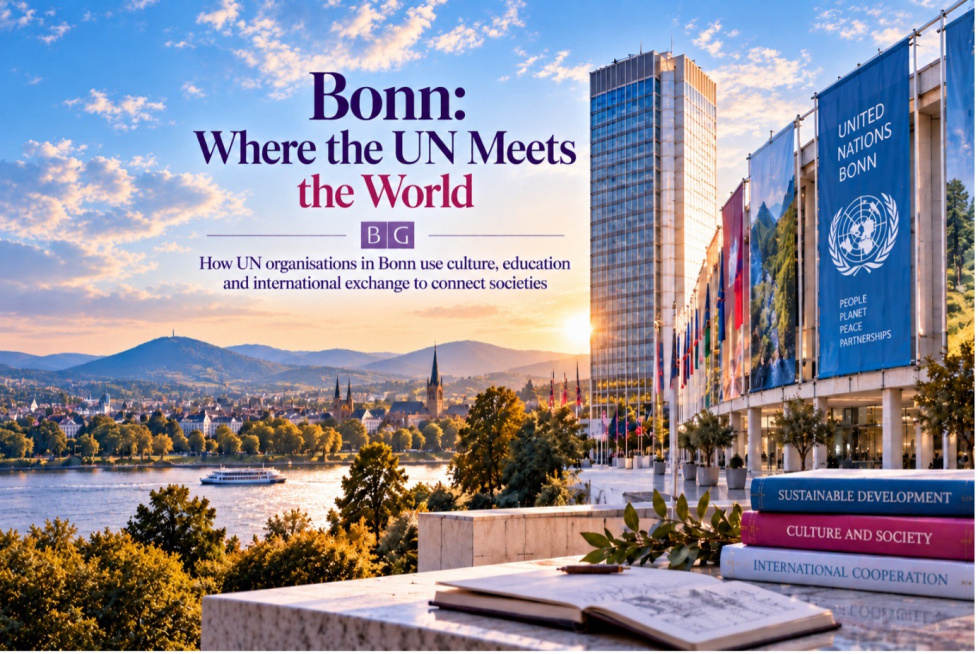
Bonn has become an important centre of the United Nations in Germany. In 2026, the city marks 30 years of the UN presence, with 27 UN entities and around 1,200 staff based in the former government district. Much of the work focuses on climate change, sustainable development, humanitarian issues and international cooperation, but the UN presence in Bonn also creates opportunities for cultural exchange, education and dialogue. From opening the UN Campus to visitors to bringing students, Indigenous representatives, artists and international volunteers into its programmes, the organisations based in Bonn show how international cooperation can reach beyond formal negotiations and connect with wider society.
1. Opening the UN Campus to Bonn
For decades, much of the work taking place at Bonn’s UN Campus was largely invisible to the public. That changed in April 2026, when UNV and Bonn Tourist Information launched guided tours of the campus. The initiative gives visitors access to a site that is normally closed to the public and introduces them to both the work of the United Nations and the history of the buildings themselves.
The tours are particularly interesting from a cultural-diplomacy perspective because they bring together Bonn’s local history and its international role. Visitors can learn about the transformation of the city from the former capital of West Germany into a centre for sustainability and international cooperation. The route includes landmarks such as the Langer Eugen, the former high-rise parliament building, as well as the Wasserwerk and other parts of the campus.
The project also makes the UN more tangible. Rather than encountering the organisation only through international news or political statements, visitors can walk through the spaces where diplomats, researchers and international organisations work. The tours have been modelled partly on similar programmes in Vienna and Geneva, creating another link between major UN cities.
In this sense, tourism becomes a form of public diplomacy. By opening the campus, the UN and the City of Bonn are allowing visitors to experience international cooperation first-hand and giving the city's residents a closer connection to the global institutions operating in their own neighbourhood.
2. When Culture and Film Enter Climate Diplomacy
Bonn’s most important UN gathering of the year, the June Climate Meetings, was not limited to negotiations. On 9 June 2026, the UNFCCC held a session entitled “The Power of Culture and Film in Climate Storytelling”, exploring how creative work can influence the way people understand climate change.
The event recognised that climate policy often relies on scientific language and technical discussions, which can be difficult for wider audiences to connect with. Film and storytelling offer another route. Personal experiences, images and narratives can make an international issue more accessible and help people understand how climate change affects communities in different parts of the world.
A related UNFCCC event later in the meetings screened the short film “An Amazon’s Night Dream” and brought together the UN initiatives Entertainment and Culture for Climate Action and Resilience Frontiers. The discussion looked at how creative industries can move beyond simply raising awareness and instead encourage people to imagine different futures and participate in climate action.
This is a particularly clear example of cultural diplomacy within the UN system. Film and culture cross national boundaries and can introduce audiences to experiences that might otherwise remain distant. By incorporating creative industries into an international policy process, the UNFCCC is creating another channel through which societies can understand one another and engage with a shared global challenge.
3. Bringing Indigenous Knowledge Into International Policy
International climate discussions are also increasingly recognising that knowledge does not only come from laboratories and universities. On 10 June, the UNFCCC’s Local Communities and Indigenous Peoples Platform held its annual dialogue at the UN Campus in Bonn, bringing together Indigenous Peoples, local communities, governments and other stakeholders.
The discussion focused on how the values, worldviews and knowledge systems of Indigenous Peoples and local communities can be incorporated into national climate policies and reporting. Under the platform’s 2025–2027 workplan, particular attention is being paid to ensuring that this knowledge is included in an ethical and equitable way.
The significance extends well beyond climate policy. Indigenous knowledge is closely connected to language, cultural identity, traditional practices and relationships with land and nature. Giving these perspectives a place in international decision-making allows communities to communicate their own experiences directly rather than having them represented exclusively by outside institutions.
Bonn therefore becomes a meeting point between very different forms of knowledge. Government negotiators, international organisations and Indigenous representatives can exchange experiences and develop policies that take local realities into account. Interpretation in several languages also helped make the dialogue accessible to participants from different regions.
From a cultural-diplomacy perspective, the meeting demonstrates how international institutions can create space for intercultural dialogue and recognition of diverse knowledge systems. In this setting, cultural exchange is not an additional element of diplomacy; it is part of how more inclusive international cooperation is built.
4. From the Classroom to the UN Negotiating Room
Bonn is also home to an unusual form of academic exchange. The Joint Master’s Programme in Geography of Environmental Risks and Human Security, run by the University of Bonn and the United Nations University Institute for Environment and Human Security (UNU-EHS), gives students the opportunity to connect university study with international policymaking.
During the June Climate Meetings, students were able to observe negotiations and interact with UNFCCC delegates and experts. The programme also organised a discussion with UNFCCC staff on just transition and equity, allowing students to hear directly from people involved in the negotiations.
For some students, the experience went even further. Mexican student Odette Ferrer supported her country's delegation, following adaptation negotiations and preparing daily reports. She also took part in the ACE Youth Hub, which connected her with other young people working on climate policy. German student Stella Eick followed climate-finance negotiations as an observer.
These experiences illustrate how academic exchange can become a form of international diplomacy. Students from different countries do not simply study global governance from textbooks; they experience it together, meet people working within the system and develop international professional networks.
The programme therefore creates links between universities, international organisations and young people. For Bonn, this is an important part of the city's role as an international hub. Students arrive from different backgrounds, encounter new perspectives and take that experience back into their own countries and professional communities.
5. Volunteerism as People-to-People Diplomacy
UNV provides another channel for international exchange from its Bonn headquarters. In May 2026, UNV hosted its Asian Partner Roundtable, bringing together representatives from Asian governments to discuss volunteerism, regional cooperation and the International Volunteer Year 2026.
One example was Kazakhstan, whose delegation was led by Gulbara Sultanova of the country's Ministry of Culture and Information. The meeting marked 40 years of cooperation between Kazakhstan and UNV and included discussions about youth, volunteerism and future international assignments. Kazakhstan also announced plans to increase its support for international and national UN Volunteer positions.
A similar partnership was strengthened in September, when UNV and Saudi Arabia’s National Center for Non-Profit Sector signed a memorandum of understanding in Bonn. The agreement aims to give Saudi volunteers international experience within the UN, strengthen volunteer organisations and develop joint learning, training and knowledge-sharing activities.
These partnerships show how volunteerism can create lasting links between people and institutions across borders. Volunteers gain professional and cultural experience abroad, while international organisations gain access to local knowledge and networks.
This is another form of cultural diplomacy through people-to-people exchange. Unlike formal diplomatic negotiations, volunteer programmes build relationships through shared work and everyday interaction. Bonn’s role as the headquarters of UNV places the city at the centre of this network, connecting governments and communities in Europe, Asia and other regions through practical international cooperation.
Bonn’s UN presence is therefore about more than the negotiations that take place behind closed doors. The city has become a place where international institutions meet universities, local communities, Indigenous Peoples, volunteers, artists and the wider public. Through these encounters, the UN system creates channels for cultural exchange, education and people-to-people connections that complement formal diplomacy. In Bonn, international cooperation is not only something negotiated between states; it is also something experienced, learned and built between societies.
References:
- https://unric.org/en/un-bonn-organizations/
- https://unric.org/en/inside-the-un-guided-campus-tours-in-bonn/
- https://unfccc.int/ru/node/657846
- https://unfccc.int/event/lcipp-annual-dialogue-among-indigenous-peoples-local-communities-parties-and-other-stakeholders-to
- https://unu.edu/ehs/news/classroom-climate-talks-student-reflections-june-climate-meetings
- https://www.unv.org/pressrelease/kazakhstan-participates-unv-asian-partner-roundtable-bonn
- https://www.unv.org/pressrelease/unv-and-saudi-arabias-national-center-non-profit-sector-strengthen-partnership
- https://www.unv.org/pressrelease/german-foreign-minister-visits-un-campus-bonn-reaffirms-support-united-nations
