
Beyond the Kangaroo: Oceania’s Diplomacy in Berlin, Vienna, NYC, Geneva and London
Five initiatives reveal how Oceania’s diplomatic missions build cultural connections and advance international cooperation
October 09th, 2026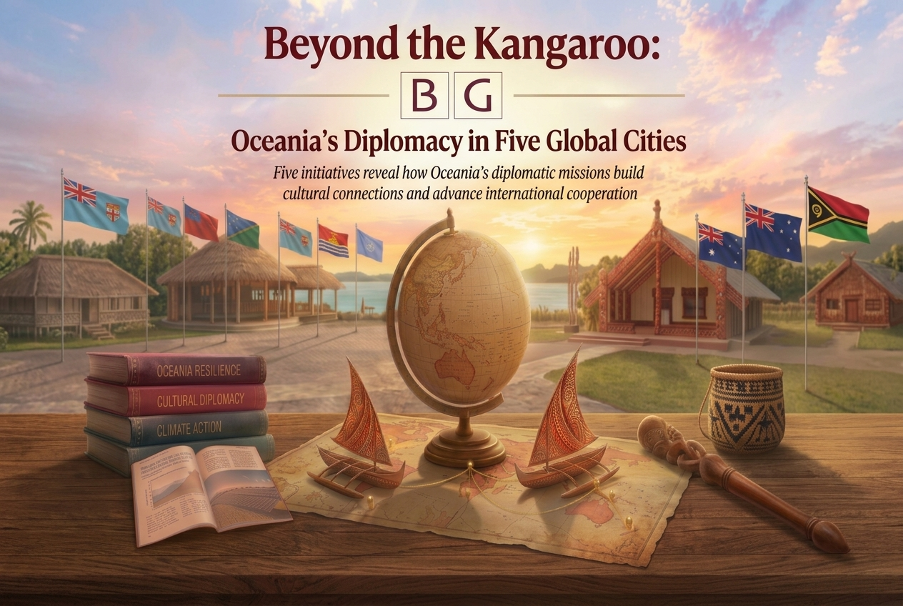
What comes to mind when we think of Oceania? Australia’s vast landscapes, New Zealand’s cultural identity, perhaps the scattered islands of the South Pacific. But how much of the region do these familiar images actually capture — and what do they leave out? Across one of the world’s most geographically dispersed regions, countries with very different histories, resources and international ambitions are finding ways to make their voices heard far beyond their shores.
Their diplomatic activity offers one way to explore this wider picture. In Berlin, Vienna, New York, Geneva and London, cultural initiatives, expert discussions and international forums provide different windows into how Oceania engages with the world. Some of the activities examined here have already taken place; others remain ongoing or form part of longer-term cultural diplomacy programmes. Together, they offer more than a list of events: they provide a way to trace the region’s priorities across different settings and moments in time.
What can an exhibition of First Nations art reveal about national identity? How do Pacific perspectives enter debates on climate security and rising sea levels? And how do smaller states make their concerns visible in global centres of power?
The five cases that follow explore these questions, looking beyond Australia without overlooking its role. Their stories may differ, but together they invite a broader understanding of Oceania’s place in the world — and of the many ways its countries seek to shape it.
Berlin: First Nations Art as Cultural Self-Representation
At the Australian Embassy in Berlin, cultural diplomacy begins with stories that reach far beyond familiar images of the country. The embassy’s current exhibition, From Australia’s Central and Western Desert: A Selection of First Nations Artworks from Sammlung Klein, brings together paintings by First Nations artists, offering a window into cultural traditions whose meanings are inseparable from community, place and spirituality. The exhibition is on view until December 2026 and has been realised in cooperation with Kunstwerk Sammlung Klein in Eberdingen-Nussdorf.
The works draw on cultural narratives, symbols and techniques passed down through generations, while expressing the distinctive artistic voices of individual creators. Their presence in a diplomatic setting gives these traditions an international platform, but the significance goes beyond showcasing Australian art abroad. First Nations artists bring perspectives and forms of knowledge that challenge any single, uniform account of Australian identity. Their work makes visible the cultural depth and diversity that can be obscured when a country is represented through its most recognisable national symbols.
The exhibition also reflects a longer-term commitment: since launching its exhibition programme in 2010, the embassy has hosted more than 40 group and solo exhibitions, with a particular focus on First Nations stories and knowledge. In Berlin, cultural diplomacy thus becomes more than national promotion. It creates space for Indigenous artistic expression to shape how Australia is understood overseas.
Vienna: Climate Security Beyond Great-Power Competition
In Vienna, Australia’s diplomatic engagement with the Pacific extends beyond cultural representation to questions of regional security and political agency. On 27 May 2026, the Australian Embassy joined the Austrian South Pacific Society and Climate Change Centre Austria in hosting a lecture by Salā Dr George Carter of the Australian National University, examining the intersection of climate security and geostrategic competition in the Pacific.
The discussion challenged the idea that the region should be understood primarily through the strategic rivalry of larger powers. Rising sea levels and increasingly severe disasters pose immediate threats to Pacific island communities, but they also shape international relations, regional cooperation and debates over sovereignty. As competition between the United States and China intensifies, Pacific countries face pressure to navigate competing interests while ensuring that their own priorities remain visible.
Carter’s Pacific-led approach places these countries not simply at the centre of a geopolitical contest, but among the actors capable of shaping its terms. Climate action can become a means of asserting political agency, strengthening regional cooperation and reframing security around the lived realities of island states.
The Vienna event therefore offered a different perspective on Australia’s role in the region. By bringing diplomatic representation together with climate expertise and Pacific-focused research, it created space for a discussion in which the Pacific was not merely the object of international strategy, but an active participant in defining what security means.
New York: Bringing Pacific Priorities to the United Nations
At the United Nations in New York, New Zealand’s engagement with the Pacific takes shape around a question that reaches beyond environmental policy: what happens to nations when the sea itself threatens the territory on which their sovereignty and identity rest? At the High-Level Meeting on sea-level rise on 24 September 2026, the issue moved to the centre of international diplomacy, bringing renewed attention to the challenges facing small island developing states and low-lying coastal countries.
In its national statement, published six days later, New Zealand described sea-level rise as a defining threat to the livelihoods and wellbeing of Pacific peoples. The country also welcomed the meeting’s Political Declaration, particularly its recognition of the need to preserve maritime zones and maintain statehood despite rising seas. These are not merely technical questions of international law: for Pacific nations, they touch on sovereignty, cultural continuity and the future of communities whose lives are closely connected to the ocean.
New Zealand’s position also highlights the role of multilateral diplomacy in amplifying the concerns of smaller states. The statement acknowledged the Pacific Islands Forum’s work on the legal dimensions of sea-level rise, showing how regional advocacy can help shape discussions at the United Nations. The challenge is no longer simply to ensure that Pacific vulnerabilities are heard, but to translate that recognition into sustained international cooperation.
In New York, therefore, the Pacific is not only a region exposed to global problems. Through diplomacy and collective advocacy, its priorities can also help shape the international response.
Geneva: Bringing Climate Diplomacy Down to the Local Level
In Geneva, climate diplomacy moves from international declarations to the lived experiences of the people most directly affected by environmental change. On 18 June 2026, the Permanent Missions of Germany and Fiji to the United Nations in Geneva presented Stories from the Blue Frontier, a documentary screening and discussion at the Palais des Nations. Produced by the German Embassy in Suva, the film gives rural communities in Fiji a voice in describing the effects of climate change and the local initiatives helping them build resilience.
The documentary brings a human dimension to debates often dominated by emissions targets, international agreements and geopolitical calculations. Coastal erosion, rising seas and extreme weather are not abstract projections for the communities featured: they affect livelihoods, access to resources and the relationship between people, land and ocean. The documentary also highlights local knowledge and adaptation efforts supported through cooperation between the Fijian and German governments.
By bringing these stories into the UN setting, the event connected local experience with international policymaking. Fiji’s Deputy Permanent Representative, Keleni Seruvatu, stressed that climate change is also a cultural reality for Pacific communities, while the discussion linked environmental harm to human rights, dignity and the ability of communities to shape their own futures.
The initiative illustrates a form of diplomacy that works from the ground up. Rather than speaking about Pacific communities only through statistics or policy positions, it brings their experiences into a global forum — showing how local voices can inform international understanding and cooperation.
London: Shared Memory as a Diplomatic Bridge
In London, Oceania’s diplomatic presence takes a different form: the public commemoration of a shared past. On 25 April 2026, the New Zealand and Australian High Commissions in the United Kingdom joined forces for ANZAC Day, honouring members of the Australian and New Zealand Army Corps who served and died in war. The date marks the 1915 Gallipoli landings, a defining moment in both countries’ national histories.
The London programme connected three symbolic locations: a dawn service at Hyde Park Corner, a wreath-laying ceremony at the Cenotaph on Whitehall, and a service of commemoration and thanksgiving at Westminster Abbey. Together, these ceremonies turned remembrance into a public expression of the enduring ties between Australia, New Zealand and the United Kingdom.
ANZAC Day is not a conventional cultural showcase or policy forum. Its diplomatic significance lies instead in how historical memory sustains relationships between countries. For Australia and New Zealand, the commemoration reinforces a shared military heritage; in Britain, it also recalls the historical connections between the South Pacific and Europe, including the journeys made by troops departing from British ports for wartime service.
The London case thus adds a final dimension to Oceania’s international engagement: diplomacy is also practised through remembrance, public ritual and the ongoing interpretation of shared history.
A Region Speaking Through Different Voices
The five cases reveal a region whose international presence is both uneven and more diverse than familiar images of Oceania might suggest. Australia and New Zealand dominate this particular selection, yet their diplomatic engagement takes different forms: from presenting First Nations art in Berlin to debating climate security in Vienna, advocating for Pacific priorities at the United Nations in New York, and maintaining historical ties through ANZAC commemorations in London. These initiatives show that diplomacy is not confined to formal negotiations. It can also operate through cultural representation, public debate, international law and shared memory.
Fiji brings another perspective into focus. Its role in the Geneva climate discussion highlights a fundamental imbalance: countries with relatively limited geopolitical weight can face some of the most existential consequences of global challenges. For Pacific island communities, rising seas and environmental disruption are not distant policy concerns, but questions touching on territory, livelihoods, cultural continuity and national identity. Their experiences therefore belong at the centre of international climate diplomacy, not at its margins.
The cases also reveal that this presence is built through more than individual embassies. Diplomatic missions, international organisations, research institutions, local communities and bilateral partnerships all contribute to how Pacific perspectives reach wider audiences and decision-making forums. The institutional setting changes, but the underlying task remains similar: to make national and regional priorities visible beyond their immediate borders.
Oceania, then, is neither a single diplomatic voice nor a synonym for Australia. Its place on the world stage emerges through different countries, unequal resources and multiple forms of engagement. Looking beyond the kangaroo means recognising not only the region’s cultural richness, but also its political agency — and the importance of listening to the Pacific voices that global debates too often overlook.
References:
- https://germany.embassy.gov.au/beln/event.html
- https://ospg.univie.ac.at/climate-security-geostrategic-competition-in-the-pacific/
- https://www.mfat.govt.nz/en/media-and-resources/united-nations-general-assembly-high-level-meeting-on-sea-level-rise-national-statement
- https://www.genevaenvironmentnetwork.org/events/climate-talk-film-screening-stories-from-the-blue-frontier/
- https://www.mfat.govt.nz/en/countries-and-regions/europe/united-kingdom/new-zealand-high-commission/anzac-day-london-2026
