
Beyond Sponsorship: Volkswagen and the Cultural Power of a Global Company
How corporate partnerships, cultural access, and historical remembrance shape international dialogue
October 20th, 2026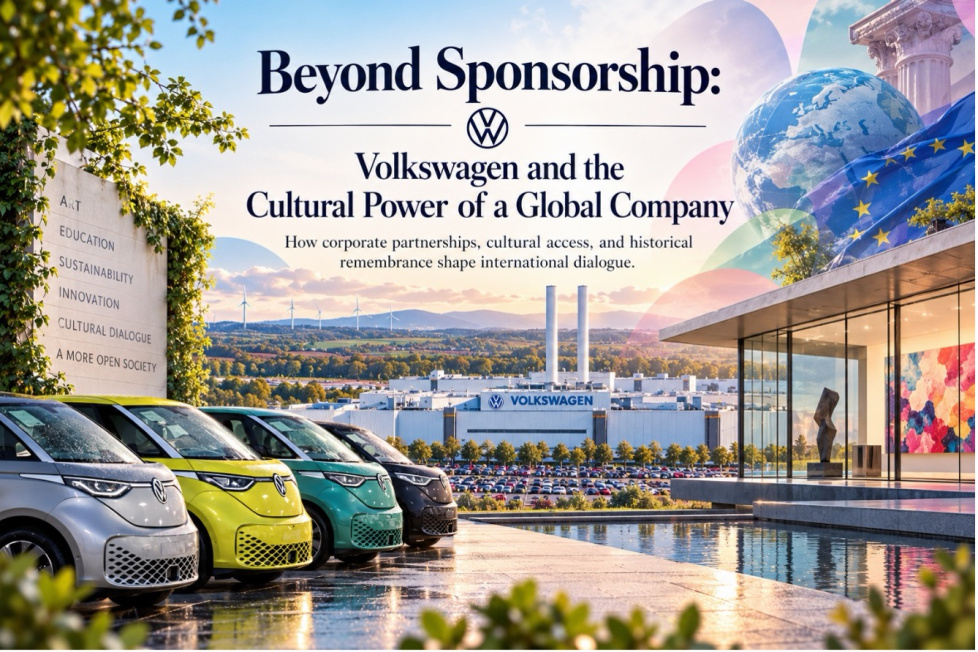
What does a global carmaker have to do with contemporary art, historical remembrance or cultural exchange? At first glance, these worlds may seem far apart. Yet the relationship between business and culture has become more complex than a question of who pays for an exhibition or puts a logo on a museum wall.
For a company such as Volkswagen, cultural engagement takes place in settings that differ considerably in purpose and meaning. It can involve confronting the legacy of the past, opening cultural institutions to broader audiences, supporting artistic work on an international stage, or sustaining a city’s connection with contemporary art. Each setting brings its own expectations — and raises a different question about the role a private company should play in cultural life.
These activities also unfold across different scales, from local communities and national cultural institutions to international partnerships. Some are rooted in long-standing relationships; others are tied to particular projects or moments. Their significance cannot be understood through funding alone: the context of each initiative, the institutions involved and the audiences they reach all matter.
Looking at Volkswagen’s recent cultural engagement through these different settings offers a closer view of the many ways a global company can intersect with culture — and invites a broader question about where sponsorship ends and cultural responsibility begins.
Historical Memory & Ethics: The International Auschwitz Committee
In August 2025, the Volkswagen Group announced a donation of €150,000 to the International Auschwitz Committee (IAC) and the International Youth Meeting Center (IYMC) in Oświęcim, Poland. The contribution continued a partnership that has connected the company with Holocaust remembrance and education for decades. Founded in 1937 under the Nazi regime, Volkswagen has a particular historical responsibility in confronting this past — a responsibility that extends beyond commemorative statements to long-term educational and preservation work.
Since 1987, Volkswagen trainees have participated in educational programmes at the Auschwitz Memorial. Working alongside Polish young people, they have contributed to the preservation of the former camp, including conservation tasks involving historical objects and the site itself. The wider partnership has also supported educational events, publications, and improvements to the Memorial’s facilities.
The significance of this engagement lies not simply in corporate funding, but in the connection between historical remembrance and education across generations and national borders. Encounters at Auschwitz bring young Germans and Poles into direct contact with a history that remains central to European memory and German-Polish relations. For Volkswagen, this work also raises a wider question: how can a company shaped by the history of the Nazi era contribute to preserving the memory of its victims while fostering a sense of responsibility among future generations?
Public Access & Democratic Participation: Volkswagen Group Art4All at the Neue Nationalgalerie
In March 2026, the Neue Nationalgalerie in Berlin and the Volkswagen Group extended their partnership, first established in 2012, for a further two years. A central part of the renewed collaboration is Volkswagen Group Art4All, which entered a new format on 2 April, offering free admission to the museum on the first Thursday of every month from 4 to 8 pm. The programme combines access to exhibitions and collections with guided tours, creative workshops, educational activities and live events. In 2025, Art4All reached more than 130,000 visitors at the Neue Nationalgalerie alone.
The initiative addresses a practical question at the heart of public cultural life: who gets to experience contemporary art, and under what conditions? By removing the admission fee on designated evenings and providing different ways to engage with the exhibitions, Art4All seeks to lower barriers between the museum and its potential audiences. Tours in German, English and accessible language, alongside opportunities to ask questions and take part in creative workshops, make the programme more than an exercise in opening the doors for free.
For Volkswagen, the partnership offers a role in shaping how a major German cultural institution connects with its public. Its significance lies not simply in the company’s association with a prominent museum, but in the opportunities for participation that its support helps sustain. While this is not diplomacy in the formal sense, the initiative illustrates how corporate cultural engagement can contribute to the public-facing institutions through which a city presents its cultural life and invites people into a shared encounter with art.
Global Diplomacy & Representation: Volkswagen and the German Pavilion at the Venice Biennale
At the 61st Venice Biennale, running from 9 May to 22 November 2026, the Volkswagen Group is supporting the educational and outreach programme of the German Pavilion. Rather than focusing solely on the presentation of artworks, the partnership places emphasis on helping visitors engage with their ideas and wider social context. Curated by Kathleen Reinhardt, this year’s pavilion presents works by Henrike Naumann and Sung Tieu, whose practices explore the long-term effects of historical ruptures and the political and social continuities that shape contemporary Germany.
The educational programme gives this national presentation a broader public dimension. By supporting activities that make the artists’ work accessible to a wider audience, Volkswagen contributes to the ways in which visitors encounter and interpret questions of history, discrimination, conflict and social change. In this setting, the German Pavilion becomes more than a showcase for contemporary art: it offers a space in which Germany’s past and present can be examined through artistic perspectives, in front of an international audience.
The partnership illustrates a distinctive intersection between corporate cultural engagement and international representation. The German Pavilion is part of a major global art event, but the conversations it enables are not confined to national image-making. They also invite audiences to question historical narratives and consider their relevance beyond Germany. Volkswagen’s role in supporting this educational work shows how a company can contribute to the public engagement surrounding a national cultural presentation, while leaving the artists and their work to shape the substance of the debate.
Transatlantic Dialogue & Representation: Volkswagen, MoMA and MoMA PS1
Between 2011 and the late 2010s, Volkswagen Group of America developed a multi-year partnership with New York’s Museum of Modern Art (MoMA) and MoMA PS1, supporting exhibitions, educational initiatives and experimental artistic programmes. The collaboration reached beyond the galleries themselves: Volkswagen-backed initiatives included the expansion of MoMA’s online art courses, which reached learners in more than 70 countries, and MoMA PS1’s VW Sunday Sessions, a programme bringing together performance, music, dance, film and discussion.
The partnership also explored the relationship between culture, public space and environmental questions. In 2013, as part of MoMA PS1’s EXPO 1: New York, Volkswagen provided a temporary geodesic dome at Rockaway Beach, an area affected by Hurricane Sandy. Conceived as a centre for cultural exchange and education, the installation invited discussion about the future sustainability of cities and waterfronts. It extended the partnership’s reach beyond established museum spaces and into a community confronting the consequences of a major environmental disaster.
While this partnership belongs to an earlier chapter of Volkswagen’s cultural engagement, it illustrates how corporate support can connect German businesses with international cultural institutions and create platforms for artistic exchange across national borders. Its significance lies less in projecting a particular national image than in supporting platforms where artists and audiences could encounter new work and debate shared cultural and social questions.
Regional Industrial Identity: Volkswagen and the Kunstmuseum Wolfsburg
In Wolfsburg, Volkswagen’s cultural engagement is closely connected to the city that grew around its automotive industry. The company was one of the founding partners of the Kunstmuseum Wolfsburg, which opened in 1994, shortly after German reunification. Three decades later, the relationship continues through programmes that bring contemporary art to local audiences, including initiatives designed to make museum visits more accessible to children, young people and the wider regional population.
Recent initiatives illustrate how this commitment operates in practice. Through Volkswagen Group Art4All, the museum offers free admission on the last Wednesday of each month, alongside guided tours, creative workshops and public discussions. The Young & Free programme, supported by Volkswagen since 2024, provides free admission for visitors under 18. Volkswagen Financial Services also supports Artmobil, a long-running initiative that transports school groups and older residents from the surrounding region to the museum, combining access with educational activities.
The partnership also extends to the museum’s professional and intellectual environment. In 2025, the Kunstmuseum welcomed fellows through the Volkswagen Group Fellowship Programme, giving emerging cultural practitioners opportunities to contribute to the work of a major contemporary art institution. Together, these initiatives show how corporate cultural engagement can operate at several levels: supporting an institution, widening access to its exhibitions and helping develop the people and programmes that sustain its work.
For Wolfsburg, this relationship adds a cultural dimension to a city widely associated with automotive manufacturing. For Volkswagen, it connects its industrial home to a regional cultural institution with an international contemporary art collection and exhibition programme. The case brings the article back to a question that runs through all five examples: a company’s cultural presence is shaped not only by the institutions it supports abroad, but also by the cultural opportunities it helps sustain in the communities where its own identity took root.
Volkswagen’s cultural engagement reveals that the relationship between business and culture extends beyond the familiar language of sponsorship. From Holocaust remembrance in Poland to educational programmes in Berlin, the German Pavilion in Venice, earlier partnerships with New York’s leading art institutions, and contemporary art initiatives in Wolfsburg, these cases illustrate the different ways a global company can participate in cultural life across national and local contexts.
Yet their significance lies not simply in the company’s visibility alongside renowned institutions. It is also found in the activities these partnerships support: preserving historical memory, widening access to art, encouraging public discussion and sustaining cultural opportunities beyond major international centres. In this sense, corporate engagement can intersect with cultural diplomacy without becoming diplomacy in the formal sense.
The relationship nevertheless raises questions about responsibility, influence and public value. Corporate funding can help cultural institutions extend their reach, but the meaning of that support depends on the independence of artistic and educational work, the substance of the programmes and the needs of the communities they serve.
Volkswagen’s experience therefore points to a broader conclusion: companies can become participants in the cultural relationships through which societies understand themselves and engage with others. Their contribution is not defined by sponsorship alone, but by what their partnerships make possible — and by the responsibilities that accompany that role.
References:
- https://www.volkswagen-group.com/en/press-releases/volkswagen-supports-remembrance-work-of-the-international-auschwitz-committee-19682
- https://www.auschwitz.org/en/museum/news/30-years-involvement-of-volkswagen-ag-at-the-auschwitz-memorial%2C1288.html
- https://www.artatberlin.com/en/news-partnership-with-the-volkswagen-group-as-the-new-lead-partner-of-education-for-a-further-two-years-and-expanded-free-educational-programmes-at-the-open-studio-hamburger-bahnhof/
- https://www.smb.museum/en/museums-institutions/neue-nationalgalerie/about-us/whats-new/detail/neue-nationalgalerie-extends-partnership-volkswagen-group-art4all-to-launch-in-a-new-format-from-2-april-2026/?utm
- https://www.volkswagen-group.com/en/press-releases/volkswagen-group-supports-education-program-of-the-german-pavilion-at-the-61st-biennale-arte-di-venezia-20364
- https://www.press.moma.org/wp-content/files_mf/vw_moma_momaps1_partnershipfinal.pdf?utm
- https://www.volkswagen-group.com/en/press-releases/kunstmuseum-wolfsburg-celebrates-30th-anniversary-world-class-art-at-the-home-of-volkswagens-headquarters-18402?utm
