
Berlin Through Culture: Where Tourism Meets Diplomacy
How diplomacy, art and travel connect Berlin with the world
October 02nd, 2026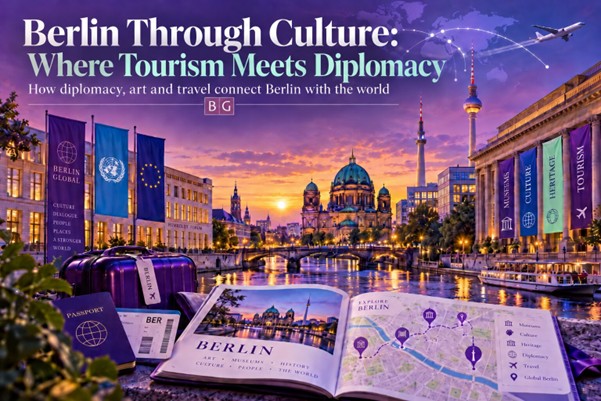
Berlin’s appeal as a cultural tourism destination is closely connected to its international character. Beyond its museums, monuments and architecture, the city increasingly serves as a meeting place where embassies, foreign governments, cultural institutions and international artists engage directly with visitors. Recent initiatives show how tourism in Berlin can become more than sightseeing: exhibitions, festivals, official partnerships and international mobility can create opportunities for cultural exchange, dialogue and greater understanding between societies.
This international character creates opportunities for cultural tourism to develop through more than traditional sightseeing. Embassies, museums, tourism institutions and international organisations can become spaces where visitors encounter other countries through art, performance, cultural presentation and direct exchange.
Recent initiatives involving Italy, Uzbekistan, Angola, the Humboldt Forum and the United Arab Emirates illustrate five different approaches. Together, they show how Berlin connects tourism with cultural diplomacy through exhibitions, international festivals, national tourism promotion, institutional cooperation and cross-border mobility.
Turning Diplomacy into an Art Destination
In September 2026, the Embassy of Italy in Berlin participated in the official programme of Berlin Art Week for the first time. The centrepiece was Caravaggio × Berlinde De Bruyckere, an exhibition held inside the Embassy that brought Caravaggio’s Mary Magdalene in Ecstasy into dialogue with a newly commissioned work by Belgian contemporary artist Berlinde De Bruyckere.
The exhibition opened on 7 September and remained accessible by appointment until 25 September. It connected more than four centuries of artistic production through themes including the body, suffering, desire and transformation. The Embassy also linked the project with other Berlin Art Week initiatives at the Neue Nationalgalerie and Hamburger Bahnhof.
The project changes the conventional role of a diplomatic building. Rather than functioning only as a place of official representation, the Embassy became part of Berlin’s wider cultural programme and welcomed visitors into a space where Italian artistic heritage encountered contemporary European art.
This approach gives cultural tourism a diplomatic dimension. Italy’s cultural presence in Berlin becomes something that audiences can experience directly, while art creates a setting for exchange between Italian, German and wider European cultural communities.
Bringing the Silk Road into a Berlin Gallery
A different form of exchange is taking place at Q Gallery Berlin through TRANSFORMATIONS – Uzbek-German Cultural Exchange, running from 24 September to 23 October 2026. The exhibition was organised by the Embassy of Uzbekistan in Germany together with Cultur-Cooperation International and Q Gallery Berlin to mark the 35th anniversary of Uzbekistan’s independence.
The exhibition presents works by Princess Sibylle of Prussia and Frank Rödel. Both artists travelled through Uzbekistan and participated in the International Art Biennale there, giving them direct exposure to the country’s landscapes, history and cultural traditions. Rödel’s works in particular draw on encounters with the Silk Road cities of Samarkand, Bukhara and Khiva.
Travel therefore becomes part of the artistic process itself. Experiences collected in Uzbekistan are transformed into artworks and subsequently presented to audiences in Berlin, allowing visitors to encounter another country through the perspectives of artists who travelled there.
The cooperation also works in both directions. Uzbekistan is represented in Germany through its cultural landscapes and history, while German artists interpret those experiences for a Berlin audience. The gallery becomes a meeting point between tourism, artistic production and bilateral cultural exchange.
Presenting Angola Through Tourism Diplomacy
International tourism fairs offer another way for countries to present their cultural identity abroad. In 2026, Angola became the official host country of ITB Berlin, following a partnership between Angola’s Ministry of Tourism and Messe Berlin. The agreement was signed by Tourism Minister Márcio de Jesus Lopes Daniel and Messe Berlin COO Dirk Hoffmann.
As host country, Angola presented a broad programme at ITB Berlin from 3 to 5 March, preceded by an opening gala at CityCube Berlin. The partnership formed part of Angola’s international tourism strategy under the brand Visit Angola – The Rhythm of Life.
The presentation extended beyond landscapes and conventional destination marketing. Angola’s cultural diversity, culinary traditions, music and dance were also placed at the centre of its international tourism profile. The country used one of the world’s largest tourism platforms to introduce international audiences to cultural elements that shape how Angola presents itself abroad.
For Berlin, ITB therefore functions as more than a commercial meeting place for the travel industry. It also provides governments with a platform for national cultural representation, bringing foreign identities, traditions and tourism narratives into direct contact with an international audience.
Humboldt Forum: Bringing Five Countries into One Cultural Space
Berlin’s museums can also connect tourism with contemporary international exchange. From 30 September to 4 October 2026, the Humboldt Forum hosted Transkontinentale 2026, bringing dance, theatre and performance productions from Cameroon, China, New Zealand, Nigeria and Brazil to the German capital.
The programme explored cultural and natural heritage, water, forests, land and questions surrounding collective ownership of history. Several productions were staged within the Humboldt Forum’s ethnological collections, creating direct interaction between contemporary artistic voices and objects held by the institution.
The programme included Luftmasse by Chinese director Tian Gebing, a wordless work by Māori choreographer Tigafua, performances by Brazilian artists, and a production connecting contemporary dance with urban life in Lagos. Visitors could also meet and speak with participating artists after performances.
This format expands the experience of visiting a museum. International collections are no longer encountered only as historical objects: contemporary artists from the cultures and regions represented in the broader programme are also able to introduce new interpretations, stories and perspectives. The museum becomes a place of active international cultural exchange.
UAE and Berlin: Connecting Cities Through Travel
Cultural tourism also depends on international mobility. On 10 September 2026, Berlin’s Governing Mayor Kai Wegner received UAE President Sheikh Mohamed bin Zayed Al Nahyan at the Rotes Rathaus during the President’s state visit to Germany. Among the subjects discussed was the expansion of air connectivity between the United Arab Emirates and Berlin.
The meeting followed an aviation agreement enabling Emirates to operate a daily long-haul connection at Berlin Brandenburg Airport. For Berlin, the route provides a stronger direct connection with the Gulf region and creates new opportunities for incoming and outgoing international travel.
The discussion also addressed broader cooperation between Berlin and cities in the Emirates, including possible exchanges in culture, technology, urban development and transport. In this context, aviation is not separate from cultural relations: it provides the infrastructure through which tourists, artists, professionals and communities are able to move between countries.
The initiative illustrates the practical side of cultural exchange. Museums, exhibitions and festivals may provide the content of cultural tourism, but international transport networks allow audiences to reach them. Physical connectivity can therefore support the longer-term development of cultural and people-to-people relations.
Berlin: Tourism Through International Exchange
Taken together, these initiatives show how different institutions contribute to Berlin’s international tourism landscape. The Italian and Uzbek examples use visual art to connect countries and audiences; Angola uses tourism itself as a platform for cultural representation; the Humboldt Forum brings artistic perspectives from several continents into a Berlin museum; and cooperation with the UAE highlights the infrastructure that allows international encounters to take place.
Cultural tourism in Berlin therefore extends beyond visiting established attractions. It also develops through temporary exhibitions, diplomatic initiatives, international festivals and partnerships that continually introduce new cultures into the city.
Through these encounters, Berlin becomes not only a destination to observe, but also a place in which visitors can experience international cultural relations directly.
References:
- https://www.itb.com/de/presse/pressemitteilungen/news_26180.html
- https://www.esteri.it/en/sala_stampa/archivionotizie/retediplomatica/2026/09/berlino-caravaggio-x-berlinde-de-bruyckere-alla-berlin-art-week/
- https://deeds.news/2026/08/transkontinentale-2026-international-festival-of-dance-theatre-and-performance-from-four-continents-humboldt-forum-berlin-30-09-04-10-2026/
- https://qgalleryberlin.de/pages/single-event/155
- https://www.berlin.de/rbmskzl/aktuelles/pressemitteilungen/2026/pressemitteilung.1712644.php
