
African Diplomacy Across Five Cities: New York, Berlin, Vienna, Geneva and London
African countries are creating new opportunities for dialogue and cooperation with their host societies
October 19th, 2026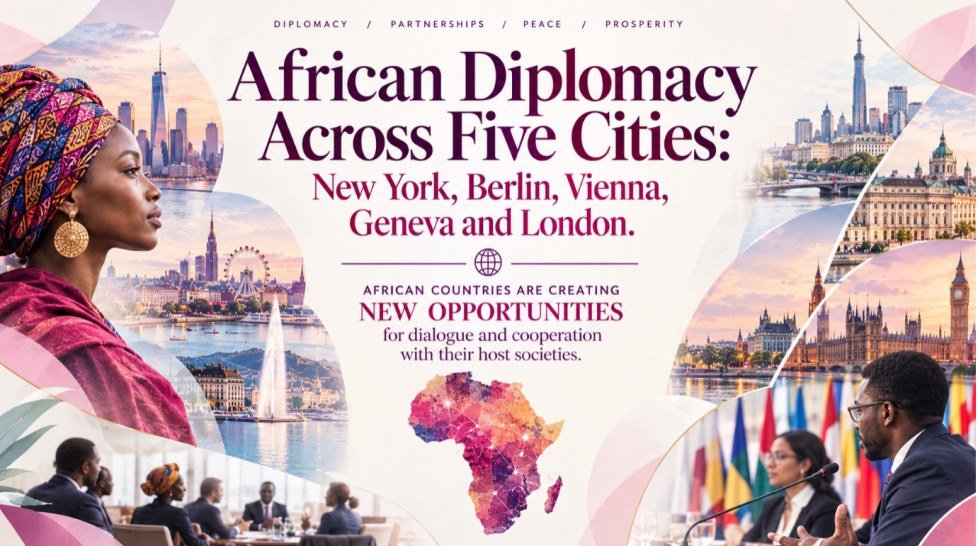
Across the world’s major diplomatic centres, African states and their diaspora communities are finding new ways to engage with their host societies.
From the United Nations General Assembly in New York to initiatives hosted by African diplomatic missions in Europe, these encounters reveal how diplomacy extends beyond formal negotiations to address representation, historical memory and social change.
New York: UN General Assembly 2026
The United Nations General Assembly is the UN’s principal deliberative body, bringing together all 193 member states to discuss issues ranging from peace and security to sustainable development. Its 81st session opened on 8 September 2026, with the high-level General Debate taking place from 22 to 28 September under the theme “Restoring Trust, Managing Transformation: A United Nations That Delivers for All”.
Nigeria was represented by Vice President Kashim Shettima, who delivered President Bola Ahmed Tinubu’s national statement on 24 September. The delegation included Foreign Affairs Minister Bianca Odumegwu-Ojukwu and Nigeria’s Permanent Representative to the UN, Ambassador Jimoh Ibrahim. A central issue was reform of the Security Council. Nigeria renewed its call for at least two permanent African seats and five non-permanent seats, reflecting the African Union’s demand for stronger representation in global governance. Shettima also called for reform of the international financial architecture, greater access to climate finance and technology, and increased investment in African industrial development. He further advocated processing Africa’s mineral resources locally rather than relying on raw-material exports, emphasising the importance of creating more economic value within the continent.
Tinubu’s absence attracted domestic criticism. On 29 September, Ambassador Ibrahim defended the decision, arguing that Shettima had adequately represented Nigeria. His comments reflected the government’s position but did not settle the political debate. For Nigeria, participation in the Assembly offers an opportunity to build international coalitions and advance national priorities. The challenge is to turn diplomatic demands into negotiated outcomes, strengthen Africa’s representation in international institutions and secure greater influence over decisions affecting the continent’s future.
Berlin: African Women for Justice & Impact
On 31 July 2026, the Embassy of Cameroon in Berlin hosted African Women for Justice & Impact, a conference organised by ASID Europe e.V. to mark Pan-African Women’s Day. Bringing together more than 40 participants from diplomacy, academy, civil society and the African diaspora, the event connected questions of women’s leadership with broader debates on historical justice and political participation.
The programme examined the barriers African women face in decision-making processes, alongside questions of cultural restitution, reparations and the interpretation of Germany’s colonial past. Researcher Marie Nadège Tsogo Momo highlighted the importance of involving African scholars more directly in the study of German colonial archives, while other speakers addressed women’s roles in transforming contemporary societies. The discussions placed historical memory and political representation within the same conversation. Restitution is not only a matter of returning cultural objects: it also raises questions about who has the authority to interpret history, whose research is recognised and whose perspectives shape public debate.
By hosting the conference, Cameroon’s diplomatic mission provided a setting in Germany for African researchers, activists and diaspora organisations to exchange perspectives with a wider institutional audience. The event also created opportunities to strengthen networks among women working across national and professional boundaries. Its significance lies in connecting historical accountability with contemporary participation. The challenge ahead is to translate discussion into sustained collaboration, greater representation and stronger recognition of African women’s expertise in European debates.
Vienna: AfriVision
On 7 November 2026, Vienna will host AfriVision, a talent and culture gala celebrating young women of African heritage living in Austria. Organised by IKAZE, the initiative aims to create a platform where talent, identity and leadership meet, strengthening connections between African communities and Austrian society.
The event will showcase 15 finalists aged between 18 and 30, who will present their talents after participating in preparatory workshops focused on identity, public speaking and leadership. Beyond the performances, the programme seeks to encourage personal development, confidence and greater visibility for young women whose experiences reflect the diversity of contemporary Austria. AfriVision also aims to bring together members of the diplomatic community, entrepreneurs, artists, business leaders and representatives of local institutions. This mix of participants creates opportunities for dialogue and professional networking beyond conventional cultural exchanges. Vienna, an international city shaped by diplomacy and migration, provides a fitting setting for an initiative that connects cultural heritage with participation in public life. By placing young women at the centre of the programme, AfriVision presents African identity not simply as a heritage to preserve, but as a source of creativity, ambition and social contribution. Although organised by civil society rather than an embassy, the initiative illustrates how people-to-people engagement can complement formal diplomacy. Its wider ambition is to turn visibility into lasting relationships, mentorship and opportunities for the next generation.
Geneva: Africa day
Geneva is known for international negotiations, humanitarian organisations and multilateral institutions. On 28 May 2026, it also became a meeting point for African cultural identity and continental cooperation as the African Union’s Permanent Delegation and the African Group organised their Africa Day celebration at the Palais des Nations.
According to the African Union, the event brought together African diplomatic missions, representatives of international organisations, United Nations agencies, civil society and members of the African diaspora. The programme combined official reflections on African unity and development with food, music and other expressions of the continent’s cultural diversity. The 2026 celebration highlighted the African Union’s long-term development ambitions under Agenda 2063. This gave the gathering a dimension beyond commemoration: Africa Day offered an opportunity to present the continent not only through its diplomatic positions, but also through the people, cultures and communities shaping its future.Geneva’s international environment makes such encounters particularly significant. Informal exchanges can complement formal negotiations by creating opportunities for representatives of different regions to meet beyond institutional agendas.
The event also demonstrated the value of collective African representation. Africa Day created a shared platform for communicating African priorities and encouraging dialogue with the wider international community.
London: The GH London Mission
In March 2026, the High Commission launched the first edition of The GH London Mission, an annual magazine unveiled during celebrations marking Ghana’s Independence Day. The publication provides information about the mission’s work, community initiatives, bilateral engagement and consular services, while also highlighting the achievements of Ghanaians living in the United Kingdom.
The initiative reflects Ghana’s recognition of its diaspora as an important contributor to national development. By describing overseas Ghanaians as the country’s “17th Region”, the mission emphasises that geographical distance need not weaken civic participation or national belonging. For London, home to different international communities, the project offers an example of how diplomatic communication can extend beyond official receptions and national anniversaries. A publication can help citizens understand available services, discover opportunities for engagement and remain informed about developments affecting their country of origin. Ghana’s experiment provides a useful case study in how embassies can combine information, identity and community participation to sustain connections across borders.
References:
- https://fmino.gov.ng/nigeria-fully-represented-at-81st-un-general-assembly-as-vice-president-shettima-leads-delegation/
- https://www.asid-ngo.org/en/about
- https://www.ikaze-africa.org/en/afrivision
- https://london.mfa.gov.gh/about
- https://www.au.int/en/pressreleases/20260528/african-union-and-african-group-geneva-celebrate-africa-day-2026
