
There are moments when the past offers surprisingly simple wisdom for problems that seem distinctly modern. One of the great challenges facing democracies today is not disagreement. Democracy exists precisely because people disagree.
The danger begins when disagreement turns into delegitimisation, when political opponents cease to regard one another as competitors and begin to treat each other as enemies who must somehow be removed from the political landscape.
Perhaps an old metaphor can help us think about this problem differently. The French have a wonderfully simple saying: “Le soleil brille pour tout le monde”, the sun shines for everyone. The traditional proverbial form, “Le soleil luit pour tout le monde,” carries a simple idea: there are things in life that everyone has the right to enjoy. The sunlight received by one person does not deprive another of his own.
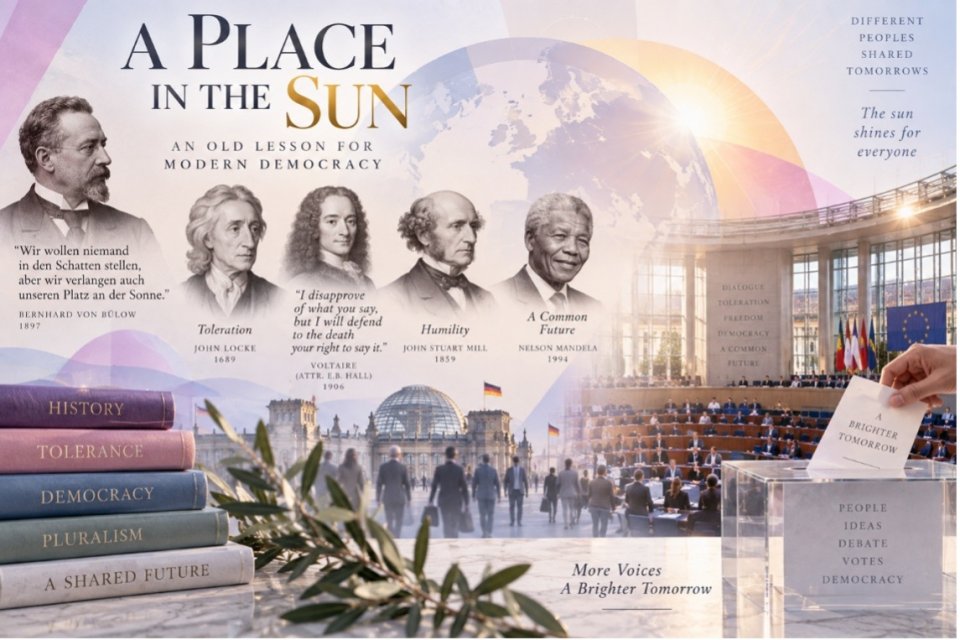
More than a century ago, the same image appeared in a very different and far more problematic political setting. On 6 December 1897, German State Secretary for Foreign Affairs Bernhard von Bülow declared before the Reichstag: “Wir wollen niemand in den Schatten stellen, aber wir verlangen auch unseren Platz an der Sonne”, “We do not wish to put anyone in the shade, but we too demand our place in the sun.”
The historical context cannot be ignored. Bülow was speaking in an age of imperial competition and colonial expansion, and his “Platz an der Sonne” became associated with Germany’s Weltpolitik and its ambitions as a great power. That history should neither be romanticised nor rehabilitated. Yet the complete sentence contains a distinction worth considering: to seek your own place in the sun does not require putting someone else in the shade. Separated from the imperial politics in which it was spoken, that distinction has something important to say to modern democracy.
Live and Let Live
The idea appears in other forms across history. Perhaps none is simpler than the old maxim “live and let live.” Its democratic meaning is almost self-explanatory: living according to my convictions does not require preventing you from living according to yours. It asks neither agreement nor affection, but something more fundamental: room for the other.
The Enlightenment transformed this instinct into a political principle. In his Letter Concerning Toleration of 1689, John Locke argued against coercion in matters of religious belief. His argument belonged to the religious conflicts of his age, but its wider lesson has endured. Strong conviction does not necessarily confer the right to impose that conviction upon everyone else.
The Right to Disagree
Another expression of the same principle is the famous sentence, “I disapprove of what you say, but I will defend to the death your right to say it.” It is often attributed to Voltaire, but the words were actually written by Evelyn Beatrice Hall in 1906 to summarise his attitude. The distinction is worth preserving, while the idea remains powerful: rejecting another person’s argument does not require rejecting that person’s right to make it.
John Stuart Mill added another dimension in On Liberty in 1859. Suppressing an opinion because we are certain it is wrong, he argued, assumes our own infallibility. Mill therefore gives us something particularly valuable for modern political debate: humility. Tolerating disagreement is not merely generosity towards others; it is also recognition that we ourselves may sometimes be mistaken.
From Adversaries to a Common Future
The twentieth century demonstrated how difficult this principle becomes after profound injustice and conflict. Nelson Mandela’s South Africa faced precisely such a challenge. The transition from apartheid did not erase the past or eliminate political differences. It sought instead to build a democratic future through negotiation, transformation and reconciliation, including a Government of National Unity after the country’s first democratic election in 1994.
The lesson is not that injustice should be forgotten or that every difference can be compromised away. It is that a lasting democracy cannot simply replace one system of political exclusion with another. At some point, even former adversaries must find a way to inhabit the same political space.
Opponents, Not Enemies
This may be the distinction modern democracy is in danger of losing. Political parties should fight to win elections. Citizens should argue vigorously for their beliefs. Governments should govern and oppositions should oppose. But there is a fundamental difference between defeating an opponent and seeking to destroy one.
When every election becomes an existential battle and every opponent is portrayed as fundamentally illegitimate, victory is no longer enough. The temptation becomes to silence, exclude or permanently defeat the other side. Yet opposition is not an inconvenience in a democracy; it is part of its architecture.
The democratic opponent therefore possesses something more fundamental than the right to agree with us: the right to disagree with us and still belong. Losing an election does not mean losing one’s place in society, just as winning one does not confer ownership of the country.
An Old Lesson for Modern Democracy
These ideas come from very different periods and should not be forced into a single tradition. Nor was the past some golden age of tolerance; history provides overwhelming evidence to the contrary. But it has left us lessons worth remembering. “Live and let live” teaches restraint. Locke teaches toleration. The Voltaire tradition defends the freedom to disagree. Mill adds intellectual humility. Mandela demonstrates the necessity of coexistence after profound division. And the French proverb gives the principle its simplest image: the sun shines for everyone.
Pluralism is not an unfortunate side effect of democracy. It is the reason democracy exists. We do not need to agree or see the world in the same way. We may fight fiercely for entirely different visions of society. What democracy requires is that we preserve a place for one another, that we fight for our convictions and fight to win, without fighting to remove our opponent’s right to stand beside us.
Perhaps that is the old lesson modern democracy most urgently needs to remember: we can seek our own place in the sun without putting others in the shade. The sun does not shine less brightly because we share it.
