
A Hundred Thousand Welcomes: The Ancient Art of Hospitality Across Civilisations
From Abraham’s Tent to the Irish Tradition of “Céad Míle Fáilte”: How Welcoming the Stranger Became One of Humanity’s Oldest Forms of Cultural Diplomacy
October 25th, 2026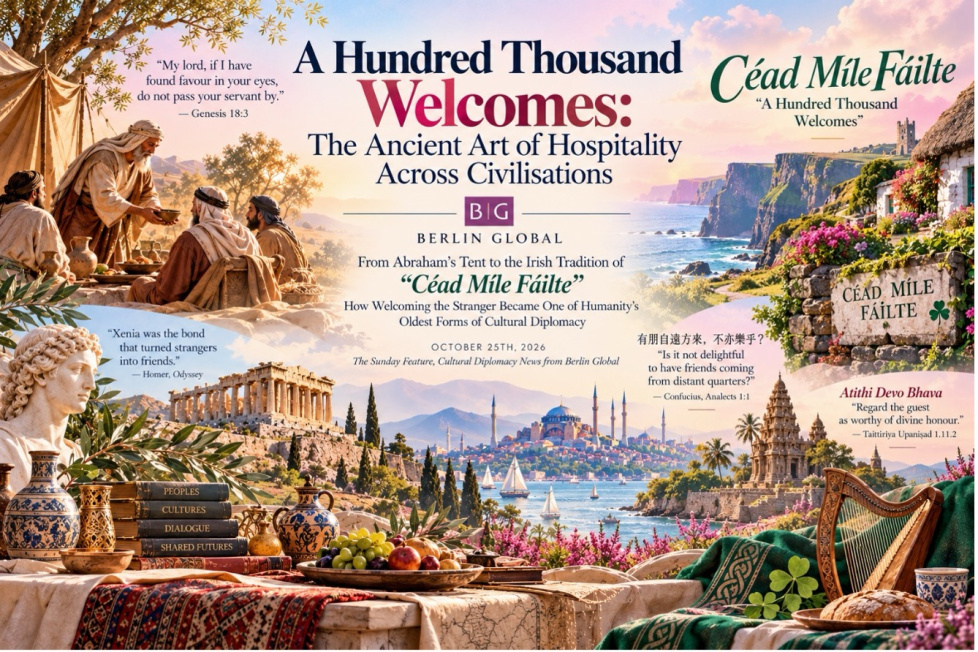
Across civilisations and throughout history, hospitality has represented far more than generosity or courtesy. It has embodied fundamental principles of human dignity, mutual respect and peaceful coexistence, creating opportunities for dialogue between people separated by geography, language, religion and culture.
From ancient religious teachings and philosophical traditions to the enduring wisdom of national cultures, welcoming the stranger has helped shape human relationships and the foundations of what we recognise today as cultural diplomacy.
From Abraham’s Tent to the Irish Tradition of a “Hundred Thousand Welcomes”
According to the Book of Genesis, Abraham was sitting at the entrance of his tent near the trees of Mamre when three visitors appeared. He hurried to greet them, offered water to wash their feet, invited them to rest and arranged a generous meal (Genesis 18:1–8).
Rather than regarding the visitors as an inconvenience, Abraham treated their arrival as an opportunity to demonstrate generosity and respect. His conduct became one of the most influential narratives of hospitality in religious history.
In a different cultural tradition, the Irish expression “Céad Míle Fáilte” — “A Hundred Thousand Welcomes” — captures a similarly generous ideal. Closely associated with Irish identity, the phrase expresses a welcome extending beyond ordinary courtesy.
Abraham’s tent and the Irish greeting belong to distinct historical worlds. Yet both illuminate an enduring human aspiration: transforming the stranger from an unfamiliar outsider into an honoured guest.
Abraham and the Sacred Responsibility of Hospitality
Abraham’s example acquired particular significance within Judaism, Christianity and Islam, although each tradition developed its own interpretations.
In Jewish thought, hachnasat orchim, the welcoming of guests, became an important ethical obligation. The Babylonian Talmud (Shabbat 127a) records a teaching attributed to Rav that hospitality is greater than receiving the Divine Presence. According to this interpretation, Abraham’s attention to his visitors demonstrates the exceptional importance of caring for others.
Christian tradition similarly associates hospitality with spiritual responsibility. Hebrews 13:2 encourages believers to welcome strangers, recalling that some have entertained angels without knowing it.
The Qur’an also describes Abraham’s reception of honoured guests and his preparation of a roasted calf for them (51:24–27).
These accounts do not establish Abraham as the historical originator of hospitality. Rather, they demonstrate how one narrative became a lasting source of ethical instruction across three religious traditions.
Their common significance lies in recognising that responsibility towards others extends beyond family, community and established relationships.
Hospitality in Ancient Civilisations
Comparable principles developed independently in other intellectual and cultural traditions.
In ancient Greece, xenia, or guest-friendship, established reciprocal obligations between hosts and visitors. Associated with Zeus Xenios, the protector of strangers, it occupied an important place in religious and social life. Homer’s Odyssey repeatedly presents the treatment of guests as a measure of moral character.
In China, the Analects, traditionally associated with Confucius, opens with a celebrated reflection:
有朋自遠方來,不亦樂乎?
“Is it not delightful to have friends coming from distant quarters?”
The passage celebrates companionship and intellectual exchange, suggesting that encounters across distance enrich human experience.
Ancient Indian philosophy offers another perspective. The Taittirīya Upaniṣad (1.11.2) instructs: Atithi Devo Bhava — regard the guest as worthy of divine honour.
These traditions differ in their philosophical foundations. Greek xenia emphasised reciprocity, Confucian teaching celebrated companionship, and the Indian injunction expressed reverence.
Their development also reflected practical realities. Travel exposed individuals to unfamiliar environments, uncertain protection and dependence upon others. Hospitality provided assistance while establishing expectations of conduct between people who might otherwise have remained strangers.
Its moral importance emerged partly from this relationship between human vulnerability and social responsibility.
The Wisdom of Nations: Hospitality Preserved in Language
Traditional expressions reveal how hospitality became embedded in cultural identity.
The Irish Céad Míle Fáilte, alongside the closely related Scottish Gaelic Ceud Mìle Fàilte, celebrates an abundance of welcome.
The Polish proverb Gość w dom, Bóg w dom — “A guest in the house, God in the house” — associates hospitality with sacred responsibility.
The Russian expression Чем богаты, тем и рады conveys the willingness to share whatever one possesses, however modest. Its emphasis is sincerity rather than material wealth.
The familiar Spanish expression Mi casa es tu casa — “My house is your house” — symbolically extends the comforts of one’s home to another person.
These expressions differ in origin, historical development and cultural significance. They should not all be regarded as ancient, nor as evidence of a single universal tradition.
Their importance lies in the preservation of social ideals. Through language, communities transmit expectations of generosity, respect and belonging across generations.
Hospitality thus becomes part of cultural memory: an inherited understanding of how individuals should receive those arriving from elsewhere.
From Hospitality to Cultural Diplomacy
Hospitality also possesses an important political dimension. Throughout history, merchants, scholars, pilgrims and envoys depended upon arrangements for protection and reception when entering unfamiliar communities. Such encounters facilitated commerce, intellectual exchange and political communication, although they did not necessarily produce peaceful relations.
In 1795, Immanuel Kant gave hospitality a distinctive place in political philosophy through his essay Perpetual Peace.
Kant argued that peaceful foreigners possessed a limited right of visitation and should not be treated with hostility merely because they arrived in another territory. He distinguished this principle from an unrestricted right of residence, connecting hospitality with cosmopolitan right rather than personal generosity alone.
Modern cultural diplomacy reflects a related insight: relationships between societies depend not exclusively upon governmental negotiations, but also upon encounters between people.
Academic exchanges, artistic collaborations, international conferences and intercultural programmes create opportunities to encounter unfamiliar perspectives. Hospitality provides an environment in which such interactions can develop.
A diplomatic reception or shared meal cannot resolve fundamental political disagreements. Nevertheless, respectful encounters can facilitate communication, challenge assumptions and establish relationships capable of supporting future cooperation.
Hospitality is therefore not synonymous with diplomacy. It is one of the human practices that can make diplomacy possible.
Hospitality in a Divided World
The ancient ethics of hospitality remain relevant amid contemporary debates concerning migration, national identity, security and international relations.
Welcoming strangers does not eliminate legitimate questions of sovereignty, borders or public responsibility. It does, however, raise a fundamental ethical question: how should societies treat those who do not belong to their immediate political or cultural communities?
Hospitality offers no universal political formula. Its contribution is the recognition that difference need not imply hostility.
For cultural diplomacy, this principle is particularly significant. Meaningful dialogue does not require identical beliefs, shared historical experiences or agreement on political questions. It begins with the willingness to recognise another person’s dignity.
The Enduring Meaning of a “Hundred Thousand Welcomes”
From Abraham’s tent to ancient Greek guest-friendship, from Confucian philosophy to the Irish Céad Míle Fáilte, civilisations have developed different ways of expressing the moral significance of hospitality.
Some understood it as sacred responsibility, others as reciprocity, generosity or the joy of companionship. Their diversity demonstrates that hospitality is not the exclusive inheritance of any one civilisation.
Its enduring importance lies in a simple possibility: the stranger need not remain a stranger.
Abraham’s invitation and Ireland’s hundred thousand welcomes remind us that relationships often begin with generosity before developing into friendship, cooperation or dialogue.
Cultural diplomacy gives contemporary expression to this ancient human capacity.
Before diplomacy became a profession, hospitality had already become a means of connecting people across boundaries. The open door, the shared table and the willingness to welcome another person remain among the simplest foundations of international understanding.
